ME-403 · THEORY OF MACHINES/Unsolved PYQ Paper
ME-403 Theory of Machines - Nov 2023 Question Paper
Under each question, How to answer lists the points an answer should cover, outlined by CampusPrep from the syllabus. Check the details against your textbook.
-
7 MarksaWhat is constrained motion? Explain and distinguish among the constrained motions with examples.
How to answer
- Define constrained motion as restriction of relative motion to definite direction
- Distinguish completely, incompletely and successfully constrained motions
- Give examples for each type e.g. square bar in square hole, shaft in circular hole, foot-step bearing
-
7 MarksbExplain the Whitworth quick return motion mechanism with a neat sketch.
How to answer
- State principle of Whitworth quick return mechanism as crank and slotted lever
- Describe construction and working with crank rotation and ram stroke
- Explain quick return ratio with neat labelled sketch
-
14 MarksA slider-crank mechanism shown in figure is subjected to a piston load of 1 kN. The link lengths are: $AB = 250\text{ mm}$; $BC = 600\text{ mm}$; Determine the input torque to the link AB for static equilibrium of the mechanism.
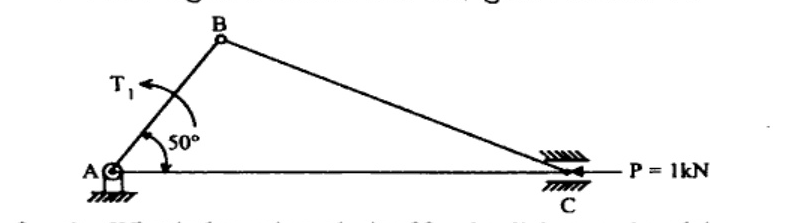
How to answer
- Draw configuration with AB = 250 mm at 50 to slider axis
- Resolve 1 kN piston force along connecting rod BC
- Take moment about A or use virtual work to find static torque T1 on AB
-
7 MarksaWhat is dynamic analysis of four bar linkage and explain Dynamic Analysis of the Slider-Crank Mechanism.
How to answer
- Define dynamic analysis including inertia and D'Alembert principle
- Write equations of motion for four-bar linkage links
- Extend to slider-crank with piston inertia, connecting rod and crank effort
-
7 MarksbExplain the classification of followers in brief with neat diagrams.
How to answer
- List follower types by shape and motion e.g. knife-edge, roller, flat, spherical
- Classify by movement: reciprocating, oscillating and by offset
- Show neat diagrams for each type
-
14 MarksA cam, with a minimum radius of 40 mm, rotating clockwise at a uniform speed, is required to give a knife edge follower the motion as described below: Draw the profile of the cam when the line of stroke of the follower passes through the centre of the cam shaft and the displacement of the follower is to take place with SHM. Draw the displacement, velocity and acceleration diagrams for one complete revolution of the cam.
- i)To move outwards through 30 mm during 90 rotation of the cam
- ii)To dwell for next 90
- iii)To return to its starting position during next 100
- iv)To dwell for the rest period of a revolution i.e. 80
How to answer
- Construct displacement diagram with SHM for 90 rise 30 mm, 90 dwell, 100 return, 80 dwell
- Lay out cam base circle 40 mm and mark angles in direction opposite rotation
- Draw cam profile through knife-edge positions and draw velocity and acceleration diagrams
-
7 MarksaWhat is belt drive? What are the various selection criteria for the selection of belt drive?
How to answer
- Define belt drive as flexible power transmission
- List selection criteria: power, speed ratio, centre distance, slip, efficiency, cost
- Explain effect of each criterion on choice
-
7 MarksbDescribe the construction and operation of a Prony brake dynamometer.
How to answer
- Show Prony brake construction with brake blocks, lever and weights
- Explain working with frictional torque balancing load
- Give power formula $P = 2\pi N T/60$
-
7 MarksaWhat is the difference between brake and Clutch? What are the various factors affecting braking?
How to answer
- Define brake as energy absorber and clutch as engagement device
- Compare function, location and operation in tabular form
- List factors affecting braking: pressure, friction coefficient, temperature, speed
-
7 MarksbTwo spur gear wheels with 18 and 26 teeth gear together. The addendum of each wheel is equal to one module and pressure angle is $20^\circ$. Find the length of the arc of contact.
How to answer
- Compute pitch circle radii and addendum radii for both wheels
- Find length of path of contact from involute geometry with $\phi=20^\circ$
- Convert path length to arc of contact as path$/\cos\phi$
-
14 MarksThe number of teeth on the gear and the pinion of two spur gears in mesh are 30 and 18 respectively. Both the gears have a module of 6 mm and a pressure angle of $20^\circ$. If the pinion rotates at 400 rpm, what will be the sliding velocity at the moment the tip of the tooth of the pinion has contact with the gear flank? Take an addendum equal to one module. Also, find the maximum velocity of sliding.
How to answer
- Calculate pitch circle radii, base circles and addendum radii with m = 6 mm
- Find path of contact and sliding velocity $(\omega_1+\omega_2)\times$ distance from pitch point
- Evaluate at start of contact for pinion tip vs gear flank and maximize for maximum sliding
-
14 MarksWrite a short note on any two:
- i)Instantaneous center
- ii)Degrees of freedom
- iii)Mechanical Power transmission
- iv)Types of gears
How to answer
- Select any two topics from instantaneous center, DOF, power transmission, gears
- Define and explain each with key points and diagrams/formulas
- Give examples and applications
Go to where you left off?
Quick Add to Notes
Save questions, your own notes and screenshots into notes filed by unit. It takes a free account.
Create free accountHave an account? Log in
Notes Panel