ME-403 · THEORY OF MACHINES/Unsolved PYQ Paper
ME-403 Theory of Machines - Jun 2025 Question Paper
Under each question, How to answer lists the points an answer should cover, outlined by CampusPrep from the syllabus. Check the details against your textbook.
-
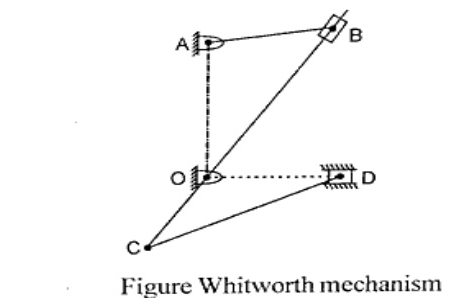
7 MarksaDesign a Whitworth quick return motion mechanism shown in Figure to have the following particulars: Return stroke $= 200\text{ mm}$ Time ratio of working to return stroke $= 2$ Length of driving crank $= 50\text{ mm}$
How to answer
- State time ratio and stroke requirement for Whitworth mechanism
- Calculate crank and frame distances / extreme positions
- Describe step-by-step construction procedure
- Show finished layout with dimensions
-
7 MarksbDefine mechanisms and machines, and differentiate between them. Explain the concept of degree of freedom in a mechanism.
How to answer
- Define mechanism as constrained kinematic chain and machine for work transmission
- Tabulate differences: purpose, energy, motion transformation
- Define degree of freedom / mobility and Kutzbach-Gruebler formula
- Give examples of DOF for four-bar, slider-crank
-
7 MarksaDifferentiate between number synthesis and motion analysis. Explain the analytical and graphical methods used for dynamic motion analysis, highlighting their advantages and limitations.
How to answer
- Define number synthesis vs motion/dynamic analysis
- Explain analytical methods with equations
- Explain graphical methods with diagrams
- Compare advantages and limitations of both
-
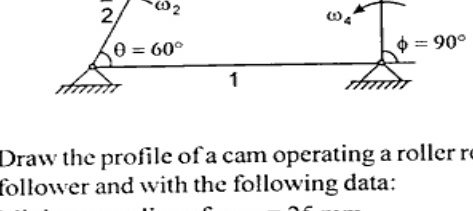
7 MarksbSynthesize a four bar linkage, as shown in Fig., Freudenstein's equation to satisfy in one of its positions. The specification of position $\theta$, velocity $\omega$ and acceleration $\alpha$ are as follows: $\theta = 60^{\circ}, \omega_{2} = 5\text{ rad/s}; \alpha_{2} = 2\text{ rad/s}^{2};$ $\phi = 90^{\circ}; \omega_{4} = 2\text{ rad/s}; \alpha_{4} = 7\text{ rad/s}^{2}$
How to answer
- State Freudenstein's equation for four-bar linkage
- Substitute given theta, phi, velocities and accelerations
- Solve for link length ratios
- Select suitable link lengths satisfying position
-
7 MarksaDraw the profile of a cam operating a roller reciprocating follower and with the following data: Minimum radius of cam $= 25\text{ mm}$ Lift $= 30\text{ mm}$ Roller diameter $= 15\text{ mm}$ The cam lifts the follower for $120^{\circ}$ with SHM followed by a dwell period of $30^{\circ}$. Then the follower lowers down during $150^{\circ}$ of the cam rotation with uniform acceleration and deceleration followed by a dwell period. If the cam rotates at a uniform speed of $150\text{ rpm}$, calculate the maximum velocity and acceleration of the follower during the descend period.
How to answer
- Draw base circle, pitch and displacement diagram per data
- Construct cam profile for SHM rise 120 deg and uniform acceleration-deceleration descent 150 deg with dwells
- State formulas for max velocity and acceleration during descent
- Calculate values for 150 rpm cam speed
-
7 MarksbDefine the following terms as applied to cam with a neat sketch:
- i)Base circle
- ii)Pitch circle
- iii)Pressure angle
- iv)Stroke of the follower
How to answer
- Define base circle, pitch circle, pressure angle, stroke
- Draw neat labelled cam-follower sketch showing each term
- State significance of each term
- Distinguish base vs pitch vs prime circle
-
7 MarksaDescribe various friction devices used in power transmission, such as pivot and collars, power screws, and clutches. Discuss the classifications of clutches and their applications.
How to answer
- Describe pivot, collar, power screw friction drives
- Classify clutches: disc, cone, centrifugal etc.
- Explain working principle of each clutch type
- List applications in power transmission
-
7 MarksbA shaft rotating at $200\text{ r.p.m.}$ drives another shaft at $300\text{ r.p.m.}$ and transmit $6\text{ kW}$ through a belt. The belt is $100\text{ mm}$ wide and $10\text{ mm}$ thick. The distance between the shafts is $4\text{m}$. The smaller pulley is $0.5\text{ m}$ in diameter. Calculate the stress in the belt, if it is (i) an open belt drive, and (ii) a cross belt drive. Take $\mu = 0.3$.
How to answer
- Calculate pulley diameters, angle of contact for open and cross drives
- Apply belt tension ratio formula with mu=0.3
- Use power equation P=(T1-T2)v to find tensions
- Compute stress = tension / cross-sectional area
-
7 MarksaExplain briefly the differences between simple, compound, and epicyclic gear trains. What are the special advantages of epicyclic gear trains?
How to answer
- Define simple, compound and epicyclic gear trains with sketches
- Compare arrangement and velocity ratio
- List advantages of epicyclic: compact, high ratio, coaxial
- Give application examples
-
7 MarksbA pair of spur gears with involute teeth is to give a gear ratio of $4:1$. The arc of approach is not to be less than the circular and smaller wheel is the driver. The angle of pressure is $14.5^{\circ}$. Find:
- i)the least number of teeth that can be used on each wheel
- ii)the addendum of the wheel in terms of the circular pitch?
How to answer
- State condition arc of approach = circular pitch for no interference
- Apply involute gear formula for minimum teeth with 14.5 deg pressure angle
- Calculate teeth on pinion and wheel for 4:1 ratio
- Express addendum in terms of circular pitch
-
7 MarksaExplain the concept of inversions and illustrate with the example of a four-bar mechanism.
How to answer
- Define kinematic inversion concept
- List four inversions of four-bar chain
- Illustrate Grashof, crank-rocker, double-crank examples
- Mention applications
-
7 MarksbShow that, in a band and block brake, the ratio of the maximum and minimum tensions in the brake strap is $$\frac{T_{0}}{T_{n}} = \left(\frac{1+\mu \tan \theta}{1-\mu \tan \theta}\right)^{n}$$ where $T_{0} =$ Maximum tension $T_{n} =$ Minimum tension $\mu =$ Coefficient of friction between the blocks and drum, $2\theta =$ Angle subtended by each block at the centre of the drum.
How to answer
- Consider equilibrium of single block with friction
- Derive tension ratio for one block using capstan analogy
- Extend to n blocks by multiplication
- Obtain final expression with T0, Tn, mu, theta
-
7 MarksaDetermine the maximum, minimum and average pressure in plate clutch when the axial force is $4\text{ kN}$. The inside radius of the contact surface is $50\text{ mm}$ and the outside radius is $100\text{ mm}$. Assume uniform wear.
How to answer
- State uniform wear theory p*r = constant
- Use axial force W=2πC(R+r)/2 relation
- Calculate C then pmax at inner radius and pmin at outer radius
- Calculate average pressure = W / area
-
7 MarksbDiscuss briefly with neat sketches the longitudinal, transverse and torsional free vibrations.
How to answer
- Define longitudinal, transverse and torsional vibrations
- Draw mass-spring models for each mode
- Give natural frequency expressions
- Compare direction of motion and restoring force
-
7 MarksaDerive an expression for the magnitude and direction of coriolis component of acceleration.
How to answer
- Explain sliding link with rotation plus translation
- Derive Coriolis acceleration 2*v*omega using method of projections
- State magnitude 2ωv formula
- State direction: 90 deg to link in sense of rotation
-
7 MarksbFour masses M1, M2, M3 and M4 are 200kg, 300kg, 240kg and 260 kg, respectively. The corresponding radii of rotation are 0.2m, 0.15m, 0.25m and 0.3m respectively and the angle between successive masses are $45^{\circ}$, $75^{\circ}$ and $135^{\circ}$. Find the position and magnitude of balance mass required if its radius of rotation is 0.25m.
How to answer
- Tabulate m*r products and angular positions
- Resolve centrifugal forces into x and y components
- Find resultant unbalanced force magnitude and angle
- Calculate balance mass m = resultant / r_bal and its angular position
Go to where you left off?
Quick Add to Notes
Save questions, your own notes and screenshots into notes filed by unit. It takes a free account.
Create free accountHave an account? Log in
Notes Panel