ME-403 · THEORY OF MACHINES/Unsolved PYQ Paper
ME-403 Theory of Machines - Dec 2024 Question Paper
Under each question, How to answer lists the points an answer should cover, outlined by CampusPrep from the syllabus. Check the details against your textbook.
-
7 MarksaA four bar linkage has the following dimensions $O_1O_2 = 50 \text{ mm}$, (distance between fixed centres of rotation) $O_1A = 62 \text{ mm}$, $AB = 37 \text{ mm}$, $O_2B = 68 \text{ mm}$, $O_1$ and $O_2$ are fixed centres of rotation. Determine the type of four bar by Grashoff's criterion. If the link AB is crank, discuss the Grashoff's criterion. If the link AB is fixed, discuss the Grashoff's criterion.
How to answer
- State Grashof's law: s+l <= p+q for at least one crank
- Identify shortest, longest and other links from O1O2=50, O1A=62, AB=37, O2B=68 mm
- Classify mechanism type for given fixed link
- Discuss case when AB is crank
- Discuss case when AB is fixed
-
7 MarksbDescribe the difference between absolute and relative motions with the help of velocity and acceleration diagrams.
How to answer
- Define absolute motion and relative motion
- Explain velocity diagrams for absolute vs relative
- Explain acceleration diagrams including Coriolis component
- List differences in tabular form
- Give example of slider-crank or four-bar
-
7 MarksaDescribe the process of kinematic synthesis of linkages. Explain D'Alembert's principle and its significance in dynamic motion analysis of mechanisms.
How to answer
- Define kinematic synthesis: type, number and dimensional synthesis
- Outline steps: motion, path and function generation
- State D'Alembert's principle: inertia force = -m*a
- Explain conversion of dynamics to statics
- Significance in joint force and shaking force analysis
-
7 MarksbIn a four bar mechanism PQRS, the link PS is fixed. The length of the links are : $PQ = 62.5 \text{ mm}$; $QR = 175 \text{ mm}$; $RS = 112.5 \text{ mm}$ and $PS = 200 \text{ mm}$. The crank PQ rotates at $10 \text{ rad/s}$ clockwise. Find the angular velocity and angular acceleration of the links QR and RS for the values of angle QPS at an interval of $60^{\circ}$.
How to answer
- Draw space diagram and velocity polygon for four-bar PQRS
- Calculate velocity of Q and angular velocity of QR and RS
- Draw acceleration polygon including normal and tangential components
- Calculate angular acceleration of QR and RS
- Repeat/tabulate for QPS at 60 degree intervals
-
7 MarksaDraw the profile of a cam operating a knife edge follower having a lift of $30 \text{ mm}$. The cam raises the follower with SHM for $150^{\circ}$ of the rotation followed by a period of dwell for $60^{\circ}$. The follower descends for the next $100^{\circ}$ rotation of the cam with uniform velocity, again followed by a dwell period. The cam rotates at a uniform velocity of $120 \text{ rpm}$ and has a least radius of $20 \text{ mm}$. What will be the maximum velocity and acceleration of the follower during the lift and the return?
How to answer
- Draw base circle radius 20 mm and displacement diagram: SHM rise 150 deg, dwell 60 deg, uniform velocity return 100 deg, dwell
- Construct cam profile for knife-edge follower
- Formula for SHM max velocity and acceleration during lift
- Formula for uniform velocity return
- Compute values at 120 rpm
-
7 MarksbDiscuss the factors influencing cam design, such as pressure angle, radius and undercutting. Explain the concept of critical path motion and torque on the cam shaft.
How to answer
- Define pressure angle, base circle radius, undercutting
- Effect of pressure angle and curvature on force transmission
- Explain critical path motion
- Explain torque on cam shaft calculation
- Remedies to avoid undercutting
-
7 MarksaExplain the kinematics of belt-pulley systems, including flat and v-belts. Discuss the conditions for maximum power transmission, efficiency and friction in power transmission systems.
How to answer
- Define belt-pulley kinematics: velocity ratio, slip, creep
- Differentiate flat vs V-belt geometry and wedging
- Condition for maximum power: T1, centrifugal tension
- Discuss efficiency and friction: capstan equation
- Power transmission formula
-
7 MarksbFind the power transmitted by a belt running over a pulley of $600 \text{ mm}$ diameter at $200 \text{ r.p.m.}$ The coefficient of friction between the belt and the pulley is $0.25$, angle of lap $160^{\circ}$ and maximum tension in the belt is $2500 \text{ N}$.
How to answer
- Convert lap angle 160 deg to radians
- Use tension ratio T1/T2 = e^(mu*theta)
- Find loose side tension from max tension 2500 N
- Calculate effective tension and belt speed from 600 mm, 200 rpm
- Compute power P = (T1-T2)*v
-
7 MarksaIn an epicyclic gear of the 'sun and planet' type shown in Figure, the pitch circle diameter of the internally toothed ring is to be $224 \text{ mm}$ and the module $4 \text{ mm}$, When the ring D is stationary, the spider A, which carries three planet wheels C of equal size, is to make one revolution in the same sense as the sunwheel B for every five revolutions of the driving spindle carrying the sunwheel B. Determine suitable numbers of teeth for all the wheels.
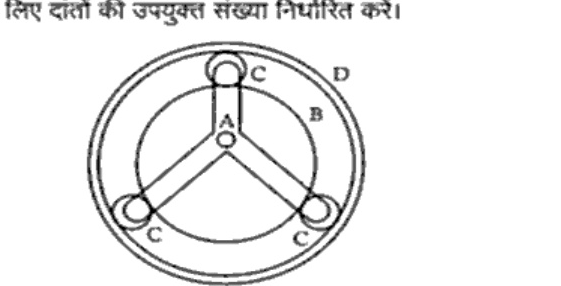
How to answer
- Calculate teeth on ring: T = PCD/module = 224/4
- Use epicyclic table for sun-planet-ring with fixed ring
- Apply speed ratio: spider 1 rev per 5 revs of sun
- Solve for teeth on sun B and planets C with geometric compatibility
- Select suitable integer teeth numbers
-
7 MarksbDiscuss the laws of gearing and classify gears based on tooth profiles. Explain the kinematic considerations for different types of gears, including spur, bevel, worm and helical gears.
How to answer
- State law of gearing: constant velocity ratio, conjugate profiles
- Classify gears by tooth profile: involute vs cycloidal
- Compare spur, bevel, worm and helical gears kinematics
- Explain contact ratio and interference
- Applications of each gear type
-
7 MarksaExplain the concept of inversions and illustrate with the example of a four-bar mechanism.
How to answer
- Define inversion: fixing different links of same chain
- List four inversions of four-bar chain
- Give examples: crank-rocker, double-crank, double-rocker
- Draw sketches of each inversion
- Applications e.g. beam engine, coupling rod
-
7 MarksbA shaft carries four masses A, B, C and D of magnitude $200 \text{ kg}$, $300 \text{ kg}$, $400 \text{ kg}$ and $200 \text{ kg}$ respectively and revolving at radii $80 \text{ mm}$, $70 \text{ mm}$, $60 \text{ mm}$ and $80 \text{ mm}$ in planes measured from A at $300 \text{ mm}$, $400 \text{ mm}$ and $700 \text{ mm}$. The angles between the cranks measured anticlockwise are A to B $45^{\circ}$, B to C $70^{\circ}$ and C to D $120^{\circ}$. The balancing masses are to be placed in planes X and Y. The distance between the planes A and X is $100 \text{ mm}$, between X and Y is $400 \text{ mm}$ and between Y and D is $200 \text{ mm}$. If the balancing masses revolve at a radius of $100 \text{ mm}$, find their magnitudes and angular positions.
How to answer
- Tabulate masses, radii, planes and angles
- Calculate centrifugal force m*r for each mass
- Apply static and dynamic balancing conditions sum F=0, sum M=0
- Solve analytically or graphically for planes X and Y
- Find magnitude and angular position of balancing masses
-
7 MarksaAn electric motor driven power screw moves a nut in a horizontal plane against a force of $75 \text{ kN}$ at a speed of $300 \text{ mm/min}$. The screw has a single square thread of $6 \text{ mm}$ pitch on a major diameter of $40 \text{ mm}$. The coefficient of friction at the screw threads is $0.1$. Estimate power of the motor.
How to answer
- Calculate mean diameter, helix angle from pitch and diameter
- Compute torque to overcome 75 kN including friction mu=0.1
- Find rotational speed from linear speed 300 mm/min and lead
- Compute power = 2*pi*N*T/60
- Estimate motor power with efficiency
-
7 MarksbCompare the performance of block and band brakes for the same drum diameter.
How to answer
- Describe working of block brake and band brake
- Derive braking torque expressions for each
- Compare heat dissipation, self-energizing effect
- Compare for same drum diameter
- Conclude suitability
-
10 MarksaIn a four bar chain ABCD, AD is fixed and is $150 \text{ mm}$ long. The crank AB is $40 \text{ mm}$ long and rotates at $120 \text{ r.p.m.}$ clockwise, while the link $CD = 80 \text{ mm}$ oscillates about D. BC and AD are of equal length. Find the angular velocity of link CD when angle $BAD = 60^{\circ}$.
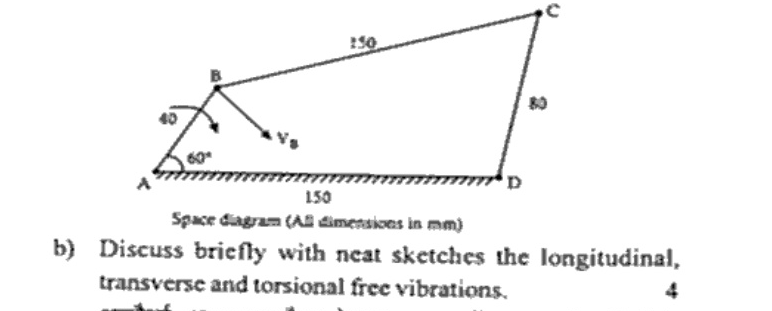
How to answer
- Draw space diagram AD=150, AB=40, CD=80, BC=AD
- Calculate velocity of B: vB = omega_AB * AB
- Use instantaneous centre or velocity polygon to find omega_CD
- Find angular velocity of CD at BAD=60 deg
- State direction of oscillation
-
4 MarksbDiscuss briefly with neat sketches the longitudinal, transverse and torsional free vibrations.
How to answer
- Define longitudinal, transverse and torsional vibrations
- Draw neat sketches of mass-spring systems for each
- Give natural frequency formulas for each
- Differentiate mode shapes and restoring forces
- Give practical examples
Go to where you left off?
Quick Add to Notes
Save questions, your own notes and screenshots into notes filed by unit. It takes a free account.
Create free accountHave an account? Log in
Notes Panel