ME-403 · THEORY OF MACHINES/Unsolved PYQ Paper
ME-403 Theory of Machines - Jun 2022 Question Paper
Under each question, How to answer lists the points an answer should cover, outlined by CampusPrep from the syllabus. Check the details against your textbook.
-
7 MarksaDefine Grashof's law. State how is it helpful in classifying the four-link mechanisms into different types.
How to answer
- State Grashof's law: s + l <= p + q for continuous relative rotation
- Define shortest, longest and other links
- Explain classification: crank-rocker, double-crank, double-rocker based on fixed link
- Give condition for Grashof and non-Grashof chains
-
7 MarksbExplain the phenomena of 'slip' and 'creep' in a belt drive.
How to answer
- Define slip: relative motion due to insufficient friction
- Define creep: differential elongation of tight and slack sides
- Explain causes and effects on velocity ratio
- Differentiate between slip and creep
-
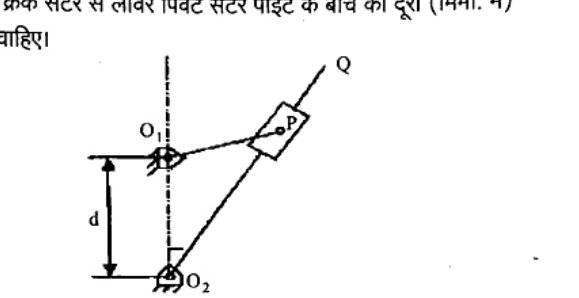
14 MarksSimple quick return mechanism is shown in the figure. The forward to return ratio of the quick return mechanism is $2:1$. If the radius of the crank $O_1P$ is $125$ mm, then the distance 'd' (in mm) between the crank centre to lever pivot centre point should be.
How to answer
- Use quick-return ratio = cutting angle / return angle = 2:1
- Relate crank radius O1P = 125 mm to centre distance d via cos of extreme positions
- Calculate angle: forward 240 deg, return 120 deg
- Compute d = O1P / cos or d = 2*O1P = 250 mm
-
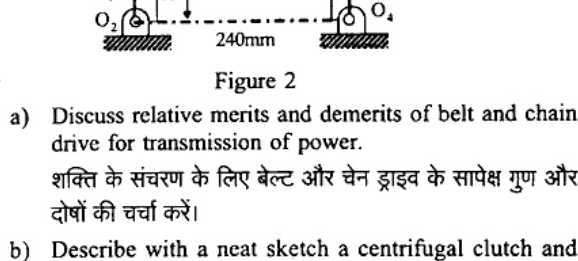
5 MarksaAn instantaneous configuration of a four-bar mechanism, whose plane is horizontal, is shown in the figure below. At this instant, the angular velocity and angular acceleration of link $O_2A$ are $\omega = 8$ rad/s and $\alpha = 0$, respectively, and the driving torque $(\tau)$ is zero. The link $O_2A$ is balanced so that its centre of mass falls at $O_2$. a) Which kind of 4-bar mechanism is $O_2ABO_4$?
How to answer
- Check Grashof condition with link lengths O2A=60mm, O2O4=240mm, O4B=160mm
- Identify shortest, longest links and fixed link
- Classify as crank-rocker / double-rocker etc.
- Justify type O2ABO4
-
5 Marksbb) At the instant considered, what is the magnitude of the angular velocity of Q4B?
How to answer
- Use relative velocity method or instantaneous centre for four-bar
- Velocity of A = omega_O2A * O2A
- Equate component along AB or use rigid body rotation
- Compute omega_Q4B = v_B / O4B
-
4 Markscc) At the same instant, if the component of the force at joint A along AB is $30$ N, then the magnitude of the joint reaction at $O_2$.
How to answer
- Draw free-body of links with force at A along AB = 30 N
- Apply equilibrium / dynamic force analysis with tau=0, alpha=0
- Take moment about O4 or O2 to find reactions
- Compute joint reaction magnitude at O2
-
7 MarksaDiscuss relative merits and demerits of belt and chain drive for transmission of power.
How to answer
- Define belt drive vs chain drive power transmission
- List merits of belt: low cost, shock absorption, long distance
- List demerits: slip, creep, low efficiency vs chain merits: positive drive, high efficiency
- Conclude with applications
-
7 MarksbDescribe with a neat sketch a centrifugal clutch and deduce an equation for the total torque transmitted.
How to answer
- Sketch centrifugal clutch: drum, shoes, springs, spider
- Explain working: centrifugal force engages shoes at speed
- Derive normal force = m*omega^2*r, friction torque
- Obtain total torque transmitted = n*mu*F*R
-
7 MarksaDescribe various inversions of a slider-crank mechanism giving examples, with neat sketch.
How to answer
- Define slider-crank and its four inversions
- Give examples: reciprocating engine, Whitworth, crank-slotted, hand pump
- Explain each inversion with fixed link change
- Provide neat sketches for each
-
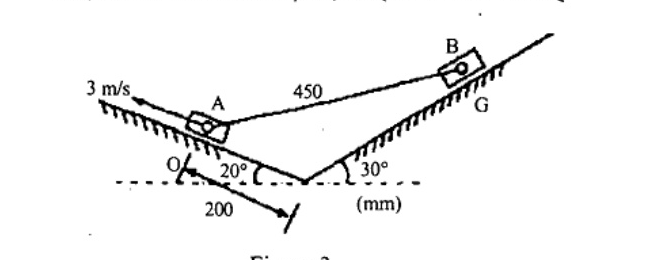
7 MarksbFor the position of the mechanism shown in Fig.3. Find the velocity of the slider B for the given configuration if the velocity of the slider A is $3$ m/s.
How to answer
- Resolve velocities along and perpendicular to link AB
- Apply relative velocity equation v_B = v_A + omega_AB x r_AB
- Use incline angles 20 deg and 30 deg for sliders
- Solve for magnitude of velocity of slider B
-
5 MarksaA gear set has an opinion with 20 teeth and a gear with 40 teeth. The pinion runs at 0 rev/s and transmits a power of 20 kW. The teeth are on the $20^{\circ}$ full-depth system and have module of 5 mm. The length of the line of action is 19 mm. a) Find the center distance for the above gear set in mm?
How to answer
- Compute pitch diameters: d = m*z, centre distance = (d1+d2)/2
- Find base pitch and contact ratio = length of action / base pitch
- Compute tangential force from power and speed, radial = Ft*tan(phi)
- Resultant = Ft / cos(phi)
-
5 Marksbb) The contact ratio of the contacting tooth?
How to answer
- Use contact ratio = path of contact / base pitch
- Compute base pitch = pi*m*cos(phi)
- Substitute length of action 19 mm
- Obtain ratio value
-
4 Markscc) The resultant force on the contacting gear tooth in N?
How to answer
- Find torque / tangential effort from power
- Resolve into tangential and radial components
- Compute resultant = sqrt(Ft^2+Fr^2)
- Express in N
-
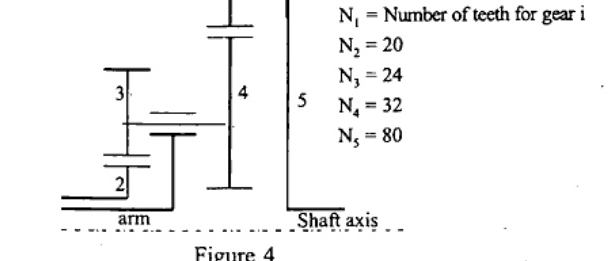
14 MarksFor the epicyclic gear arrangement shown in the figure, $\omega_2 = 100$ rad/s clockwise (CW) and $\omega_{arm} = 80$ rad/s counter clockwise (CCW). The angular velocity $\omega_5$, (in rad/s) is
How to answer
- Apply tabular method for epicyclic gear: arm, gears 2-5
- Use teeth numbers N2=20, N3=24, N4=32, N5=80
- Insert omega2=100 CW, omega_arm=80 CCW with sign convention
- Solve for omega5
-
14 MarksA cam consists of a circular disc of diameter 75 mm with its centre displaced 25 mm from the camshaft axis. The follower has a flat surface (horizontal) in contact with the cam and the line of action of the follower is vertical and passes through the shaft axis as shown in Fig.5. The mass of the follower is 2.3 kg and is pressed downwards by a spring which has a stiffness of 3.5 N/mm. In the lowest position the spring force is 45 N.
- i)Derive an expression for the acceleration of the follower in terms of the angle of rotation from the beginning of the lift.
- ii)As the cam shaft speed is gradually increased, a value is reached at which the follower begins to lift from the cam surface. Determine the camshaft speed for this condition.
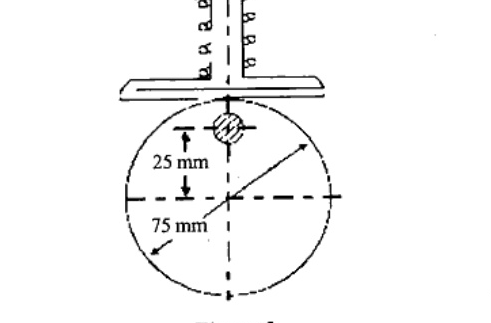
How to answer
- Define eccentric circular cam: lift x = e(1-cos theta)
- Differentiate to get velocity and acceleration vs rotation angle
- Include follower mass 2.3 kg, spring stiffness 3.5 N/mm, preload 45 N
- For jump condition equate inertia force to spring + weight; solve camshaft speed
Go to where you left off?
Quick Add to Notes
Save questions, your own notes and screenshots into notes filed by unit. It takes a free account.
Create free accountHave an account? Log in
Notes Panel