ME-403 · THEORY OF MACHINES/Unsolved PYQ Paper
ME-403 Theory of Machines - Jun 2024 Question Paper
Under each question, How to answer lists the points an answer should cover, outlined by CampusPrep from the syllabus. Check the details against your textbook.
-
7 MarksaWrite the inversions of the double slider crank mechanism and explain any two of them with a neat sketch.
How to answer
- List three inversions of double slider crank chain
- Explain any two e.g. Scotch yoke, Oldham coupling, elliptical trammel with working
- Neat sketches of the two explained
-
7 MarksbExplain the Crank and slotted lever quick return motion mechanism with a neat sketch.
How to answer
- Describe construction: crank, slotted lever, ram, fixed frame
- Explain working and quick return action with extreme positions
- Neat sketch and time ratio expression
-
7 MarksaDefine Instantaneous center and locate all the Instantaneous centers of slider crank mechanism with crank length of $25 mm$ rotating clockwise at a uniform speed of $100$ rpm. The crank makes $45^{\circ}$ with IDC and the connecting rod is $400$ mm long. Determine the velocity of the slider and the angular velocity of the connecting rod.
How to answer
- Define instantaneous centre and number n(n-1)/2 = 6 for 4-link slider crank
- Locate all ICs by Kennedy theorem construction
- Use velocity image to find slider velocity and angular velocity of connecting rod
-
7 MarksbExplain D'Alembert's principle and how it is used in dynamic analysis of mechanisms.
How to answer
- State D'Alembert's principle: inertia force = -m*a reverses dynamics to statics
- Explain inertia force and couple
- Application steps in dynamic analysis of mechanisms with example
-
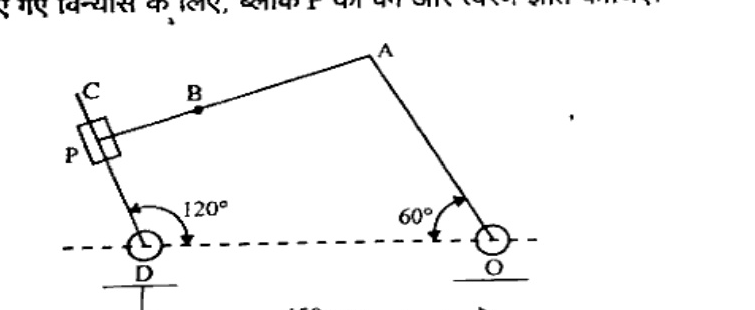
14 MarksIn the slider-crank mechanism shown in figure, the block P reciprocates along the fixed line CD. The crank OA rotates clockwise at a uniform speed of $150$ rpm. The dimensions of the links (in mm) are $OA = AB = 250$; $AP = 400$; for the given configuration, find the velocity and acceleration of the block P.
How to answer
- Draw configuration and velocity polygon to get velocity of P
- Draw acceleration polygon including Coriolis/normal components
- Report magnitude and direction of velocity and acceleration of block P
-
14 MarksIn a symmetrical tangent cam operating a roller follower, the least radius of the cam is $30$ mm and roller radius is $18$ mm. The angle of ascent is $80^{\circ}$ and the total lift is $18$ mm. The speed of the camshaft is $800$ r.p.m. Calculate:
- i)The principal dimensions of the cam;
- ii)the accelerations of the follower at the beginning of the lift Where the straight flank merges into the circular nose and at the apex of the circular nose. Assume that there is no dwell between ascent and descent.
How to answer
- Compute cam principal dimensions: base circle, flank radius, nose radius, etc. from lift and ascent angle
- Calculate angular velocity of camshaft
- Evaluate follower acceleration at junction and at nose apex using tangent cam formulas
-
7 MarksaExplain the Classification of CAMS with neat sketches.
How to answer
- Define cam and follower types by motion, shape, etc.
- Classify with examples
- Provide neat sketches for each class
-
7 MarksbDiscuss the various types of brakes with a neat sketch.
How to answer
- List types: shoe, band, block, internal expanding, disc brakes
- Explain working principle of each
- Neat sketch of brake arrangements
-
14 MarksAn open belt $100$ mm wide connects two pulleys mounted on parallel shafts with their centers $2.4$ m apart. The diameter of the larger pulley is $450$ mm and that of the smaller pulley $300$ mm. The coefficient of friction between the belt and the pulley is $0.3$ and the maximum stress in the belt is limited to $14$ N/mm width. If the larger pulley rotates at $120$ r.p.m. find the maximum power that can be transmitted.
How to answer
- Compute tight side tension from max stress and width
- Find angle of contact and tension ratio using belt friction formula
- Calculate belt velocity and max power = (T1-T2)*v
-
7 MarksaTwo involute gears of $20^{\circ}$ pressure angle have $25$ teeth each. They are required to have an arc of contact which exceeds the circular pitch by $60\%$. Calculate the addendum of the gears.
How to answer
- Express arc of contact = 1.6 * circular pitch
- Relate arc/contact ratio to path of contact and module
- Solve for addendum from geometry
-
7 MarksbDefine the 'Law of Gearing'. Derive the expression for the same.
How to answer
- Define law of gearing for constant velocity ratio
- Derive condition using common normal through pitch point
- State expression and implications
-
14 MarksWrite a short note on any Two
- i)Kinematic link and Kinematic chain
- ii)Velocity and acceleration
- iii)Applications of CAMs and Followers
- iv)Types of friction
How to answer
- Select any two topics from i-iv
- Give definition, key points and examples
- Add neat sketch/formula where relevant
Go to where you left off?
Quick Add to Notes
Save questions, your own notes and screenshots into notes filed by unit. It takes a free account.
Create free accountHave an account? Log in
Notes Panel