EC-404 · Control System/Unsolved PYQ Paper
EC-404 Control System - Nov 2023 Question Paper
Under each question, How to answer lists the points an answer should cover, outlined by CampusPrep from the syllabus. Check the details against your textbook.
-
7 MarksaDefine open loop and closed loop systems and describe effect of feedback on external disturbances.
How to answer
- Define open-loop system (no feedback) with example
- Define closed-loop system (feedback) with example/block diagram
- Effect of feedback on external disturbance: attenuation in closed loop vs no effect in open loop
- Formula for disturbance transfer and conclusion
-
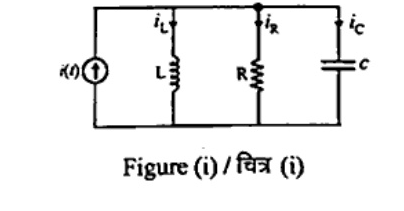
7 MarksbWrite mathematical model of electrical and mechanical system shown in figure (i) and figure (ii).
How to answer
- Draw/label electrical parallel RLC circuit and write KCL at node V
- Derive integro-differential / transfer model for Figure (i)
- Draw/label mechanical 2-mass system and free-body diagrams
- Write differential equations of motion for M1, M2 / force-voltage analogy
-
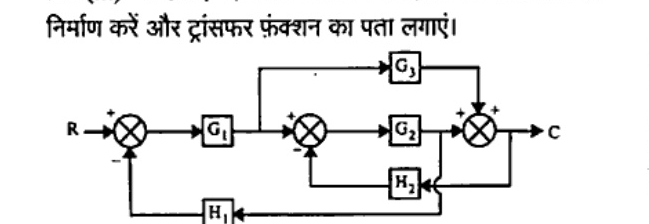
7 MarksaConstruct signal flow graph for block diagram shown in figure (iii) and find out transfer function.
How to answer
- Convert each block/summing point/take-off to SFG nodes and branches G1,G2,G3,H1,H2
- Draw signal flow graph
- Apply Mason's gain formula: list forward paths and loops
- Obtain C(s)/R(s) transfer function
-
7 MarksbDefine terminologies used in control system and classify different types of control systems with suitable examples.
How to answer
- Define basic terminologies: plant, controller, feedback, error, etc.
- Classify: open vs closed loop, linear vs non-linear, time-invariant vs variant, SISO vs MIMO
- Give suitable example for each type
- Comparison summary
-
7 MarksaFor a unity feedback system having $$G(s)=\frac{35(s+4)}{s(s+2)(s+5)}.$$ Find error constants and error for ramp input with magnitude 5.
How to answer
- Identify unity feedback, type and Kp, Kv, Ka formulas
- Compute Kp, Kv, Ka for $G(s)=35(s+4)/s(s+2)(s+5)$
- Use $e_{ss}=A/Kv$ for ramp input
- Evaluate error for magnitude 5
-
7 MarksbDiscuss time response of following :
- i)1st order system
- ii)2nd order system
How to answer
- Give transfer function and step/ramp response of 1st order system
- Define time constant, steady-state value
- Give 2nd order response for under/critical/over-damped cases
- Mention overshoot, settling time, damping ratio
-
7 MarksaDescribe following in detail
- i)Concept of stability of linear systems
- ii)Routh Hurwitz stability criteria
How to answer
- Define stability: BIBO, absolute vs relative
- Explain pole locations in s-plane for linear systems
- State Routh-Hurwitz criterion and array construction
- Mention special cases and stability decision
-
7 MarksbCalculate the angle of asymptotes and the centroid for the system having, $$G(s)H(s)=\frac{K(s+3)}{s(s+2)(s+4)(s+5)}$$
How to answer
- Count poles (n=4) and zeros (m=1) to get number of asymptotes
- Compute asymptote angles $(2q+1)180/(n-m)$
- Compute centroid $\sigma=(\sum poles-\sum zeros)/(n-m)$
- Substitute poles -0,-2,-4,-5 and zero -3
-
7 MarksaDiscuss following in brief
- i)Polar plots
- ii)Bode plots
- iii)Correlation between time and frequency response
How to answer
- Define polar plot and procedure to sketch
- Define Bode plot: magnitude and phase vs frequency
- Explain correlation: resonant peak, bandwidth vs transient specs
- Give example sketches
-
7 MarksbWrite Nyquist stability criterion and draw the Nyquist plot for $G(s)H(s)=\frac{1}{(s+2)}$. Also decide stability.
How to answer
- State Nyquist stability criterion Z = N+P
- Map Nyquist path and plot $1/(s+2)$
- Count encirclements of -1+j0
- Decide closed-loop stability
-
7 MarksaDescribe types of compensation techniques.
How to answer
- Define compensation purpose
- List series/parallel/feedback compensation
- Describe lag, lead, lag-lead characteristics
- Mention applications
-
7 MarksbDesign compensators in time and frequency domain for following cases.
- i)Phase lag
- ii)Phase lead lag
How to answer
- State design specs in time and frequency domain
- Outline phase-lag design steps
- Outline phase lead-lag design steps
- Mention transfer functions and Bode shaping
-
7 MarksaWrite notes on following:
- i)Proportional and derivative controllers
- ii)Integral controllers
- iii)Composite controllers
How to answer
- Explain P and PD control law and transfer function
- Explain I control effect on steady-state error
- Explain composite PI, PD, PID controllers
- Mention advantages, disadvantages with diagrams
-
7 MarksbExpress the following transfer function in state space phase variable form. $$\frac{Y(s)}{U(s)}=\frac{5s^2+2s+6}{s^3+7s^2+11s+8}$$
How to answer
- Write differential equation from $Y(s)/U(s)$
- Choose phase variables as outputs of integrators
- Form A in companion form, B, C from numerator coefficients
- Write state and output equations
-
7 MarksaEvaluate the controllability and observability of the system with $$A=\begin{bmatrix}0 & 1 & 0\\0 & 0 & 1\\0 & -3 & -4\end{bmatrix}, B=\begin{bmatrix}0\\0\\1\end{bmatrix} \text{and} C=\begin{bmatrix}2 & 3 & 1\end{bmatrix}$$
How to answer
- Form controllability matrix Qc=[B AB A^2B] and check rank
- Form observability matrix Qo=[C; CA; CA^2] and check rank
- Compute determinants for given A,B,C
- Conclude controllability and observability
-
7 MarksbDiscuss following in detail :
- i)Transfer function decomposition
- ii)State Transition Matrix (STM)
- iii)Kalman's Test
How to answer
- Explain partial-fraction / transfer function decomposition
- Define STM $e^{At}$ properties and computation
- State Kalman's test for controllability/observability
- Give formulas and significance
Go to where you left off?
Quick Add to Notes
Save questions, your own notes and screenshots into notes filed by unit. It takes a free account.
Create free accountHave an account? Log in
Notes Panel