EC-404 · Control System/Unsolved PYQ Paper
EC-404 Control System - Dec 2024 Question Paper
Under each question, How to answer lists the points an answer should cover, outlined by CampusPrep from the syllabus. Check the details against your textbook.
-
7 MarksaDefine transfer function. Derive the expression for closed loop transfer function.
How to answer
- Define transfer function as ratio of Laplace of output to input with zero initial conditions
- Draw general closed-loop block with forward path G(s) and feedback H(s)
- Write equations C(s)=G(s)E(s), E(s)=R(s)-H(s)C(s)
- Derive C(s)/R(s)=G(s)/(1+G(s)H(s)), unity feedback case
-
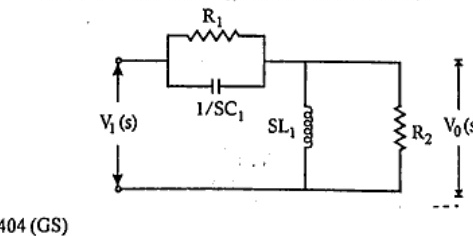
7 MarksbFind the transfer function of given circuit.
How to answer
- Convert circuit to s-domain: $R_1 \parallel 1/SC_1$, $SL_1 \parallel R_2$
- Find equivalent series and shunt impedances
- Apply voltage divider $V_o(s)/V_1(s)=Z_2/(Z_1+Z_2)$
- Simplify to rational function in $s$
-
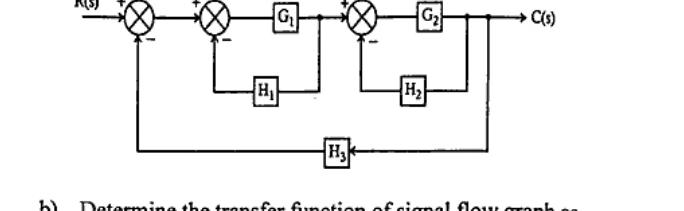
7 MarksaFind the transfer function for the block diagram shown as below.
How to answer
- Reduce inner loops G1 with H1 and G2 with H2 to G1/(1+G1H1) and G2/(1+G2H2)
- Combine cascaded blocks and resolve outer feedback H3
- Apply block reduction / Mason's rule step by step
- Write final C(s)/R(s) expression
-
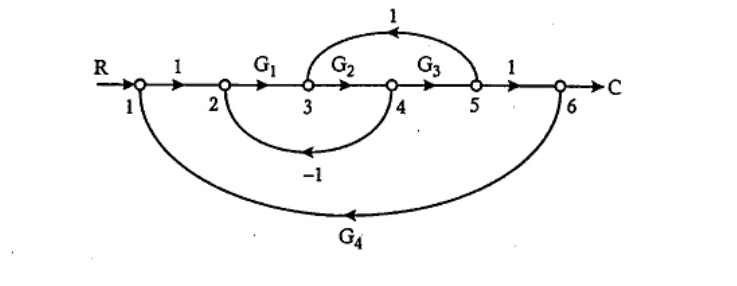
7 MarksbDetermine the transfer function of signal flow graph as shown in figure by using Mason's gain formula.
How to answer
- Identify nodes 1 to 6, forward path gains and loops
- List forward paths Pk and individual loops L1, L2, etc.
- Compute graph determinant Delta and path cofactors Delta_k
- Apply Mason's formula T = sum(Pk*Delta_k)/Delta
-
7 MarksaExplain about various test signals used in control system.
How to answer
- Define step, ramp, parabolic, impulse and sinusoidal signals with Laplace forms
- Give mathematical and graphical representation of each
- Explain use for transient and steady-state analysis
- Mention which signal tests which error constant
-
7 MarksbThe closed loop transfer function of a unity feedback control system is given by $$\frac{C(s)}{R(s)} = \frac{20}{s^2 + 16s + 25}$$ Determine:
- i)Damping ratio
- ii)Natural undamped resonance frequency
- iii)Percentage peak overshoot
How to answer
- Compare denominator with $s^2+2\zeta\omega_n s+\omega_n^2$ to get $\omega_n$ and $\zeta$
- Compute $\omega_n = 5$, $\zeta = 1.6$ indicating overdamped
- Compute % peak overshoot formula $e^{-\pi\zeta/\sqrt{1-\zeta^2}}$ (zero for >1)
- Interpret results for second-order unity feedback
-
7 MarksaWhat is root locus? Describe steps involved in sketching root locus.
How to answer
- Define root locus as locus of closed-loop poles with varying gain K
- List construction rules: poles, zeros, asymptotes, breakaway, angles
- Explain steps for sketching in sequence
- Mention use for stability and design
-
7 MarksbApply Routh Hurwitz stability criteria to determine the stability for given characteristic equation. $$s^5 + s^4 + 2s^3 + 2s^2 + 3s + 5 = 0$$
How to answer
- Form Routh array for $s^5+s^4+2s^3+2s^2+3s+5=0$
- Handle special cases: zero row / auxiliary equation if needed
- Check first-column sign changes to count RHP poles
- Conclude stability / instability
-
7 MarksaWrite a short note on polar plot.
How to answer
- Define polar plot as G(jw) magnitude vs phase for w 0 to infinity
- Explain procedure to plot magnitude and angle
- Mention features: start/end points, crossings
- State use for stability and frequency response
-
7 MarksbState Nyquist stability criterion and describe procedure of assessment of relative stability using Nyquist plot.
How to answer
- State Nyquist criterion Z = N+P with encirclement of -1+j0
- Describe Nyquist path and mapping procedure
- Explain gain margin, phase margin for relative stability
- Relate encirclements to stability assessment
-
7 MarksaDiscuss types of compensation techniques and design of phase-lag compensators.
How to answer
- List series, parallel, feedback and lag, lead, lag-lead compensation
- Explain phase-lag characteristics and transfer function
- Give design steps using Bode plot for lag compensator
- Mention effects on steady-state error and stability
-
7 MarksbWrite a short note on Bode Plot.
How to answer
- Define Bode plot as log magnitude and phase vs log frequency
- Explain procedure: corner frequencies, slopes, asymptotes
- Mention determination of GM, PM and stability
- Give example sketch for typical factor
-
14 MarksDerive the relationship between '$\alpha$' and '$\phi m$' for a lead compensator.
How to answer
- Write lead compensator $G_c(s)=(1+Ts)/(1+\alpha Ts)$ with $\alpha<1$
- Derive max phase $\phi_m$ at $\omega_m$ by differentiating phase
- Show $\sin\phi_m=(1-\alpha)/(1+\alpha)$ and $\omega_m$
- Relate $\alpha$ to required phase lead
-
7 MarksaConvert the following transfer function into state-space form: $$\frac{V(s)}{U(s)} = \frac{k(c_2s + c_1)}{s^3 + a_3s^2 + a_2s + a_1}$$
How to answer
- Write transfer function in controllable/observable canonical form
- Define state vector and derive A matrix from denominator coefficients
- Form B matrix from numerator coefficients $k,c1,c2$
- Write output matrix C and D
-
7 MarksbObtain the solution of state equation and write the properties of state transition matrix.
How to answer
- Write state equation solution $x(t)=e^{At}x(0)+\int e^{A(t-\tau)}Bu d\tau$
- Derive state transition matrix $\phi(t)=e^{At}=L^{-1}[(sI-A)^{-1}]$
- List properties: $\phi(0)=I$, $\phi^{-1}=\phi(-t)$, semigroup
- Mention significance for stability and response
Go to where you left off?
Quick Add to Notes
Save questions, your own notes and screenshots into notes filed by unit. It takes a free account.
Create free accountHave an account? Log in
Notes Panel