EC-404 · Control System/Unsolved PYQ Paper
EC-404 Control System - Jun 2024 Question Paper
Under each question, How to answer lists the points an answer should cover, outlined by CampusPrep from the syllabus. Check the details against your textbook.
-
7 MarksaWhat is control system? Briefly explain the classification of control system.
How to answer
- Define control system as interconnection of components to obtain desired output
- Classify by open-loop vs closed-loop, linear vs non-linear, time-invariant vs time-variant, continuous vs discrete
- Give examples and block diagrams for each class
- Summarize advantages/disadvantages
-
7 MarksbReduce the given block diagram into
- i)A form having one block in the forward path and one in the feedback path
- ii)Single block representation
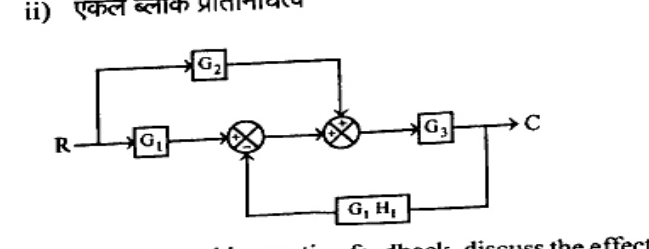
How to answer
- Apply block diagram reduction rules stepwise
- Obtain equivalent with one forward block and one feedback block
- Further reduce to single block transfer function C/R
- State final transfer function
-
7 MarksaFor the system with negative feedback, discuss the effect of feedback on the following Obtain mathematical expression in each case
- i)Disturbance
- ii)System parameter variation
- iii)System time constant
How to answer
- Write closed-loop model with feedback H(s) and disturbance
- Derive effect on disturbance rejection: divided by 1+GH
- Derive sensitivity to parameter variation
- Derive effective time constant reduction
-
7 MarksbDiscuss about the effect of addition of poles and zeros to open loop and close loop system.
How to answer
- Define poles and zeros of open-loop transfer function
- Explain effect of added pole: stability decreases, root locus shifts right
- Explain effect of added zero: stability improves, root locus shifts left
- Contrast for open-loop vs closed-loop response
-
7 MarksaDetermine the stability of a system having following characteristics equation using Routh Hurwitz criterion $$S^5 + S^4 + 2S^3 + 2S^2 + 11S + 10 = 0$$
How to answer
- Form Routh array for $S^5+S^4+2S^3+2S^2+11S+10=0$
- Check first column sign changes
- Identify rows of zeros / auxiliary equation if any
- Conclude stability / number of RHP poles
-
7 MarksbSketch the root locus of the system whose open loop transfer function is $$G(s) = \frac{K}{s(s+2)(s+4)}$$ Find the value of K so that the damping ratio of the closed loop system is 0.5.
How to answer
- Identify poles at 0, -2, -4 and asymptotes, centroid, breakaway points
- Sketch root locus for $K>0$
- Use angle condition for damping ratio 0.5 line intersection
- Calculate gain K at intersection point
-
7 MarksaDerive the expressing for resonant peak and resonant frequency. Establish correlation between time and frequency response parameters.
How to answer
- Write standard second-order closed-loop frequency response
- Differentiate magnitude to get resonant frequency and resonant peak formulas
- Relate resonant peak/frequency to damping ratio
- Correlate with time-domain Mp, ts, tr
-
7 MarksbSketch the bode plot for the following open loop control system. $$G(s) = \frac{K(1+0.2S)(1+0.025 S)}{S^3(1+0.001 S)(1+0.005 S)}$$
How to answer
- Identify corner frequencies from time constants 0.2, 0.025, 0.001, 0.005 and triple pole at origin
- Draw asymptotic magnitude and phase plots
- Combine to get complete Bode magnitude and phase
- Determine gain/phase margins if required
-
7 MarksaUsing Nyquist criterion investigate the closed loop stability of the system whose open loop transfer function is $$G(s)H(s) = \frac{K(s+1)}{(s+0.5)(s-2)}$$ Consider K = 1.25
How to answer
- Identify open-loop poles: -0.5 and +2, so P=1
- Plot Nyquist path and mapping of G(s)H(s) with K=1.25
- Count encirclements N of -1+j0
- Apply Z=N+P to decide closed-loop stability
-
7 MarksbDraw the diagram of lead compensator and find the expression for its transfer function.
How to answer
- Draw circuit diagram of lead compensator (R-C network)
- Derive transfer function using voltage division / Laplace
- Express in form (1+T s)/(1+alpha T s) with alpha<1
- Mention pole-zero locations
-
7 MarksaA unity feedback control system has an open loop transfer function of $G(s) = 1/s^2$. Design a suitable compensating network such that a phase margin of $45^\circ$ is achieved without sacrificing system velocity error constant.
How to answer
- Analyze G(s)=1/s^2: double integrator, velocity constant needs
- Choose lag-lead or lead compensator to get 45 deg phase margin
- Calculate compensator parameters without reducing Kv
- Verify phase margin and Kv
-
7 MarksbExplain in brief propositional, derivative, integral and composite controllers.
How to answer
- Define P, D, I control actions with transfer functions
- Explain composite PI, PD, PID controllers
- Give response characteristics and applications
- Summarize comparison table
-
7 MarksaDiscuss the concept of controllability and observability with suitable example.
How to answer
- Define controllability and observability matrices
- State Kalman rank conditions
- Illustrate with suitable example calculation
- Explain physical significance
-
7 MarksbThe transfer function of a system is given by $$\frac{Y(s)}{U(s)} = \frac{s^2 + 3s + 2}{s^3 + 9s^2 + 26s + 24}$$ Determine the state model by using direct decomposition method.
How to answer
- Factor numerator and denominator or use direct decomposition
- Assign state variables to integrator outputs
- Write state equations in controllable / observable form
- Obtain A, B, C, D matrices
-
14 MarksWrite a short note on any two
- a)Open loop and close loop systems
- b)Effect of location of poles on stability
- c)Log magnitude versus phase plot
- d)State space representation of system
How to answer
- Select any two topics from a-d
- Give definition, diagram/formula and key points for each
- Mention applications / significance
- Conclude briefly
Go to where you left off?
Quick Add to Notes
Save questions, your own notes and screenshots into notes filed by unit. It takes a free account.
Create free accountHave an account? Log in
Notes Panel