EC-404 · Control System/Unsolved PYQ Paper
EC-404 Control System - Jun 2023 Question Paper
Under each question, How to answer lists the points an answer should cover, outlined by CampusPrep from the syllabus. Check the details against your textbook.
-
7 MarksaWhat are effects of feedback? Classify different types of control systems with examples.
How to answer
- Define feedback and list its effects: sensitivity, stability, bandwidth, noise, steady-state error
- Classify control systems: open-loop vs closed-loop, linear vs non-linear, time-invariant vs variant, SISO vs MIMO, continuous vs discrete
- Give examples for each type
-
7 MarksbWrite mathematical model of mechanical system shown in figure (i) and write analogous electrical equations.
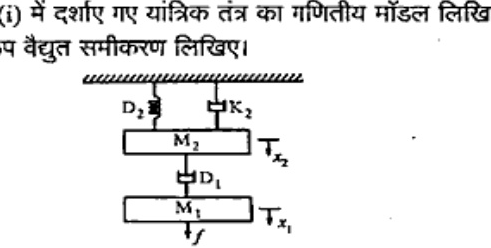
How to answer
- Draw free-body diagrams for masses M1, M2 with displacements x1, x2
- Write force equilibrium differential equations with dampers D1, D2 and spring K2
- Draw analogous electrical circuits using force-voltage and force-current analogy
- Write loop/node electrical equations
-
7 MarksaCompare open loop and closed loop systems and find transfer function of block diagram shown in figure (ii) by reduction rules
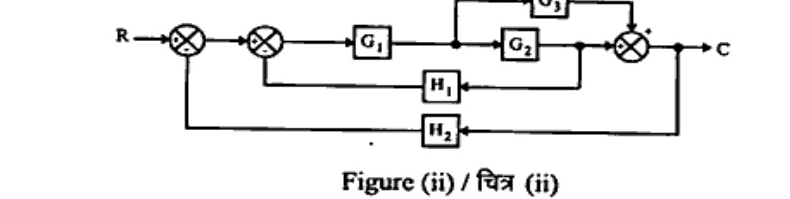
How to answer
- Compare open-loop vs closed-loop: definition, feedback, accuracy, stability, cost, examples
- Apply block reduction rules stepwise: shift takeoffs, combine G2+G3 parallel, inner loop with H1
- Reduce outer loop with H2 to get C/R
-
7 MarksbDetermine transfer function of signal flow graph as shown in figure (iii) by using Mason's gain formula.
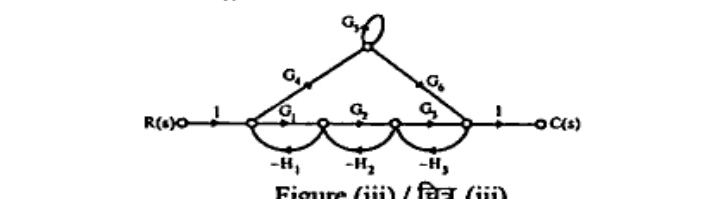
How to answer
- Identify forward paths, individual loops, non-touching loops from signal flow graph
- Compute graph determinant Delta and path cofactors Delta_k
- Apply Mason's gain formula C(s)/R(s) = sum(Pk*Delta_k)/Delta
-
7 MarksaDescribe standard test signals, steady state errors and error constants in detail.
How to answer
- Define step, ramp, parabolic, impulse test signals with Laplace forms
- Define steady-state error ess and static error constants Kp, Kv, Ka
- Give ess formulas for type 0,1,2 systems
-
7 MarksbDiscuss effects of additions of poles and zeros to open loop and closed loop system.
How to answer
- Explain effect of adding pole on stability, transient response and steady-state
- Explain effect of adding zero on damping, peak overshoot and stability
- Contrast effects for open-loop vs closed-loop systems
-
7 MarksaApply Routh Hurwitz stability criteria to determine the stability and find the number of roots lying in the right half of the s-plane if characteristic equation of the two systems are given as follows:
- i)$s^4 + 21s^3 + 21s^2 + 36s + 20 = 0$
- ii)$s^5 + 6s^4 + 3s^3 + 2s^2 + s + 1 = 0$
How to answer
- Construct Routh array for each characteristic equation
- Check first-column sign changes for stability
- Count sign changes to get number of roots in right-half s-plane
-
7 MarksbWhat is root locus? Describe steps involved in sketching root locus.
How to answer
- Define root locus as plot of closed-loop poles vs gain K
- List construction rules: poles/zeros, real axis, asymptotes, breakaway, angles
- Explain steps to sketch root locus
-
7 MarksaEstablish correlation between time response and frequency response parameters.
How to answer
- Define time-domain specs: Mp, tp, tr, ts and frequency specs: Mr, wr, bandwidth, phase margin
- Derive relations for second-order system: Mr vs damping ratio, bandwidth vs natural frequency
- State correlation formulas
-
7 MarksbDefine gain margin, phase margin and draw bode plot for the system having open loop transfer function. $$G(s)H(s)=\frac{50}{(s+1)(s+2)}$$
How to answer
- Define gain margin and phase margin with formulas
- Compute magnitude and phase for G(s)H(s)=50/((s+1)(s+2))
- Sketch Bode magnitude and phase plots and mark GM, PM
-
7 MarksaState Nyquist stability criterion and describe procedure of assessment of relative stability using Nyquist plot.
How to answer
- State Nyquist stability criterion Z = N+P
- Explain Nyquist contour and encirclement of -1+j0
- Describe gain margin, phase margin and relative stability from Nyquist plot
-
7 MarksbDiscuss types of compensation techniques and design of phase - lag and phase lead compensators.
How to answer
- Classify compensators: lag, lead, lag-lead
- Give transfer functions and pole-zero locations
- Explain design procedure for phase-lag and phase-lead compensators
-
7 MarksaCompare proportional, derivative, integral and composite controllers.
How to answer
- Define P, I, D actions with transfer functions
- Compare effects on error, speed, stability and noise
- Describe composite PI, PD, PID controllers
-
7 MarksbDescribe general state space representation and write state model for $n^{th}$ order differential equation.
How to answer
- Define state vector, state equation x_dot=Ax+Bu, output y=Cx+Du
- Explain nth-order differential equation to first-order form
- Write companion/state model matrices
-
7 MarksaConvert the following transfer function into state - space form: $$\frac{Y(s)}{R(s)} = \frac{s^2 + 2s + 4}{s^3 + 3s^2 + 6s + 10}$$
How to answer
- Express transfer function in controllable/observable canonical form
- Choose state variables and write A, B, C, D matrices
- Verify by C(sI-A)^-1B+D
-
7 MarksbWrite short note on following
- i)Controllability and observability
- ii)Transfer function decomposition
- iii)Solution of state equation
- iv)All-pass and minimum - phase systems.
How to answer
- Define controllability/observability tests with matrices
- Explain transfer function decomposition methods
- Give solution x(t) using state transition matrix; define all-pass and minimum-phase
Go to where you left off?
Quick Add to Notes
Save questions, your own notes and screenshots into notes filed by unit. It takes a free account.
Create free accountHave an account? Log in
Notes Panel