EC-404 · Control System/Unsolved PYQ Paper
EC-404 Control System - Jun 2025 Question Paper
Under each question, How to answer lists the points an answer should cover, outlined by CampusPrep from the syllabus. Check the details against your textbook.
-
7 MarksaExplain the following terms with reference to block diagram representation
- i)Block Diagram
- ii)Output
- iii)Summing Point
- iv)Take-off Point
- v)Forward path
- vi)Feedback Path
How to answer
- Define block diagram representation purpose
- Explain each term: block, output, summing point, take-off point, forward and feedback path
- Mention symbols/sign conventions with small sketches
- Relate to closed-loop structure
-
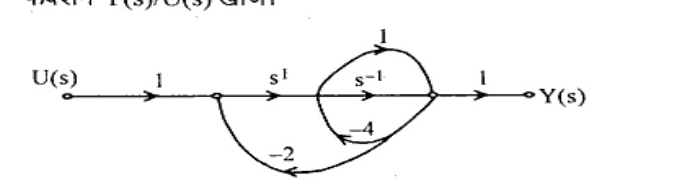
7 MarksbThe signal flow graph for a system is given below. Find the transfer function Y(s)/U(s)
How to answer
- Identify forward paths and individual loops from signal flow graph
- Apply Mason's gain formula $\Delta = 1-\sum L_1+\sum L_2-...$
- Compute path determinants $\Delta_k$
- Obtain $Y(s)/U(s)=\sum P_k\Delta_k/\Delta$ and simplify
-
7 MarksaDraw the block diagram of open loop and close loop control system and compare them. Give the advantages and disadvantages of each.
How to answer
- Draw labelled block diagrams of open-loop and closed-loop systems
- Compare on basis of feedback, accuracy, stability, cost, sensitivity
- List advantages of each
- List disadvantages of each
-
7 MarksbWrite down the steps of drawing the root locus of any system. How the stability can be judged by the root locus.
How to answer
- List standard root locus construction rules (poles, zeros, asymptotes, breakaway, angles)
- Describe step-by-step procedure
- Explain how pole locations in s-plane indicate stability
- Mention crossing of imaginary axis and gain margin
-
7 MarksaThe open loop transfer function of a unity feedback is given by $$G(s) = \frac{40}{[s(0.2s+1)]}$$ Determine steady state error using error series for the input $r(t) = (3+4t)t$
How to answer
- Write $G(s)=40/[s(0.2s+1)]$ and input $r(t)=(3+4t)t$
- Find error constants or error series coefficients
- Compute steady-state error for ramp and parabolic components
- Obtain total steady-state error
-
7 MarksbThe open loop transfer function of a unity feedback control system is given by $$G(s) = \frac{K}{s(1+sT_1)(1+sT_2)}$$ Applying Routh Hurwitz criterion, determine the value of K in term of $T_1$ and $T_2$ for the system to be stable.
How to answer
- Form closed-loop characteristic equation $1+G(s)=0$
- Construct Routh array in terms of $K, T_1, T_2$
- Apply Routh-Hurwitz conditions for no sign change
- Derive range/condition for K for stability
-
7 MarksaWhat do you understand by polar and inverse polar plots. How do they differ from bode plot.
How to answer
- Define polar plot and inverse polar plot
- Explain procedure to obtain them from frequency response
- Differentiate from Bode plot (gain-phase vs log magnitude/phase vs log frequency)
- Mention uses and limitations
-
7 MarksbA unity feedback control system with open loop transfer function $$G(s)\frac{50(s+60)}{(s+2)(s+10)}$$ Draw the bode plot and find the gain crossover frequency, phase crossover frequency, gain margin as well as phase margin.
How to answer
- Rewrite $G(s)=50(s+60)/((s+2)(s+10))$ in Bode standard form
- Draw magnitude and phase plots vs log frequency
- Identify gain crossover and phase crossover frequencies
- Determine gain margin and phase margin
-
7 MarksaAscertain stability by Nyquist criterion for the following open loop control system $$G(s)H(s) = \frac{(4s+1)}{s^2(1+s)(1+2s)}$$
How to answer
- State Nyquist stability criterion $Z = P - N$
- Plot Nyquist path for $G(s)H(s)=(4s+1)/(s^2(1+s)(1+2s))$
- Count encirclements of -1+j0
- Conclude stability
-
7 MarksbWhat is Compensation? Draw the phase lead network and explain phase lead compensation.
How to answer
- Define compensation in control systems
- Draw circuit of phase lead network
- Derive its transfer function
- Explain effect on phase, gain margin and transient response
-
7 MarksaExplain in brief propositional, derivative, integral and composite controllers.
How to answer
- Define proportional, derivative, integral actions
- Give transfer function/output equation of each
- Explain composite (PI, PD, PID) controllers
- Mention effects on steady-state and transient response
-
7 MarksbDesign a compensating network for $$G(s) = \frac{K}{s(1+0.2s)(1+0.01s)}$$ So that its phase margin at least will be $40^{\circ}$ and the steady state error will not exceed 2% of the final velocity.
How to answer
- Determine K from velocity error requirement (2% of final velocity)
- Plot Bode of uncompensated system and find phase margin
- Design lead/lag compensator to achieve >=40 deg phase margin
- Verify compensated frequency response
-
7 MarksaWhat do you mean by transfer function decomposition and discuss about direct decomposition.
How to answer
- Define transfer function decomposition
- Explain need for state-space realization
- Discuss direct decomposition (parallel/series) method
- Mention example of splitting into first-order terms
-
7 MarksbThe state equation of a linear time invariant system is given below $$\begin{bmatrix} x_1 \\ x_2 \end{bmatrix} = \begin{bmatrix} -2 & 0 \\ 1 & -1 \end{bmatrix} \begin{bmatrix} x_1 \\ x_2 \end{bmatrix} + \begin{bmatrix} 0 \\ 1 \end{bmatrix} u(t); t > 0$$ Find the controllability of the system and calculate the state transition matrix.
How to answer
- Write state matrices A, B from given equation
- Test controllability via $Q_c=[B\ AB]$ rank
- Compute $\Phi(s)=(sI-A)^{-1}$ then inverse Laplace
- Obtain state transition matrix $e^{At}$
-
14 MarksWrite a short note on any two :
- a)Linearization effect of feedback
- b)Effect of location of poles on stability
- c)Log magnitude versus phase plot
- d)State space representation of system
How to answer
- Select any two topics from a-d
- Give definition and key concepts for each
- Add relevant formulas/diagrams/examples
- Conclude with significance in control systems
Go to where you left off?
Quick Add to Notes
Save questions, your own notes and screenshots into notes filed by unit. It takes a free account.
Create free accountHave an account? Log in
Notes Panel