EC-404 · Control System/Unsolved PYQ Paper
EC-404 Control System - Jun 2022 Question Paper
Under each question, How to answer lists the points an answer should cover, outlined by CampusPrep from the syllabus. Check the details against your textbook.
-
7 MarksaExplain the classification of control systems.
How to answer
- Define open-loop vs closed-loop systems
- Classify by feedback, linearity, time-variance, continuity, etc.
- Give examples of each type
-
7 MarksbDefine transfer function and determine the transfer function of RLC series circuit if the voltage across the capacitor is a output variable and input is voltage source $v(s)$.
How to answer
- Define transfer function as ratio of Laplace output to input with zero initial conditions
- Write RLC series differential equation in s-domain
- Derive Vc(s)/V(s) = (1/sC)/(R+sL+1/sC)
-
7 MarksaDiscuss basis for framing the rules of block diagram reduction technique? What are drawbacks of the block diagram reduction technique?
How to answer
- State need for block diagram reduction rules
- List shifting of summing point and take-off point rules
- Discuss drawbacks like loss of physical insight, tedious for complex systems
-
7 MarksbFind the transfer function for the block diagram shown as below.
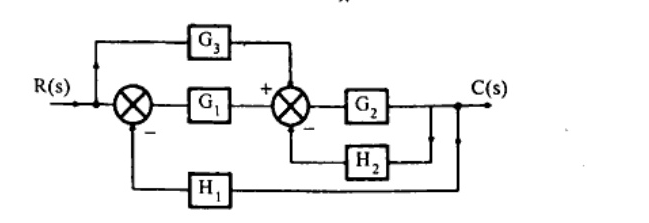
How to answer
- Identify forward blocks G1, G2, G3 and feedbacks H1, H2
- Apply series, parallel and feedback reduction steps
- Obtain overall C(s)/R(s) expression
-
4 MarksaExplain about various test signals used in control systems?
How to answer
- Define purpose of test signals
- Describe step, ramp, parabolic and impulse signals with Laplace forms
- Explain use in transient and steady-state analysis
-
10 MarksbThe closed loop transfer function of a unity feedback control system is given by $C(s)/R(s) = 20/(s^2+16s+25)$ Determine:
- i)Damping ratio
- ii)Natural undammed resonance frequency
- iii)Percentage peak overshoot
- iv)Expression for error response
How to answer
- Compare denominator with $s^2+2\zeta\omega_n s+\omega_n^2$ to find $\zeta, \omega_n$
- Calculate peak overshoot $M_p = e^{-\pi\zeta/\sqrt{1-\zeta^2}}$
- Write error response expression for second-order system
-
5 MarksaWhat are the necessary conditions to have all the roots of characteristics equation in the left half of s-plane?
How to answer
- State Routh-Hurwitz necessary conditions
- All coefficients positive and non-zero
- All powers of s present in characteristic equation
-
9 MarksbFor the unity feedback system the open loop T.F. $$G(s)=\frac{K}{s(1+0.6s)(1+0.4s)}$$ Determine
- a)Range of values of K
- b)Marginal K
- c)Frequency of sustained oscillations
How to answer
- Form characteristic equation $1+G(s)=0$
- Build Routh array and apply $K>0$ conditions
- Find marginal K for zero row and frequency from auxiliary equation
-
7 MarksaWrite short notes on various frequency domain specifications.
How to answer
- Define resonant peak, resonant frequency, bandwidth, gain and phase margins
- Give formulas in terms of damping ratio
- Explain significance in frequency response
-
7 MarksbDerive expression for resonant peak and resonant frequency and hence establish correlation between time and frequency response.
How to answer
- Start from second-order closed-loop magnitude $M(j\omega)$
- Differentiate to find resonant frequency $\omega_r = \omega_n\sqrt{1-2\zeta^2}$
- Derive $M_r = 1/(2\zeta\sqrt{1-\zeta^2})$ and correlate with time response
-
14 MarksThe open loop transfer function of a system is $$G(s)=\frac{K}{s(1+s)(1+0.1s)}$$ Determine the value of K such that
- i)Gain Margin = 10dB
- ii)Phase Margin = 50 degree
How to answer
- Plot Bode / Nyquist to find phase cross-over and gain cross-over frequencies
- Apply GM = -20log|G| and PM = 180+angle conditions
- Solve for K for GM=10dB and PM=50 degree
-
7 MarksaWhat is lag-lead compensator? Under what conditions it is employed?
How to answer
- Define lag-lead compensator with pole-zero combination
- Explain need to improve both transient and steady-state
- List conditions for employment
-
7 MarksbDerive the relationship between '$\alpha$' and '$\Phi_{m}$' for a lead compensator.
How to answer
- Write lead compensator transfer function with $\alpha<1$
- Find frequency of maximum phase lead $\omega_m$
- Derive $\sin\Phi_m = (1-\alpha)/(1+\alpha)$ relation
-
8 MarksaObtain the solution of state equation and list the properties of state transition matrix.
How to answer
- Write state equation solution $x(t)=e^{At}x(0)+\int e^{A(t-\tau)}Bu d\tau$
- Define state transition matrix $\phi(t)=e^{At}$
- List properties like $\phi(0)=I$, $\phi^{-1}(t)=\phi(-t)$
-
6 MarksbTest the given system for Observability using Kalman's test. $$A=\begin{bmatrix} 0 & 1 & 0 \\ 0 & 0 & 1 \\ -6 & -11 & -6 \end{bmatrix}, B=\begin{bmatrix} 0 \\ 0 \\ 1 \end{bmatrix}$$
How to answer
- State Kalman's observability condition with $Q_o = [C^T A^TC^T ...]$
- Substitute given A, B matrices (C missing)
- Check rank for full observability
Go to where you left off?
Quick Add to Notes
Save questions, your own notes and screenshots into notes filed by unit. It takes a free account.
Create free accountHave an account? Log in
Notes Panel