EX-405 · Control System/Unsolved PYQ Paper
EX-405 Control Systems - Dec 2025 Question Paper
Under each question, How to answer lists the points an answer should cover, outlined by CampusPrep from the syllabus. Check the details against your textbook.
-
7 MarksaExplain open-loop and closed-loop control systems with a suitable example in each case.
How to answer
- Define open-loop system with block diagram and no feedback
- Give example e.g. electric washing machine / traffic signal
- Define closed-loop system with feedback path and error detector
- Give example e.g. automatic temperature control / human body
- Compare advantages, accuracy, stability and cost
-
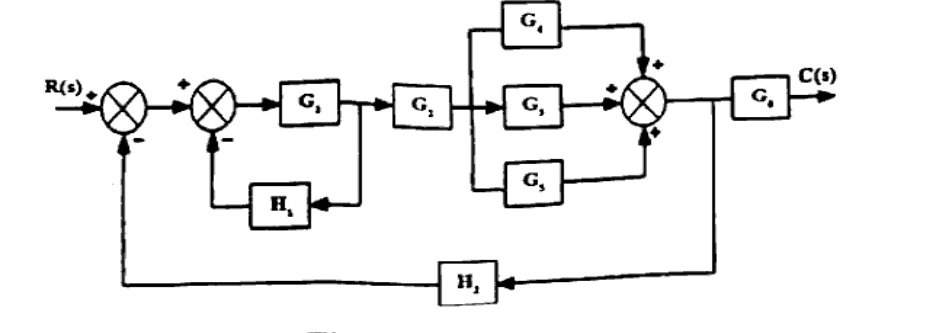
7 MarksbObtained signal flow graph representation for a system whose block diagram (Figure 1) is given below, and using Mason's gain formula, determine the ratio C(S)/R(S).
How to answer
- Convert each block diagram summing point and take-off to SFG nodes
- Draw signal flow graph with gains G1-G6, H1-H2
- Identify forward paths and individual / non-touching loops
- Apply Mason's gain formula $T = \frac{1}{\Delta}\sum P_k\Delta_k$
- Simplify to obtain $C(S)/R(S)$ including $G_6$
-
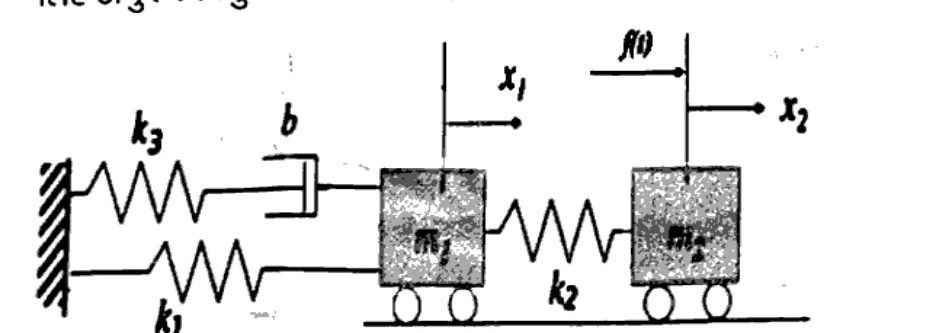
7 MarksaDraw the analogous electrical network for the mechanical system in figure 2 using force-voltage analogy.
How to answer
- Write mechanical equations for masses m1, m2 with displacements x1, x2
- Map force->voltage, mass->inductance, damper->resistance, spring->capacitance
- Draw loop currents for x1 and x2 velocities
- Show series-parallel L-R-C network analogous to Figure 2
- Label voltage source f(t) and component values
-
7 MarksbExplain the components of control systems for servomotors and tacho-generators.
How to answer
- Define servomotor as error-controlled actuator, types AC/DC
- Explain construction and transfer function of servomotor
- Define tacho-generator as velocity feedback transducer
- Explain DC/AC tacho-generator working and output voltage vs speed
- State role in control systems for damping and feedback
-
7 MarksaThe open loop transfer function of a unity feedback system is given by $$G(S) = \frac{108}{S^2(S + 4)(S^2 + 3S + 12)}$$ Find the static error coefficients and steady state error of the system when subjected to an input given by $r(t) = 2 + 5t + 2t^2$
How to answer
- Identify type 2 system from $S^2$ in denominator
- Calculate $K_p = \lim G(S)$, $K_v = \lim S G(S)$, $K_a = \lim S^2 G(S)$
- Write steady-state errors for step, ramp, parabolic components
- Compute total $e_{ss}$ for $r(t)=2+5t+2t^2$
- Interpret infinite Kp, Kv and finite Ka
-
7 MarksbA unity feedback system G(s) characterized by the open loop transfer function of the response to a unit step input. $$G(S) = \frac{10}{(S + 2)(S + 5)}$$ (i) Find damping factor (ii) Determine rise time, peak time and peak overshoot of the system
How to answer
- Form closed-loop characteristic $1+G(S)=0$ and compare with $s^2+2\zeta\omega_n s+\omega_n^2=0$
- Compute damping ratio $\zeta$ and natural frequency $\omega_n$
- Calculate damped frequency $\omega_d = \omega_n\sqrt{1-\zeta^2}$
- Evaluate $t_r$, $t_p = \pi/\omega_d$, $M_p = e^{-\pi\zeta/\sqrt{1-\zeta^2}}$
- Comment on overdamped/underdamped nature
-
7 MarksaDerive the expressions for the frequency domain specifications of a second-order system.
How to answer
- Start from second-order closed-loop magnitude $M(j\omega)$
- Derive resonant peak $M_r = 1/(2\zeta\sqrt{1-\zeta^2})$ and $\omega_r$
- Derive bandwidth $\omega_b$ and cut-off relations
- Derive resonant frequency and phase expressions
- State validity for $\zeta < 0.707$
-
7 MarksbConstruct R-H criterion and determine the stability of a system representing the characteristics equation $S^6 + 2S^5 + 8S^4 + 12S^3 + 20S^2+ 16S + 16 = 0$. Comment on the location of the roots of the characteristic equation.
How to answer
- Form Routh array for 6th-order polynomial up to s^0 row
- Handle special cases of zero row with auxiliary equation if needed
- Count sign changes in first column for RHP roots
- Decide stability / marginal stability
- Locate roots: RHP, LHP, imaginary axis
-
7 MarksaDraw the Root locus of the system whose open-loop transfer function is. $$G(s)H(s) = \frac{K}{s(s + 6)(s^2 + 4s + 13)}$$
How to answer
- Locate open-loop poles: 0, -6, -2±j3 and mark real-axis sections
- Calculate asymptotes, centroid and breakaway points
- Find angle of departure from complex poles and jw crossing
- Sketch branches for K>0 approaching infinity/zeros
- Determine stability range of K from Routh / intersection
-
7 MarksbExplain the effect of the addition of poles and zeros of the root locus.
How to answer
- State effect of adding pole: pushes locus right, reduces stability
- State effect of adding zero: pulls locus left, improves stability
- Explain changes in breakaway, asymptotes and damping
- Give illustrative root locus sketches
- Summarize compensation viewpoint
-
7 MarksaDraw the polar plot of the unity feedback system whose open loop transfer function is given by: $$G(s) = \frac{1}{(1 + s)(1 + 2s)}$$ Determine the phase and gain margin.
How to answer
- Substitute $s=j\omega$ and find $|G(j\omega)|$ and $\angle G(j\omega)$
- Plot polar locus for $\omega:0\to\infty$ from 1∠0° to origin
- Find gain crossover and phase crossover frequencies
- Compute gain margin and phase margin formulas
- Comment on stability from margins
-
7 MarksbDraw the Nyquist plot for the system whose open loop transfer function is: $G(S)H(S) = 20/ S (S+1) (S+2)$
How to answer
- Map Nyquist contour avoiding pole at origin
- Plot $G(j\omega)H(j\omega)$ for $\omega>0$ and mirror for $\omega<0$
- Find intersection with negative real axis
- Apply $Z = P - N$ criterion with P=0
- Conclude closed-loop stability
-
7 MarksaSketch the Bode plot for the transfer function. $$G(S)H(s) = \frac{10}{S(S + 1)(S + 2)}$$
How to answer
- Rewrite in time-constant form $K/s(1+s)(1+s/2)$
- Draw magnitude asymptotes: -20 dB/dec from integrator, corner at 1, 2 rad/s
- Draw phase plot from -90° with lags
- Find gain and phase crossover and margins
- Comment on stability
-
7 MarksbExplain the effect of Lag, lead and lag-lead compensation on frequency response in detail.
How to answer
- Define lag, lead, lag-lead compensator transfer functions
- Explain pole-zero locations and Bode characteristics
- Describe effect on gain, phase, bandwidth and steady-state error
- Compare improvements in transient vs steady-state
- Give applications and frequency response sketches
-
7 MarksaExplain briefly the PI controller action with block diagram and obtain its transfer function model.
How to answer
- Describe PI control law $u = K_p e + K_i\int e dt$
- Draw block diagram with proportional and integral paths
- Derive transfer function $K_p + K_i/s = K_p(1+1/T_i s)$
- Explain elimination of steady-state error and effect on stability
- Mention applications and tuning
-
7 MarksbState the properties of State Transition Matrix. Compute the State Transition Matrix when $$A = \begin{bmatrix} -1 & 1 \\ 0 & 2 \end{bmatrix}$$
How to answer
- State properties: $\phi(0)=I$, $\phi^{-1}(t)=\phi(-t)$, $\phi(t_2-t_1)\phi(t_1-t_0)=\phi(t_2-t_0)$ etc.
- Compute $(sI-A)^{-1}$ for given $2\times2$ matrix
- Take inverse Laplace to get $e^{At}$
- Simplify to $\phi(t) = [[e^{-t}, (e^{2t}-e^{-t})/3],[0, e^{2t}]]$
- Verify initial condition
Go to where you left off?
Quick Add to Notes
Save questions, your own notes and screenshots into notes filed by unit. It takes a free account.
Create free accountHave an account? Log in
Notes Panel