EX-405 · Control System/Unsolved PYQ Paper
EX-405 Control System - Nov 2023 Question Paper
Under each question, How to answer lists the points an answer should cover, outlined by CampusPrep from the syllabus. Check the details against your textbook.
-
7 MarksaWhat is a mason gain formula? Explain each component of the formula and mention its advantages over block diagram reduction techniques.
How to answer
- State Mason's gain formula T = (1/Delta) sum Pk Delta_k
- Define forward path Pk, loop gains, Delta = 1 - sum L1 + sum L2 - ...
- Define Delta_k as cofactor removing touching loops
- Steps to apply to SFG
- Advantages over block reduction: no stepwise reduction, systematic, complex MIMO, computer friendly
-
7 MarksbObtain the overall transfer function C/R from the signal flow graph shown.
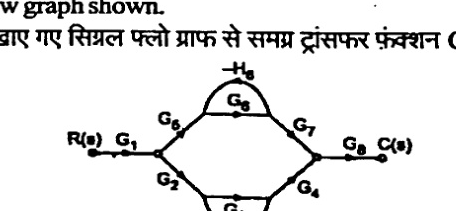
How to answer
- Draw given SFG with nodes and gains G1-G8, H2, H3
- Identify forward paths and individual loops
- Compute Delta and Delta_k
- Apply Mason's formula C/R = sum Pk Delta_k / Delta
- Simplify to overall transfer function
-
7 MarksaDetermine the transfer function for the block diagram shown in Figure.
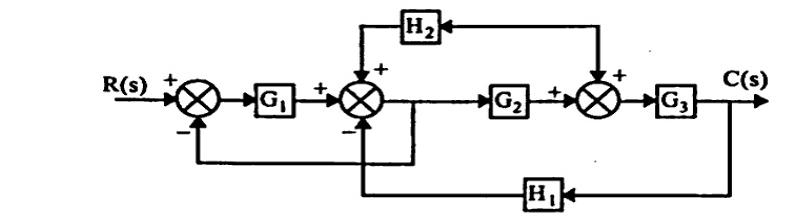
How to answer
- Redraw block diagram with G1, G2, G3, H1, H2
- Shift / combine summing points and pickoff points
- Reduce inner loops with feedback
- Combine cascade blocks
- Obtain C(s)/R(s) expression
-
7 MarksbExplain time response of first order system to unit step and unit ramp input. Find the steady state error response for both.
How to answer
- Model first order system T(s)=1/(Ts+1)
- Unit step response c(t)=1-exp(-t/T), error ess
- Unit ramp response c(t)=t-T+T exp(-t/T), steady error = T
- Plot/explain transient and steady state
- Compare steady state errors for both inputs
-
7 MarksaWhat are the standard test signals used in time domain analysis, explain each one in detail?
How to answer
- Define impulse, step, ramp, parabolic signals with Laplace
- Give mathematical and graphical representation
- Explain use in time domain analysis
- Explain transient vs steady state testing
- Give example of order suitability
-
7 MarksbDiscuss the derivative and integral control in detail.
How to answer
- Define PD/PI actions: derivative on error rate, integral on accumulation
- Give transfer functions Kd*s and Ki/s
- Explain effect on transient, steady error, stability
- Explain practical implementation issues
- Compare applications
-
7 MarksaComment on the stability of the system whose characteristic equation is given by $$s^5 + 2s^4 + 3s^3 + 6s^2 + 2s + 1 = 0.$$
How to answer
- Form Routh array for s^5+2s^4+3s^3+6s^2+2s+1=0
- Check first column sign changes and zero rows
- Identify auxiliary equation if needed
- Conclude number of RHP poles
- Comment on absolute/relative stability
-
7 MarksbSketch the root locus for a system having transfer function as $$G(s)=\frac{k(s+1)}{(s+3)}$$
How to answer
- Identify pole at s=-3 and zero at s=-1, gain k
- Plot real-axis locus, breakaway, angles
- Sketch root locus branches vs k
- Mark stability range
- Conclude locus shape
-
7 MarksaConsider the following polar plot shown in Figure below. If now a pole at origin and a pole at $s = -1/T_2$ are added, sketch the polar plot.
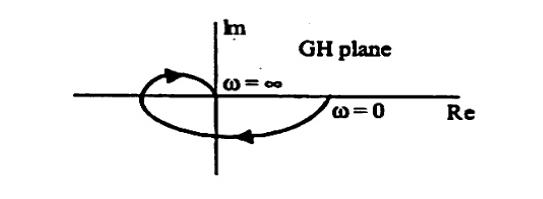
How to answer
- Describe given GH-plane polar plot (omega=0 to infinity)
- Add 90 deg per pole at origin and lag of 1/(1+T2 s)
- Rotate start/end by -180 deg total
- Sketch modified polar plot shape
- Note intersections with axes
-
7 MarksbSketch the bode plot for the following transfer function and determine phase margin and gain margin. $$G(s)=\frac{75(1+0.2s)}{[s(s^2+16s+100)]}$$
How to answer
- Rewrite G(s)=75(1+0.2s)/[s(s^2+16s+100)] in Bode form
- Identify corner frequencies 5 rad/s and 10 rad/s
- Draw asymptotic magnitude and phase plots
- Find gain crossover, phase crossover
- Read gain margin and phase margin
-
7 MarksaDraw the polar plot for open loop transfer function for unity feedback system.
How to answer
- State open-loop TF assumed for unity feedback (type/order)
- Compute magnitude and phase vs omega
- Tabulate and plot Im vs Re polar curve
- Mark omega=0 and omega=infinity points
- Comment on stability indication
-
7 MarksbState and explain Nyquist stability criteria.
How to answer
- State Nyquist criterion Z = N + P
- Explain encirclement of -1+j0 point
- Explain mapping of Nyquist contour
- Steps to check stability
- Give example interpretation
-
7 MarksaWhat is lag-lead compensator? Under what conditions it is employed? Explain.
How to answer
- Define lag-lead compensator TF with both lag and lead sections
- Give pole-zero arrangement and Bode characteristics
- Explain when both transient and steady state improvement needed
- Give design conditions/applications
- Compare with lag-only/lead-only
-
7 MarksbObtain the solution of state equation and list the properties of state transition matrix.
How to answer
- Write state equation x_dot=Ax+Bu, y=Cx+Du
- Solve using Laplace: x(t)=phi(t)x0+integral phi...
- Define STM phi(t)=exp(At)=L^-1[(sI-A)^-1]
- List properties: phi(0)=I, phi^-1=phi(-t), phi(t1+t2)=...
- Mention significance
-
14 MarksWrite a short notes on any two:
- i)Eigen values and Eigen vectors
- ii)Servomotors
- iii)Gain and Phase Margin
- iv)Relative stability
How to answer
- Choose any two topics from four options
- Give definition, formula/diagram for each
- Explain key features and applications
- Give example where relevant
- Conclude with significance in control
Go to where you left off?
Quick Add to Notes
Save questions, your own notes and screenshots into notes filed by unit. It takes a free account.
Create free accountHave an account? Log in
Notes Panel