EX-405 · Control System/Unsolved PYQ Paper
EX-405 Control System - Dec 2024 Question Paper
Under each question, How to answer lists the points an answer should cover, outlined by CampusPrep from the syllabus. Check the details against your textbook.
-
7 MarksaDiscuss the significance of feedback in control systems and how it improves system performance.
How to answer
- Define feedback and closed-loop structure
- Effects: error reduction, disturbance rejection, sensitivity reduction
- Stability, bandwidth and performance trade-offs
- Examples of improvement in accuracy and transient response
-
7 MarksbExplain the working of servo motors in detail. Discuss the advantages and disadvantages of servo motors.
How to answer
- Construction and working principle of servo motor with error detector
- Transfer function / control operation diagram
- Advantages: high accuracy, fast response, closed-loop control
- Disadvantages: cost, complexity, stability and maintenance issues
-
7 MarksaDetermine the value of K such that the roots of the characteristic equation given below lie to the left of line $s = 0$. $$s^3 + 7s^2 + s + K - 9 = 0$$
How to answer
- Form Routh-Hurwitz array for $s^3+7s^2+s+K-9=0$
- Apply positivity conditions on first column
- Obtain inequality for K for all roots with negative real parts
- State allowable range of K
-
7 MarksbWrite short notes on :
- i)Stepper motors
- ii)Nyquist plot
How to answer
- Stepper motors: principle, types, stepping operation and applications
- Nyquist plot: mapping, encirclement of -1+j0, stability criterion
- Key formulas / diagrams for each
- Comparison of uses and limitations
-
7 MarksaDiscuss the advantages and disadvantages of Proportional, Integral and Derivative (PID) controllers.
How to answer
- P, I, D control laws and transfer functions
- Advantages: steady-state error, speed, damping
- Disadvantages: offset, windup, noise amplification, tuning complexity
- Summary table of effects on rise time, overshoot, steady-state error
-
7 MarksbDescribe the concept of stability in control system and explain why it is important.
How to answer
- Definition of stable, marginally stable, unstable systems
- Conditions: pole locations, Routh-Hurwitz, bounded input bounded output
- Importance for safety, performance and design
-
7 MarksaDescribe the procedure for constructing a bode plot. How do Bode plots represent the frequency response of a system?
How to answer
- Steps: transfer function in Bode form, corner frequencies, asymptotes
- Magnitude plot: 20 dB/decade slopes and phase plot construction
- Gain margin, phase margin from plots
- Interpretation as frequency response
-
7 MarksbExplain the concept of steady state error. The open loop transfer function of a control system is given by $$G(s)H(s) = \frac{2(s^2 + 3s + 20)}{s(s+2)(s^2 + 4s + 10)}$$ Determine the static error coefficients and steady state error to the following inputs:
- i)5
- ii)4t
- iii)$\frac{4t^2}{2}$
How to answer
- Define $K_p, K_v, K_a$ and steady-state error formulas
- Identify system type 1 from $G(s)H(s)$ and compute coefficients
- Compute $e_{ss}$ for step $5$, ramp $4t$ and parabolic $4t^2/2$
- Comment on effect of type and gain
-
7 MarksaExplain Eigen values and Eigen vectors. Compute the Eigen values and Eigen vectors for the system model with matrix A is given by $A = \begin{bmatrix} 0 & 1 \\ -2 & -3 \end{bmatrix}$.
How to answer
- Define eigenvalues $|A-\lambda I|=0$ and eigenvectors $(A-\lambda I)x=0$
- Solve characteristic $\lambda^2+3\lambda+2=0$ to get $\lambda=-1,-2$
- Solve for eigenvectors corresponding to each eigenvalue
- Physical significance in state-space stability/modes
-
7 MarksbDerive the response of the second order system with unit step response.
How to answer
- Standard second-order closed-loop $C(s)/R(s)=\omega_n^2/(s^2+2\zeta\omega_n s+\omega_n^2)$
- Partial fraction with unit step $R(s)=1/s$ and inverse Laplace
- Expressions for underdamped, critically damped, overdamped cases
- Plot characteristics: overshoot, settling time, damping ratio
-
7 MarksaExplain the concept of Nyquist and relative stability with suitable examples.
How to answer
- Nyquist criterion $Z=N+P$ and mapping of Nyquist contour
- Relative stability via gain margin and phase margin
- Illustrative examples of stable/unstable encirclements
- Interpretation for design
-
7 MarksbThe open-loop transfer function of a unity feedback system is given by $G(s) = \frac{K}{s(1+0.2s)}$. Design a suitable compensator such that the system will have $K_v = 10$ and phase margin P.M. $= 50^\circ$.
How to answer
- Determine K from $K_v=\lim_{s\to 0}sG(s)=10$
- Plot Bode magnitude/phase of uncompensated system and find PM
- Calculate required phase lead and design lead compensator parameters
- Verify compensated $K_v=10$ and P.M. $=50^\circ$
-
7 MarksaDetermine the overall transfer function of the given system using Mason's gain formula.
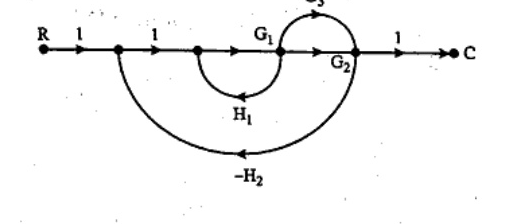
How to answer
- Identify forward paths, individual loops and non-touching loops from graph
- Compute $\Delta$ and $\Delta_k$ using Mason's rule
- Form $C(s)/R(s)=\sum P_k\Delta_k/\Delta$
- Simplify to overall transfer function
-
7 MarksbExplain the concept of poles and zeros in control system analysis and design.
How to answer
- Define poles as roots of denominator and zeros as roots of numerator
- Effect on stability, transient response and frequency response
- Pole-zero plot interpretation and cancellation concept
- Role in controller design and compensation
-
7 MarksaDiscuss the compensation techniques employed in the design of control system.
How to answer
- Need for compensation: improve margins and steady-state accuracy
- Lead, lag and lead-lag networks: characteristics and design steps
- Series vs feedback compensation comparison
- Selection guidelines with Bode/root-locus
-
7 MarksbWhat is the state transition matrix? Explain the significance of the state transition matrix in predicting future state of a dynamic system.
How to answer
- Definition $\phi(t)=e^{At}=L^{-1}[(sI-A)^{-1}]$ and properties
- Solution $x(t)=\phi(t)x(0)+\int$ convolution for forced response
- Computation methods: Laplace, series, diagonalization
- Significance in predicting free and forced future states
Go to where you left off?
Quick Add to Notes
Save questions, your own notes and screenshots into notes filed by unit. It takes a free account.
Create free accountHave an account? Log in
Notes Panel