EX-405 · Control System/Unsolved PYQ Paper
EX-405 Control System - Jun 2023 Question Paper
Under each question, How to answer lists the points an answer should cover, outlined by CampusPrep from the syllabus. Check the details against your textbook.
-
7 MarksaDistinguish between Open loop control system and closed loop control system.
How to answer
- Definition of open loop system with block diagram and examples
- Definition of closed loop system with feedback, block diagram and examples
- Comparison on feedback, accuracy, stability, cost, sensitivity
- Advantages/disadvantages summary
-
7 MarksbFind the transfer function using Mason's gain equation.
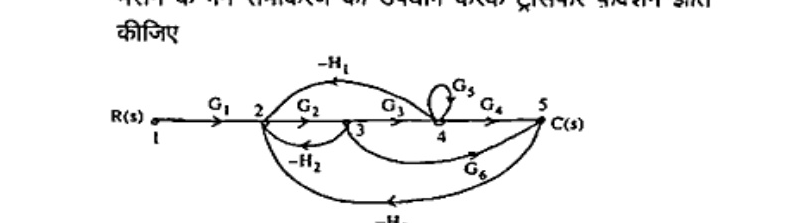
How to answer
- Identify forward paths, individual loops and non-touching loops from signal flow graph
- Apply Mason's gain formula $T = \frac{1}{\Delta}\sum P_k\Delta_k$
- Compute $\Delta$ and $\Delta_k$ for the graph
- Simplify to get $C(s)/R(s)$
-
7 MarksaDetermine the transfer function $X_1(s)/F(s)$ for the system shown below.
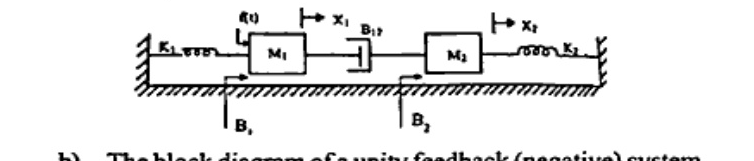
How to answer
- Draw free-body diagrams and write force balance equations for M1 and M2
- Take Laplace transform with zero initial conditions
- Eliminate X2(s) to relate X1(s) and F(s)
- Write final $X_1(s)/F(s)$ in standard form
-
7 MarksbThe block diagram of a unity feedback (negative) system is shown in figure. Determine the steady state error for unit ramp input when K=400. Also determine the value of K for which the steady state error to unit ramp will be 0.02.

How to answer
- Find open-loop transfer function and system type for ramp input
- Compute velocity error constant $K_v = \lim_{s\to 0} sG(s)$
- Compute $e_{ss}=1/K_v$ for K=400
- Solve $K$ for specified $e_{ss}=0.02$
-
7 MarksaExplain time response of first order system to unit step and unit ramp input. Find the steady state error response for both.
How to answer
- Write first-order transfer function $1/(Ts+1)$ and step/ramp responses
- Plot/explain transient with time constant T
- Derive steady-state errors using final value theorem
- Compare zero error for step vs constant error T for ramp
-
7 MarksbDiscuss the proportional and integral control in detail.
How to answer
- Principle and control law of proportional control
- Principle and control law of integral control
- Effect on steady-state error, stability and transient
- Applications and limitations
-
7 MarksaDetermine the RH stability of given characteristic equation, $s^4 + 8s^3 + 18s^2 + 16s + 5 = 0$.
How to answer
- Form Routh array for $s^4+8s^3+18s^2+16s+5=0$
- Check first-column sign changes
- Conclude about RH-plane poles / stability
- State number of unstable roots if any
-
7 MarksbSketch the root locus for the unity feedback system whose open loop transfer function is $G(s)H(s) = K/[s (s+4) (s^2+4s+20)]$
How to answer
- Locate open-loop poles/zeros and root-locus branches
- Draw asymptotes, centroid, breakaway points and imaginary-axis crossing
- Sketch complete root locus for $K>0$
- Comment on stability with gain
-
7 MarksaConsider the following polar plot shown in Figure below. If now a pole at origin and a pole at $s = -1/T_2$ are added, sketch the polar plot.
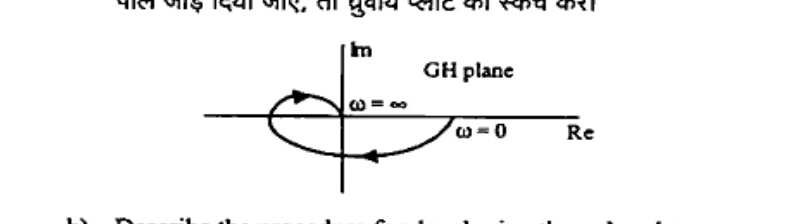
How to answer
- Recall given polar plot shape in GH-plane (omega=0 to infinity)
- Add -90 deg per pole at origin and lag of $1/(1+j\omega T_2)$
- Rotate/shape plot for added two poles
- Sketch resulting polar plot with start/end angles
-
7 MarksbDescribe the procedure for developing the polar plot
How to answer
- Definition of polar plot $G(j\omega)$ magnitude vs phase
- Steps: substitute $s=j\omega$, compute magnitude and phase vs omega
- Tabulate/plot for $\omega=0$ to $\infty$ on polar coordinates
- Interpretation for stability
-
7 MarksaDraw the Nyquist plot for the system whose open loop transfer function is $G(s)H(s) = K/[s(s+2) (s+10)]$ Determine the range of K for which the closed loop system is stable.
How to answer
- Map Nyquist path and plot $G(s)H(s)=K/[s(s+2)(s+10)]$ for $\omega$
- Find intersection with negative real axis
- Apply Nyquist stability criterion $Z=N+P$
- Solve range of K for Z=0 (stable closed loop)
-
7 MarksbSketch the bode plot for the following transfer function and determine phase margin and gain margin. $G(s) = 75 (1+0.2s) / [s (s^2+16s+100)]$
How to answer
- Rewrite $G(s)=75(1+0.2s)/[s(s^2+16s+100)]$ in Bode standard form
- Plot asymptotic magnitude and phase vs log frequency
- Find gain crossover, phase crossover, GM and PM
- Comment on stability from margins
-
7 MarksaDraw the electrical circuit diagram that represents the Lead-Lag compensator and explain in detail.
How to answer
- Circuit diagram of Lead-Lag compensator using R-C network / op-amp
- Transfer function form with lead and lag time constants
- Working in different frequency regions
- Design considerations and uses
-
7 MarksbGiven the state equations below, write the transfer function for this system. Assume the output variable in the transfer function is $y(t)$ which is equal to the state variable $x_1$. $$\begin{bmatrix} \dot{x}_1 \\ \dot{x}_2 \end{bmatrix} = \begin{bmatrix} 0 & 1 \\ -6 & -3 \end{bmatrix} \begin{bmatrix} x_1 \\ x_2 \end{bmatrix} + \begin{bmatrix} 0 \\ 2u(t) \end{bmatrix}$$
How to answer
- Write state model $\dot{x}=Ax+Bu$, $y=Cx$ with given A, B, C
- Use $T(s)=C(sI-A)^{-1}B$ formula
- Compute $(sI-A)^{-1}$ and multiply
- Simplify to rational transfer function
-
14 MarksWrite a short notes on any two
- i)Tacho-generators
- ii)PID Controller
- iii)Stability by root loci
- iv)Relative stability
How to answer
- Select any two topics from the four options
- Give definition, principle/block diagram and working for each
- Mention key formulas, characteristics and applications
- Conclude with significance in control systems
Go to where you left off?
Quick Add to Notes
Save questions, your own notes and screenshots into notes filed by unit. It takes a free account.
Create free accountHave an account? Log in
Notes Panel