EX-405 · Control System/Unsolved PYQ Paper
EX-405 Control System - Jun 2024 Question Paper
Under each question, How to answer lists the points an answer should cover, outlined by CampusPrep from the syllabus. Check the details against your textbook.
-
7 MarksaObtain the expression for $y(t)$ which is satisfying the differential equations $\frac{d^2y(t)}{dt^2}+6\frac{dy(t)}{dt}+8y(t)=16e^{-t}$ Neglect initial conditions.
How to answer
- Take Laplace transform with zero initial conditions.
- Obtain Y(s) = 16/((s+1)(s+2)(s+4)).
- Partial fraction expansion.
- Inverse Laplace to get y(t) for t>=0.
-
7 MarksbFor the mechanical system shown, obtain the F-V analogous electrical network.
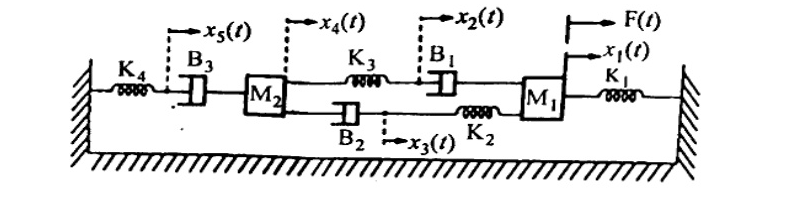
How to answer
- Write mechanical equilibrium equations for M1 and M2.
- Map force to voltage, velocity to current for F-V analogy.
- Map mass to inductance, damper to resistance, spring to capacitance.
- Draw series-parallel electrical network with loops for x1, x2.
-
7 MarksaUsing Mason's gain formula to find out C/R, of the signal flow graph shown.
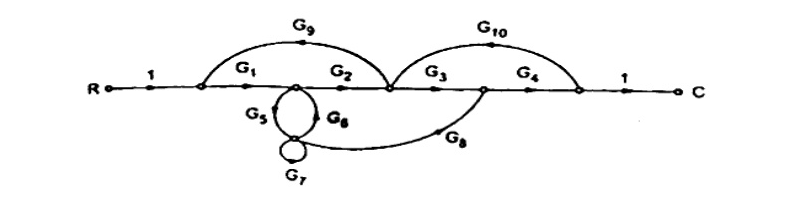
How to answer
- Identify forward paths and individual loops.
- Find non-touching loops and determinant Delta.
- Find path co-factors Delta_k.
- Apply Mason's formula C/R = sum P_k Delta_k / Delta.
-
7 MarksbDerive the expressions for peak time and rise time in terms of $\xi$ and $w_n$ for a second order control system.
How to answer
- Write standard second-order step response with damping ratio.
- Differentiate and set to zero for peak time.
- Obtain Tp = pi / (wn*sqrt(1-xi^2)).
- Derive rise time Tr expression in terms of xi and wn.
-
7 MarksaFor a control system in fig., find the values of $K_1$ and $K_2$ that $M_p = 25\%$ and $T_p = 4$ sec. Assume unit step input.
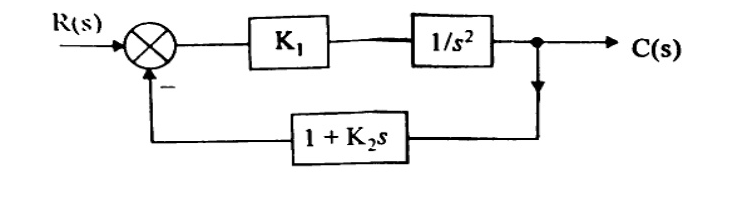
How to answer
- Find closed-loop transfer function C(s)/R(s).
- Compare with standard second-order form to get xi, wn.
- Use Mp and Tp formulas to solve for xi, wn.
- Solve for K1 and K2.
-
7 MarksbDetermine static error coefficients of a unity feedback system with $G(s)=\frac{K}{s^2+(s+20)(s+30)}$.
How to answer
- Identify type and order from G(s).
- Compute position coefficient Kp = lim G(s).
- Compute velocity coefficient Kv = lim sG(s).
- Compute acceleration coefficient Ka = lim s^2 G(s).
-
7 Marksa$s^6+4s^5+3s^4-16s^2-64s-48=0$. Find the number of roots of this equation with positive real part, zero real part and negative real part.
How to answer
- Form Routh array for 6th order polynomial.
- Handle missing s^3 term and zero row if any.
- Count sign changes in first column.
- Infer numbers with positive, zero and negative real parts.
-
7 MarksbThe open loop transfer function of a control system is given by $G(s)=\frac{K}{s(s+2)(s^2+6s+25)}$ sketch the complete root locus as K is varies from 0 to infinity.
How to answer
- Find poles, zeros and number of branches.
- Draw real-axis sections, asymptotes and centroid.
- Find breakaway points and jw crossings.
- Sketch complete locus for K 0 to infinity.
-
7 MarksaWhat are the effects adding open loop poles and zero on the nature of the root locus and on system?
How to answer
- State effect of adding pole on locus shift and stability.
- State effect of adding zero on locus shift and stability.
- Explain with angle condition and examples.
- Summarize relative stability implications.
-
7 MarksbFor a particular unity feedback system $G(s)=\frac{242(s+5)}{s(s+1)(s^2+5s+121)}$ Sketch the Bode Plot. Find $\omega_{gc}$ and $\omega_{pc}$, G.M., P.M. Comment on stability.
How to answer
- Write G(jw) and corner frequencies.
- Draw asymptotic magnitude and phase plots.
- Find gain crossover, phase crossover, GM, PM.
- Comment on closed-loop stability.
-
7 MarksaExplain the concept of gain margin and phase margin. Explain how these values help in studying relative stability.
How to answer
- Define gain margin and phase margin.
- Show them on Bode/Nyquist plots.
- Relate positive margins to relative stability.
- Explain use for design specifications.
-
7 MarksbFor a certain control system $G(s)H(s)=\frac{K}{s(s+2)(s+10)}$ Sketch the Nyquist plot and hence calculate the range of values of K for stability.
How to answer
- Map Nyquist contour avoiding pole at origin.
- Plot G(jw)H(jw) and mirror for negative frequencies.
- Apply Nyquist stability criterion N = Z-P.
- Find K range for no encirclement of -1+j0.
-
7 MarksaFind the eigen values, eigen matrix and model matrix for, $A=\begin{bmatrix}0 & 0 & 1\\2 & 0 & 0\\8 & 2 & -5\end{bmatrix}$.
How to answer
- Form characteristic equation |lambda I - A|=0.
- Solve cubic for eigenvalues.
- Find eigenvectors for each eigenvalue.
- Form eigen matrix and modal matrix.
-
7 MarksbWrite down properties of state transition matrix.
How to answer
- Define state transition matrix phi(t)=exp(At).
- List properties: phi(0)=I, phi inverse, composition.
- Include differentiation and similarity properties.
- Brief justification of each property.
-
14 MarksWrite a short notes on (any two)
- i)Tacho-Generators
- ii)Polar plot
- iii)AC servomotors
- iv)Proportional, derivative and integral control
How to answer
- Select any two topics from list.
- Give principle, construction/working and diagram.
- Mention transfer function or applications.
- Conclude with advantages/uses in control.
Go to where you left off?
Quick Add to Notes
Save questions, your own notes and screenshots into notes filed by unit. It takes a free account.
Create free accountHave an account? Log in
Notes Panel