EX-403 · Digital Electronics Logic Design/Unsolved PYQ Paper
EX-403 Digital Electronics and Logic Design (DELD) - Jun 2025 Question Paper
Under each question, How to answer lists the points an answer should cover, outlined by CampusPrep from the syllabus. Check the details against your textbook.
-
7 MarksaConvert the following.
- i)$(53.625)_{10}$ to $(?)_{2}$
- ii)$(3FD)_{16}$ to $(?)_{2}$
- iii)$(A69.8)_{16}$ to $(?)_{10}$
- iv)$(726.56)_{8}$ to $(?)_{10}$
How to answer
- State positional weights for binary, octal, hexadecimal and decimal
- Convert integer part by repeated division and fractional part by repeated multiplication where applicable
- Show stepwise conversion for all four parts
- Write final equivalent values with correct base subscript
-
7 MarksbUsing the tabulation method, obtain the simplified expression in product of sums for the Boolean function $F(w, x, y, z) = \Pi(1, 3, 5, 7, 13, 15)$.
How to answer
- List maxterms Pi(1,3,5,7,13,15) for 4 variables w,x,y,z
- Apply Quine-McCluskey tabulation: grouping, prime implicants, prime implicant chart
- Select essential prime implicants for POS
- Write minimal product-of-sums expression
-
7 MarksaExplain the error detection using parity method in digital transmission. Discuss how odd parity error detection carried out for transmitting the letter 'B' in ASCII code.
How to answer
- Define parity bit, even vs odd parity
- Explain error detection principle at transmitter and receiver
- Give ASCII code of letter 'B' (1000010) and odd parity bit addition
- Discuss limitation: detects odd number of errors only
-
7 MarksbWhat do you understand by Subtractor Circuit? Design a Half Subtractor circuit with truth table and logic diagram.
How to answer
- Define subtractor and need for Difference and Borrow
- Give truth table of half subtractor for inputs A,B
- Derive Difference = A xor B, Borrow = A' B
- Show logic diagram using XOR, NOT, AND gates
-
7 MarksaWhat do you understand by decoder? Design a binary to Gray code Decoder.
How to answer
- Define decoder and its n to 2^n function
- Give binary to Gray conversion relation
- Derive truth table and output expressions for Gray decoder
- Show logic diagram implementation
-
7 MarksbWhat is Magnitude comparator? Design a 2 bit magnitude comparator.
How to answer
- Define magnitude comparator and outputs A>B, A<B, A=B
- Write truth table for 2-bit numbers A1A0, B1B0
- Derive logic expressions for three outputs
- Show logic diagram
-
7 MarksaDefine the following and explain:
- i)State Diagram
- ii)State Table
- iii)State Equation
- iv)State Assignment
How to answer
- Define state diagram, state table, state equation, state assignment
- Explain each with sequential circuit context
- Give small example representation
- Mention use in state reduction and flip-flop assignment
-
7 MarksbExplain the working principle of Master Slave flip flop with its Truth Table and Suitable circuit diagram.
How to answer
- Explain master-slave configuration to avoid race-around
- Describe operation on clock phases with SR/JK master and slave
- Give truth table / characteristic operation
- Show circuit diagram with two latches and inverter clock
-
7 MarksaWrite logical equation and construct transition table for the circuit output in term of the circuit inputs and secondary variable.
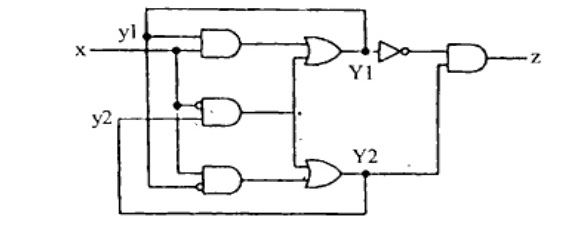
How to answer
- Identify gates, inputs x, secondary variables y1,y2 and outputs Y1,Y2,z
- Write Boolean equations for Y1,Y2 and output z
- Construct transition table for present state, input and next state
- Mention stable states concept
-
7 MarksbExplain 4-bit synchronous up-down binary counter.
How to answer
- Define synchronous up-down counter and control input
- Explain flip-flop excitation and up/down logic
- Describe counting sequence 0-15 and reverse
- Show block diagram / timing concept
-
7 MarksaWhat do you understand by Registers? Discuss about Shift Right and Shift Left with suitable diagram.
How to answer
- Define register as group of flip-flops for storage
- Explain shift right operation with serial shift
- Explain shift left operation with serial shift
- Show diagrams of shift registers with clock and data flow
-
7 MarksbWhat is a Counter. Explain the working of Ring counter with suitable diagram.
How to answer
- Define counter and classification
- Explain ring counter as circulating single 1
- Give 4-bit example sequence and logic
- Show diagram with shift register and feedback
-
7 MarksaExplain about Read and Write cycles of a static RAM with neat timing waveforms.
How to answer
- Define static RAM cell and control signals
- Explain read cycle timing: address, chip select, output enable
- Explain write cycle timing: address, write enable, data setup/hold
- Draw neat timing waveforms for both cycles
-
7 MarksbWith a neat diagram explain in detail about two dimensional memory decoding scheme.
How to answer
- Explain 2D decoding concept with row and column decoders
- Describe address partitioning and memory array selection
- Discuss advantage of reduced decoder size
- Show neat diagram of 2D memory decoding scheme
-
14 MarksWrite a short note on any two :
- a)Priority Encoder
- b)Decoding in Counter
- c)Programmable Logic Array (PLA)
- d)R-2R D to A Converter
How to answer
- Select any two topics from four options
- Give definition, block diagram and working for each
- Mention applications and key features
- Conclude with comparison or use-case
Go to where you left off?
Quick Add to Notes
Save questions, your own notes and screenshots into notes filed by unit. It takes a free account.
Create free accountHave an account? Log in
Notes Panel