EX-304 · Network Analysis/Unsolved PYQ Paper
EX-304 Network Analysis - Nov 2022 Question Paper
Under each question, How to answer lists the points an answer should cover, outlined by CampusPrep from the syllabus. Check the details against your textbook.
-
7 MarksaFind the voltage across the $3\Omega$ resister by mesh analysis
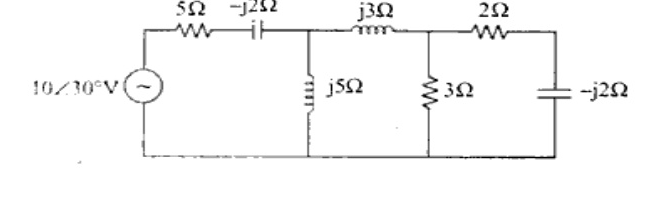
How to answer
- Write mesh equations for three meshes in phasor domain
- Solve for mesh currents with $10\angle 30^{\circ}$ V source
- Find current through $3\Omega$ branch and compute $V = I \times 3$
- Express magnitude and phase of voltage
-
7 MarksbTwo similar coils connected in series gave a total inductance of 600 mH and when one of the coils is reversed, the total inductance is 300 mH. Determine the mutual inductance between the coils and coefficient of coupling.
How to answer
- Use $L_{aiding}=2L+2M=600$ mH and $L_{opposing}=2L-2M=300$ mH
- Solve to get $L$ and $M=75$ mH
- For similar coils $L1=L2=L$, find $k=M/L$
- State mutual inductance and coefficient of coupling
-
7 MarksaFor the network shown in figure below, draw the graph and write down the cut set Matrix.
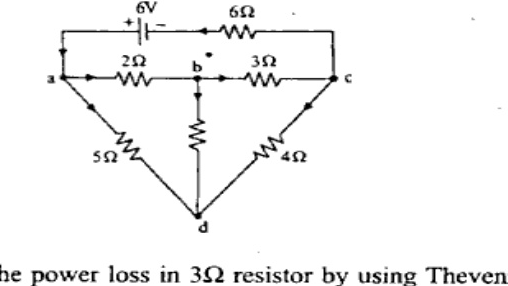
How to answer
- Replace elements by graph branches and label nodes a,b,c,d
- Draw oriented graph with 6 branches
- Select tree and identify cut-sets
- Write cut-set matrix Q with branch orientation
-
7 MarksbFind the power loss in $3\Omega$ resistor by using Thevenin theorem.
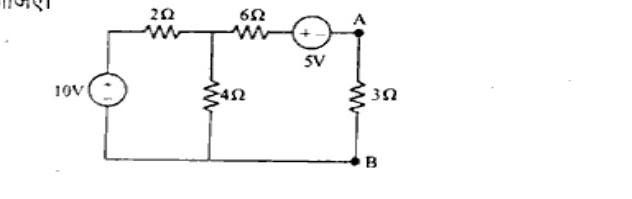
How to answer
- Remove $3\Omega$ load and find $V_{th}$ between A-B
- Find $R_{th}$ by deactivating sources
- Compute load current $I = V_{th}/(R_{th}+3)$
- Compute power loss $P = I^2 \times 3$
-
7 MarksaFind the voltage drop across $3\Omega$ resistor by Superposition theorem.
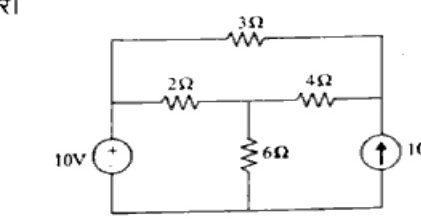
How to answer
- Consider 10V alone (10A open) and find voltage across 3 ohm
- Consider 10A alone (10V short) and find voltage across 3 ohm
- Add contributions algebraically for total voltage drop
- State final magnitude and polarity
-
7 MarksbState and explain the Millman's theorem with suitable example.
How to answer
- State Millman's theorem for parallel voltage sources
- Give formula for Millman voltage and impedance
- Explain with circuit diagram and steps
- Give numerical example
-
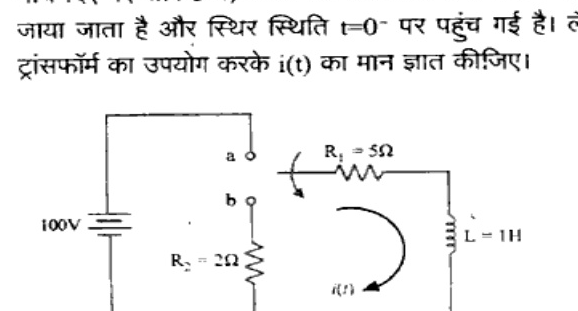
7 MarksaIn the circuit given below, the switch is moved from position $a$ to $b$ at t=0 and steady state has been reached at $t=0^-$. By using Laplace transform find the value of i(t)
How to answer
- Find inductor current at $t=0^-$ with switch at a in steady state
- Write s-domain circuit for $t>0$ with switch at b
- Solve for $I(s)$ using Laplace transform
- Take inverse Laplace to get $i(t)$
-
7 MarksbVerify the final value theorem for the following function.
- i)$2+e^{-3t} \cos 2t$
- ii)$6(1-e^{-t})$
How to answer
- Find Laplace transform $F(s)$ of each function
- Compute final value $\lim_{s\to 0}sF(s)$
- Compute time-domain limit $\lim_{t\to\infty}f(t)$
- Compare to verify theorem and check pole conditions
-
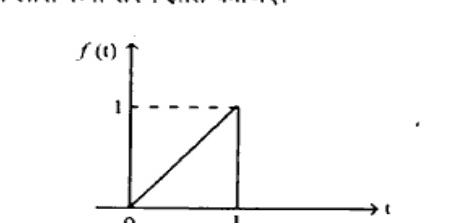
7 MarksaFor the waveform shown in figure below. Write the expression and find the Laplace transform
How to answer
- Write time-domain expression using gate functions: $f(t)=t[u(t)-u(t-1)]$
- Apply Laplace shift property
- Derive $F(s)=(1-e^{-s}(1+s))/s^2$
- State final transform
-
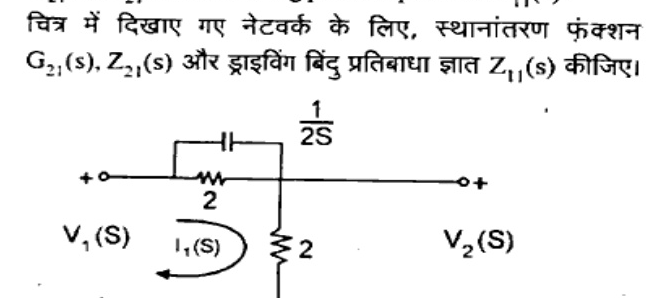
7 MarksbFor the network shown in figure, find the transfer function $G_{21}(s)$, $Z_{21}(s)$ and driving point impedance $Z_{11}(s)$.
How to answer
- Write s-domain nodal equations for $V1(S), V2(S)$
- Find $Z_{11}(s)=V1/I1$ with output open
- Find $Z_{21}(s)=V2/I1$ and voltage ratio $G_{21}=V2/V1$
- Simplify expressions with $1/2S$ capacitor and resistors
-
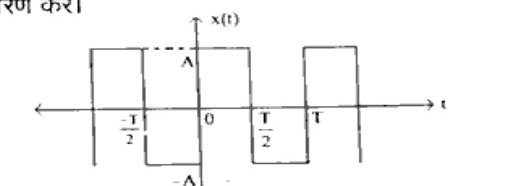
7 MarksaDetermine the trigonometric form of Fourier series of the waveform shown below.
How to answer
- Identify odd symmetric square wave with amplitude A and period T
- Compute Fourier coefficients a0, an, bn
- Write trigonometric series with only sine/cosine odd harmonics
- State final series expression
-
7 MarksbFind the value of $i(0^+)$ using the initial value theorem for the function $I(s) = (2s+3)/[(s+1)(s+3)]$
How to answer
- State initial value theorem $i(0^+)=\lim_{s\to\infty}sI(s)$
- Multiply given $I(s)$ by $s$ and take limit
- Compute value $2$
- Mention applicability condition
-
7 MarksaDetermine the Z-parameters for the network shown in figure.
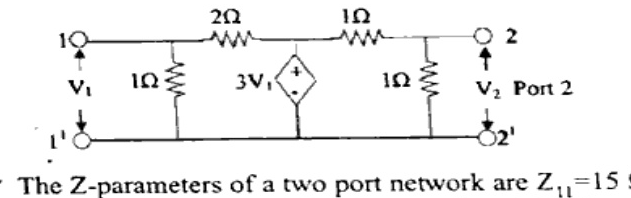
How to answer
- Apply open-circuit tests: $Z_{11}=V1/I1$, $Z_{21}=V2/I1$ with I2=0
- Apply $I1=0$ tests for $Z_{12}, Z_{22}$ including dependent source $3V1$
- Solve nodal equations for voltages
- Present 2x2 Z-matrix
-
7 MarksbThe Z-parameters of a two port network are $Z_{11}=15 \Omega$, $Z_{22}=24\Omega$, $Z_{12}=Z_{21}=6\Omega$. Determine ABCD and h-parameters.
How to answer
- Use conversion formulas $A=Z_{11}/Z_{21}$, $B=\Delta Z/Z_{21}$ etc.
- Compute $\Delta Z = Z_{11}Z_{22}-Z_{12}Z_{21}$
- Derive h-parameters $h_{11}=\Delta Z/Z_{22}$ etc.
- Give numerical ABCD and h values
-
14 MarksWrite a short notes on any Two
- i)Dual Networks
- ii)Terminated two port network
- iii)Network Topology
- iv)Tellegen's Theorem
How to answer
- Define chosen topics with principle/formulas
- Give circuit/topology example and diagram
- Mention applications and key relations
- Conclude with significance
Go to where you left off?
Quick Add to Notes
Save questions, your own notes and screenshots into notes filed by unit. It takes a free account.
Create free accountHave an account? Log in
Notes Panel