EX-304 · Network Analysis/Unsolved PYQ Paper
EX-304 Network Analysis - Jun 2023 Question Paper
Under each question, How to answer lists the points an answer should cover, outlined by CampusPrep from the syllabus. Check the details against your textbook.
-
7 MarksaState and explain Kirchhoff's voltage and current law with an example.
How to answer
- Statement of KVL: algebraic sum of voltages around closed loop is zero
- Statement of KCL: algebraic sum of currents at a node is zero
- Explanation with sign conventions
- Illustrative example circuit with calculations
-
7 MarksbDefine Graph, Tree, Basic tie set matrix and cut set matrix for a planar network with an example.
How to answer
- Definition of graph, oriented and planar graph
- Definition of tree, branch, link, twig
- Basic tie-set (f-loop) matrix B with example
- Basic cut-set matrix Q with example
-
7 MarksaFor a series resonant circuit with constant voltage and variable frequency, obtain the frequency at which voltage across the inductor is maximum. Calculate this maximum voltage when R=50 ohms, L= 0.05H, C = $20\mu F$ and V = 100 volts.
How to answer
- Impedance of series RLC and current expression vs frequency
- Voltage across inductor $V_L = I \cdot \omega L$ and condition $dV_L/d\omega=0$
- Derive frequency for maximum $V_L$
- Substitute R=50, L=0.05, C=20uF, V=100 to compute frequency and $V_{Lmax}$
-
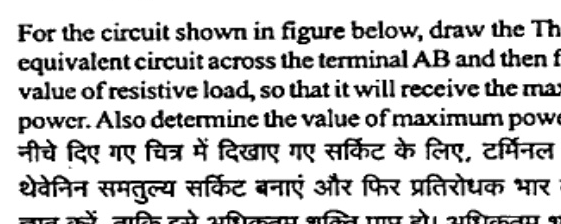
7 MarksbFind the current 'I' by using Norton's Theorem.
How to answer
- Identify load branch with current I (6 ohm resistor)
- Find Norton current by shorting load terminals
- Find Norton equivalent resistance
- Compute current through 6 ohm using current division
-
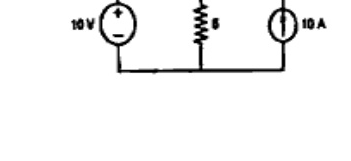
7 MarksaFor the circuit shown in figure below, draw the Thevenin equivalent circuit across the terminal AB and then find the value of resistive load, so that it will receive the maximum power. Also determine the value of maximum power.
How to answer
- Find open-circuit voltage $V_{th}$ across AB
- Find Thevenin resistance $R_{th}$ (deactivate 10V short, 10A open)
- Draw Thevenin equivalent with $V_{th}, R_{th}$
- Condition $R_L = R_{th}$ for max power and $P_{max}=V_{th}^2/4R_{th}$
-
7 MarksbState and explain the Tellegen's theorem with suitable example.
How to answer
- Statement of Tellegen's theorem: sum of instantaneous powers is zero
- Explanation based on KVL, KCL and energy conservation
- Illustrative example with branch voltages and currents verifying $\sum v_k i_k =0$
-
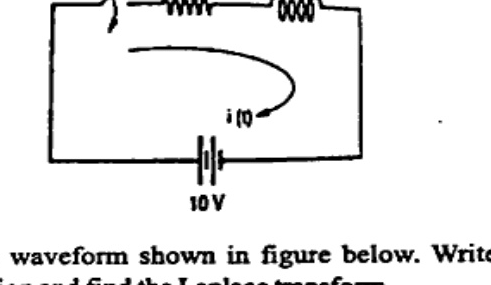
7 MarksaIn the circuit given below the switch is closed at t=0. By using Laplace transform find the current $i(t)$.
How to answer
- Write time-domain KVL equation for RL circuit with 10V source
- Take Laplace transform with zero initial current, switch closed at t=0
- Solve for $I(s)=10/[s(R+sL)]$
- Inverse Laplace to get $i(t)=5(1-e^{-4t})$ A
-
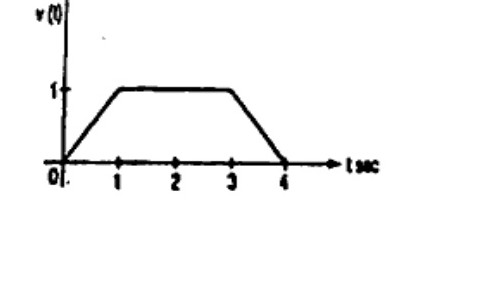
7 MarksbFor the waveform shown in figure below. Write the expression and find the Laplace transform
How to answer
- Describe trapezoidal waveform piecewise: ramp 0-1s, constant 1-3s, falling 3-4s
- Write $v(t)$ using unit step / ramp functions
- Take Laplace transform term by term
- Simplify to expression in $1/s^2$ with exponential shifts
-
7 MarksaState and explain Initial Value and Final value theorem.
How to answer
- Statement of initial value theorem $f(0+)=lim_{s\to\infty}sF(s)$
- Statement of final value theorem $f(\infty)=lim_{s\to 0}sF(s)$
- Conditions for existence (poles location)
- Simple example illustrating both
-
7 MarksbDraw the pole Zero diagram for the given network function I(s) and hence obtain $i(t)$ $$I(s) = 20s/[(s+5)(s+2)]$$
How to answer
- Identify zero at s=0 and poles at s=-5, -2
- Plot poles (x) and zero (o) on s-plane
- Partial fraction expansion of I(s)
- Inverse Laplace to obtain $i(t)$
-
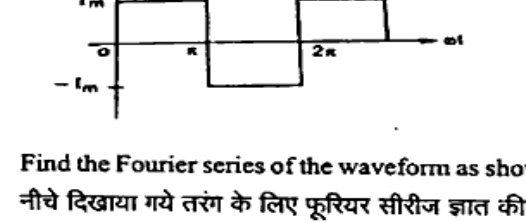
7 MarksaFind the Exponential Fourier series for the waveform as shown below.
How to answer
- Identify periodic square wave amplitude Im, period $2\pi$
- Formula for exponential coefficients $C_n = (1/T)\int i(t)e^{-jn\omega_0 t}dt$
- Evaluate $C_n$ for n=0 and n!=0
- Write series $i(t)=\sum C_n e^{jn\omega_0 t}$
-
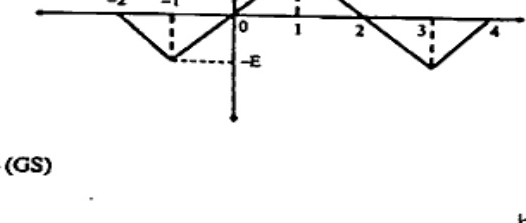
7 MarksbFind the Fourier series of the waveform as shown below
How to answer
- Identify triangular periodic waveform amplitude E, period 4
- Check odd/even symmetry to simplify coefficients
- Compute $a_n, b_n$ by integration
- Write trigonometric Fourier series
-
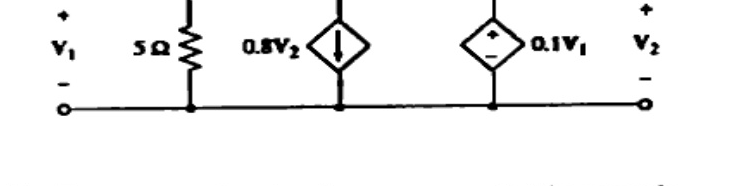
7 MarksaObtain both the impedance and admittance parameters for the two-port network.
How to answer
- Write port equations $V=ZI$ and $I=YV$
- Apply open/short tests with dependent sources $0.8V_2$ and $0.1V_1$
- Solve for $z_{11},z_{12},z_{21},z_{22}$
- Invert or solve for $y$-parameters
-
7 MarksbTwo two-port networks are connected in cascade. Prove that the overall transmission parameter matrix is the product of individual transmission parameter matrices.
How to answer
- Define transmission (ABCD) parameters for each two-port
- Write cascade connection constraints $V_{1b}=V_{2a}, I_{1b}=-I_{2a}$
- Matrix multiplication of individual ABCD matrices
- Conclude overall $[T]=[T_a][T_b]$
-
14 MarksWrite a short note on any Two:
- i)Dual Networks
- ii)Terminated two port network
- iii)Network Topology
- iv)Millman's Theorem
How to answer
- Select any two topics from i-iv
- Give definition, relevant formulas/circuit and significance for each
- Add suitable diagram/example
- Conclude with applications
Go to where you left off?
Quick Add to Notes
Save questions, your own notes and screenshots into notes filed by unit. It takes a free account.
Create free accountHave an account? Log in
Notes Panel