EX-304 · Network Analysis/Unsolved PYQ Paper
EX-304 Network Analysis - Dec 2024 Question Paper
Under each question, How to answer lists the points an answer should cover, outlined by CampusPrep from the syllabus. Check the details against your textbook.
-
7 MarksaDraw the parallel resonant circuit and derive the expression for resonant frequency.
How to answer
- Parallel resonant circuit diagram with R-L-C in parallel across source
- Admittance expression $Y = 1/R + j(\omega C - 1/\omega L)$
- Resonance condition $Im(Y)=0$ and derivation steps
- Expression for resonant frequency $f_0 = (1/2\pi)\sqrt{1/LC - R^2/L^2}$ or ideal $1/2\pi\sqrt{LC}$
-
7 MarksbState and explain KCL and KVL with example.
How to answer
- Statement of KCL: algebraic sum of currents at node is zero
- Statement of KVL: algebraic sum of voltages around loop is zero
- Illustrative example circuit for each
- Equations for example
-
7 MarksaDefine Graph, oriented graph, Twigs and Cut set matrix.
How to answer
- Definition of graph in network topology
- Definition of oriented/directed graph
- Definition of twigs with respect to tree
- Definition of cut-set matrix
-
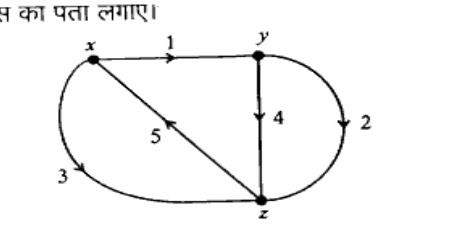
7 MarksbWhat is incidence matrix? Find the complete incidence matrix for the graph shown in figure.
How to answer
- Definition of incidence matrix with entries 1, -1, 0
- Identification of nodes x, y, z and oriented branches 1-5 from figure
- Construction of rows for nodes vs columns for branches
- Complete $(3 \times 5)$ incidence matrix
-
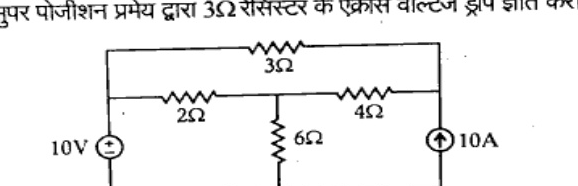
7 MarksaFind the voltage drop across $3\Omega$ resistor by superposition theorem.
How to answer
- Superposition theorem steps: consider one source at a time
- Voltage contribution due to 10V source alone with 10A open
- Voltage contribution due to 10A source alone with 10V shorted
- Algebraic sum to get voltage drop across $3\Omega$
-
7 MarksbState and explain the Norton theorem with example.
How to answer
- Statement of Norton theorem: equivalent current source in parallel with resistance
- Steps to find $I_N$ and $R_N$
- Illustrative example circuit with calculation
- Source conversion relation to Thevenin
-
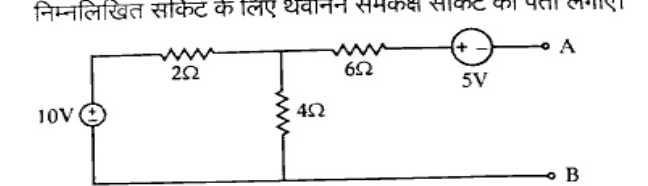
7 MarksaFind the Thevenin equivalent circuit for the following circuit.
How to answer
- Find open-circuit voltage Vth between A-B
- Find equivalent resistance Rth seen from A-B
- Include 5V source effect in Vth and Rth
- Draw Thevenin equivalent $V_{th}$ in series with $R_{th}$ across A-B
-
7 MarksbState and explain maximum power transfer theorem for DC network.
How to answer
- Statement of maximum power transfer theorem for DC
- Condition $R_L = R_{th}$ for maximum power
- Derivation $P = I^2 R_L$ and $dP/dR_L=0$
- Expression for $P_{max} = V_{th}^2/4R_{th}$
-
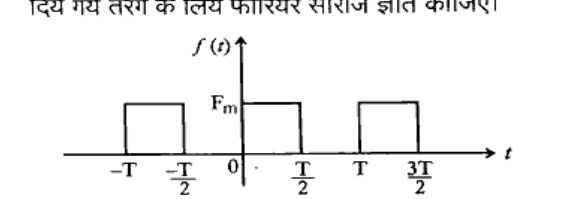
7 MarksaFind the Fourier series for the given waveform.
How to answer
- Identify periodic rectangular waveform with amplitude Fm and period T
- Determine symmetry and Fourier coefficients a0, an, bn
- Evaluate integrals over 0 to T/2 etc.
- Write trigonometric Fourier series
-
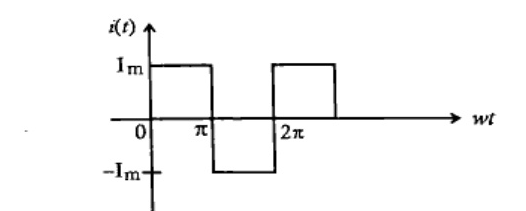
7 MarksbFind the exponential Fourier series for the given waveform.
How to answer
- Identify square wave i(t) with amplitude Im vs wt
- Formula for exponential coefficients $C_n$
- Evaluation over 0 to 2pi
- Write series $i(t)=\sum C_n e^{jnwt}$
-
7 MarksaFind the value of $i(0)$ using initial value theorem for the function $I(s) = \frac{2s+3}{(s+1)(s+3)}$
How to answer
- Initial value theorem $i(0^+)=\lim_{s\to\infty}sI(s)$
- Substitute $I(s) = (2s+3)/((s+1)(s+3))$
- Evaluate limit as $s\to\infty$
- Result $i(0)=2$
-
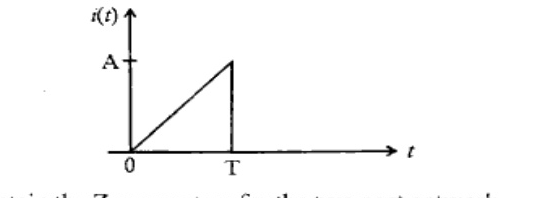
7 MarksbWrite the expression and find the Laplace transform for the waveform shown in figure below.
How to answer
- Time-domain expression $i(t) = (A/T)t$ for $0<t<T$
- Laplace transform of ramp using $L[t u(t)]$
- Apply time-shifting / gate function
- Result $I(s)$ expression
-
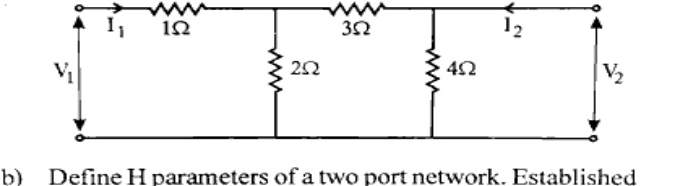
7 MarksaObtain the Z parameters for the two port network.
How to answer
- Z-parameter definitions $V_1=Z_{11}I_1+Z_{12}I_2$, $V_2=Z_{21}I_1+Z_{22}I_2$
- Open-circuit tests to find $Z_{11}, Z_{22}, Z_{12}=Z_{21}$
- Simplify 1-2-3-4 ohm network
- Numerical Z-matrix
-
7 MarksbDefine H parameters of a two port network. Established the relation between H parameters and ABCD parameters.
How to answer
- Definitions of H parameters $V_1=h_{11}I_1+h_{12}V_2$, $I_2=h_{21}I_1+h_{22}V_2$
- Definitions of ABCD parameters
- Algebraic conversion from one set to other
- Final relations for A,B,C,D in terms of h
-
14 MarksWrite short notes on any two:
- i)Controlled sources
- ii)Millman's theorem
- iii)Y parameters
How to answer
- Brief definition and concept of first chosen topic
- Relevant formula or circuit diagram
- Key points and application
- Brief coverage of second chosen topic similarly
Go to where you left off?
Quick Add to Notes
Save questions, your own notes and screenshots into notes filed by unit. It takes a free account.
Create free accountHave an account? Log in
Notes Panel