EX-304 · Network Analysis/Unsolved PYQ Paper
EX-304 Network Analysis - Dec 2023 Question Paper
Under each question, How to answer lists the points an answer should cover, outlined by CampusPrep from the syllabus. Check the details against your textbook.
-
7 MarksaUse mesh analysis to find current $i_o$ in the figure.
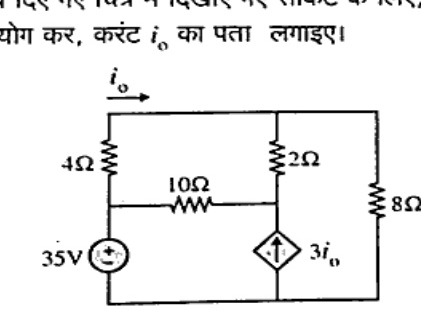
How to answer
- Define mesh currents and write KVL for each mesh
- Incorporate dependent source 3i_o constraint relating mesh currents
- Solve mesh equations for i_o
- State final value of i_o with direction
-
7 MarksbFor the network shown in below Figure below find $Z_{ab}$ and $I_o$.
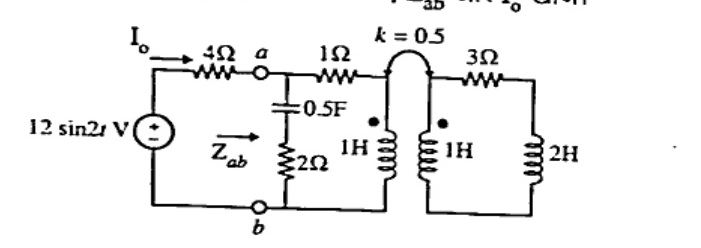
How to answer
- Convert to phasor domain at omega=2: L to jwL, C to 1/jwC
- Compute mutual impedance jwM with k=0.5
- Find reflected impedance from secondary to primary
- Compute Z_ab as parallel of capacitor branch and coupled-coil branch plus series terms and then I_o = V/Z_total
-
7 MarksaDefine and explain the following with an example:
- i)Oriented Graph
- ii)Tree of a Graph
- iii)Tie set and a basic Tie set
How to answer
- Define oriented graph with directed branches and example
- Define tree: connected, acyclic subgraph covering all nodes with example
- Define tie-set and basic tie-set with respect to a tree with example
- Give small graph sketches illustrating each
-
7 MarksbIn the network shown in the figure, the switch is closed at $t = 0$ and there is no initial charge on either of the Capacitors. Find the current $i(t)$
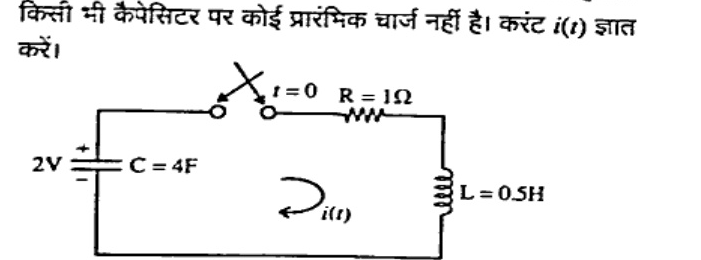
How to answer
- Draw circuit for t>0 with initial conditions zero
- Write integro-differential equation for i(t) or s-domain equation
- Solve using Laplace / time-domain for series RLC with DC excitation
- State i(t) expression showing damped nature
-
7 MarksaState and explain Thevenin's theorem with an example.
How to answer
- State Thevenin statement: Vth in series with Zth
- Explain steps to find Vth and Zth
- Give simple example circuit with calculation
- Mention source transformation / load connection
-
7 MarksbCompute the current in 23 ohm resistor using super position theorem for the circuit shown.
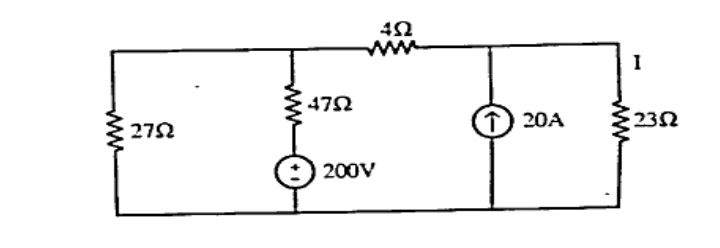
How to answer
- Consider 200V alone (open current source) and find partial current
- Consider 20A alone (short voltage source) and find partial current
- Add algebraically for total current in 23 ohm
- State final magnitude and direction
-
7 MarksaShow that under the condition of maximum power transfer, the efficiency of the circuit is $50\%$.
How to answer
- Write power to load P = I^2 R_L with source R_s
- Differentiate dP/dR_L = 0 to get R_L = R_s condition
- Compute efficiency eta = P_out / P_in = 0.5
- Conclude 50% efficiency at max power
-
7 MarksbFor an RC series circuit, a sinusoidal voltage $V(t) = V_m \sin \omega t$ is applied at $t = 0$. Find the expression for transient current using Laplace transform approach.
How to answer
- Write time-domain KVL for RC with Vm sin wt
- Take Laplace transform with zero initial condition
- Solve for I(s) and take inverse Laplace
- Separate transient vs steady-state terms
-
7 MarksaState and explain Initial Value and Final value theorem.
How to answer
- State initial value theorem formula limit s->infinity
- State final value theorem formula limit s->0
- Explain conditions for existence (poles)
- Give example application
-
7 MarksbR-C series circuit is suddenly excited from a step voltage V. Derive an expression for the current as a function of time and draw the graph current Vs Time.
How to answer
- Write KVL V = Ri + (1/C) integral i
- Solve first-order ODE with step input
- Obtain i(t) = (V/R) e^{-t/RC}
- Sketch exponentially decaying current vs time
-
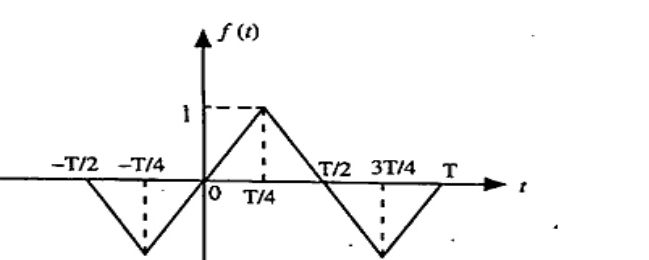
7 MarksaDetermine the Fourier series expansion (Trigonometrical form) for the wave form as shown in figure.
How to answer
- Identify period T and symmetry of triangular wave
- Compute a0, an, bn integrals over period
- Write trigonometric Fourier series sum
- Mention odd/even harmonic content
-
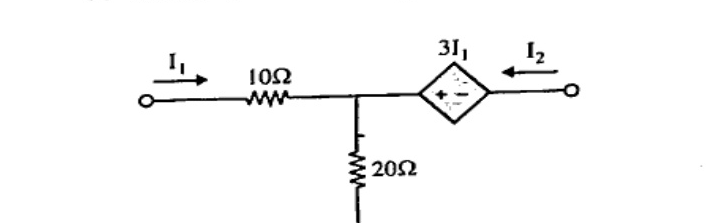
7 MarksbFind the transmission parameters of the following two port network.
How to answer
- Write port equations with 10 ohm, 20 ohm shunt and dependent source 3I1
- Apply open/short conditions to find A,B,C,D
- Solve for V1, I1 in terms of V2, -I2
- Present ABCD matrix
-
7 MarksaA two port network has the Z-parameters $Z_{11} = 20\Omega$, $Z_{22} = 30\Omega$ and $Z_{12} = Z_{21} = 40\Omega$ then find the ABCD and h-parameters for the network.
How to answer
- Recall Z to ABCD and Z to h conversion formulas
- Substitute Z11=20, Z22=30, Z12=Z21=40
- Compute determinant Delta_Z
- Simplify to A,B,C,D and h11,h12,h21,h22
-
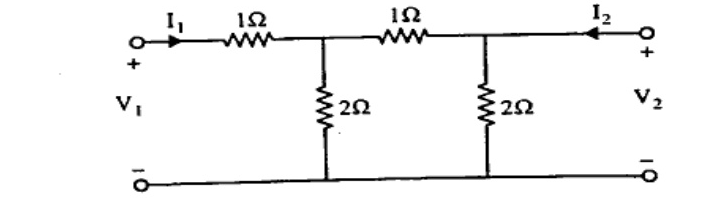
7 MarksbFind the Z-parameters for the network shown in figure.
How to answer
- Apply open-circuit tests: I1=0, I2=0
- Compute V1/I1, V2/I1 with output open etc.
- Use voltage division in 1 ohm-2 ohm ladder
- Assemble 2x2 Z matrix
-
14 MarksWrite a short notes on any two
- i)Incidence Matrix
- ii)Substitution Theorem
- iii)Short Circuit Admittance Parameters
- iv)Terminated Two Port Network
How to answer
- Choose any two topics from four
- Give definition, formulas/matrix and brief explanation for each
- Add small example or circuit illustration
- Conclude with application
Go to where you left off?
Quick Add to Notes
Save questions, your own notes and screenshots into notes filed by unit. It takes a free account.
Create free accountHave an account? Log in
Notes Panel