EX-304 · Network Analysis/Unsolved PYQ Paper
EX-304 Network Analysis - Jun 2024 Question Paper
Under each question, How to answer lists the points an answer should cover, outlined by CampusPrep from the syllabus. Check the details against your textbook.
-
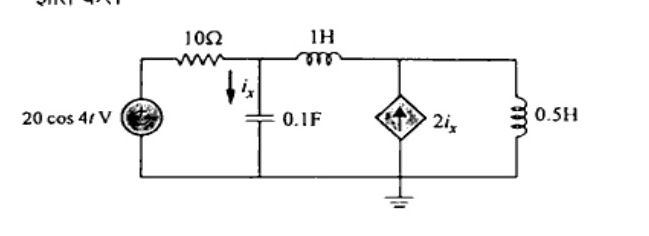
7 MarksaFind the current $i_x$ in the circuit shown below by using nodal analysis.
How to answer
- Convert to phasor domain at $\omega=4$ rad/s: $j\omega L$, $1/j\omega C$.
- Write nodal equations at non-reference nodes including supernode/dependent source $2i_x$.
- Express $i_x$ in terms of node voltage.
- Solve for phasor $I_x$ and write $i_x(t)$ in time domain.
-
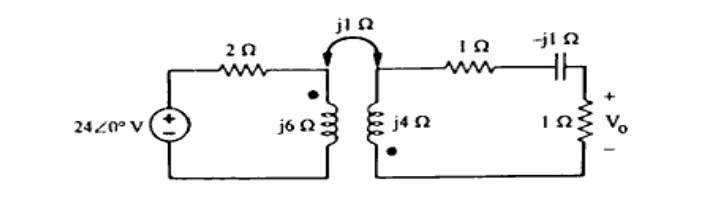
7 MarksbFor the circuit in figure find $V_o$.
How to answer
- Write mesh equations with mutual term $j\omega M=j1\,\Omega$.
- Account for dot convention for sign of mutual voltage.
- Solve primary and secondary mesh currents.
- Compute $V_o = I_2 \times 1\,\Omega$ magnitude and phase.
-
7 MarksaExplain the following with an example:
- i)Tree and Co-Tree
- ii)Twigs and Links
How to answer
- Define graph, tree with n-1 branches.
- Define co-tree as remaining links.
- Give example graph and identify twigs vs links.
- State number of twigs and links relation.
-
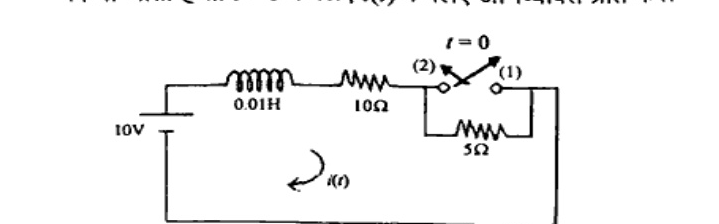
7 MarksbIn the circuit shown in Figure, the switch is initially in position 1 for a long time. Derive the expression for $i(t)$ for $t > 0$ if the switch is transferred to position 2 at $t = 0$.
How to answer
- Find inductor current at $t=0^-$ with switch at 1 for long time (steady DC).
- Apply $i_L(0^+)=i_L(0^-)$ for $t>0$ circuit with switch at 2.
- Form RL first-order equation and time constant $\tau=L/R_{eq}$.
- Write $i(t)=i(\infty)+[i(0)-i(\infty)]e^{-t/\tau}$ for $t>0$.
-
7 MarksaState and explain the Norton's theorem for A.C excitation with suitable example.
How to answer
- State Norton theorem for AC: equivalent current source in parallel with impedance.
- Explain steps to find $I_N$ and $Z_N$.
- Give AC example with phasor calculation.
- Show equivalent circuit.
-
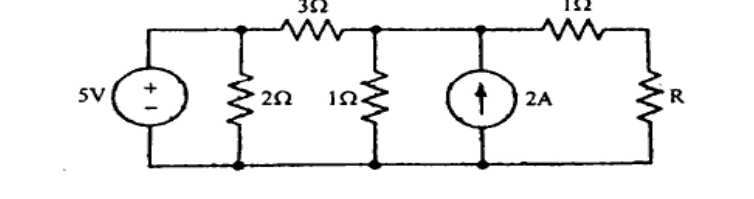
7 MarksbFind the value of R in the circuit shown in figure such that maximum power transfer takes place. What is the amount of this power?
How to answer
- Find Thevenin equivalent seen from terminals of R.
- Set $R=R_{Th}$ for maximum power transfer.
- Compute $P_{max}=V_{Th}^2/4R_{Th}$.
- State numerical values of R and power.
-
7 MarksaVerify the Tellegen's theorem for the circuit shown.
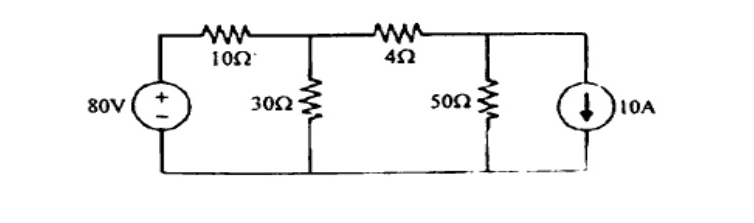
How to answer
- Compute branch voltages and currents (80V source, 10,30,4,50 ohm, 10A source).
- Evaluate $\sum v_k i_k$ for all branches with sign.
- Show algebraic sum equals zero.
- Conclude Tellegen's theorem verified.
-
7 MarksbUsing Laplace Transform, solve for the current i(t) in the RLC circuit. The capacitor is initially charged to a voltage of 2V.
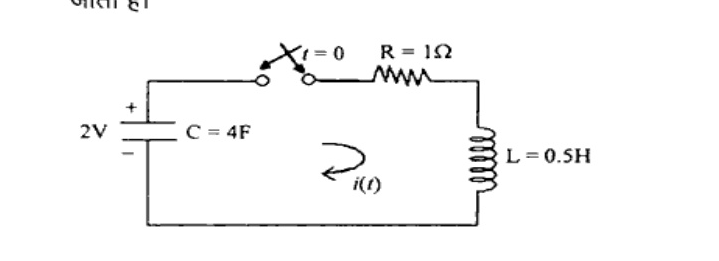
How to answer
- Draw s-domain circuit with initial capacitor voltage 2V.
- Write KVL equation $I(s)[R+sL+1/sC]=V_{C}(0)/s$ form.
- Take inverse Laplace to get damped $i(t)$.
- Substitute R=1, L=0.5H, C=4F values.
-
7 MarksaDetermine the initial and final values of the current where $$I(S) = \frac{0.42}{S(S^2 + 0.35s + 0.816)}$$
How to answer
- Apply initial value theorem $i(0^+)=\lim_{s\to\infty}sI(s)$.
- Apply final value theorem $i(\infty)=\lim_{s\to 0}sI(s)$.
- Substitute $I(S)=0.42/[S(S^2+0.35s+0.816)]$.
- Give numerical initial and final currents.
-
7 MarksbR-C series circuit is suddenly excited from a step voltage V. Derive an expression for the current as a function of time and draw the graph current Vs Time
How to answer
- Write KVL for step V applied to R-C series with zero initial charge.
- Solve first-order equation for $q(t)$ and $i(t)=(V/R)e^{-t/RC}$.
- Explain time constant.
- Sketch exponentially decaying current vs time starting at V/R.
-
7 MarksaFor the given triangular wave form, determine the Fourier series expansion.
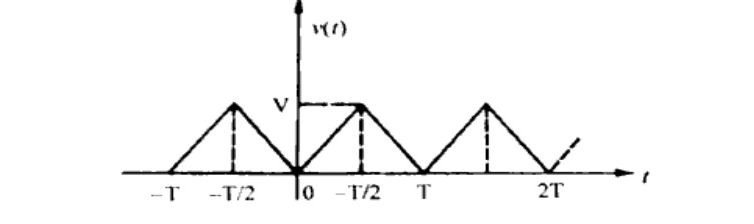
How to answer
- Describe triangular periodic waveform period T, peak V.
- Use symmetry to find Fourier coefficients $a_0, a_n, b_n$.
- Show only cosine terms with $1/n^2$ dependence.
- Write final series expansion.
-
7 MarksbDetermine the 'h' parameters of the network shown in figure. https://www.rgpvonline.com
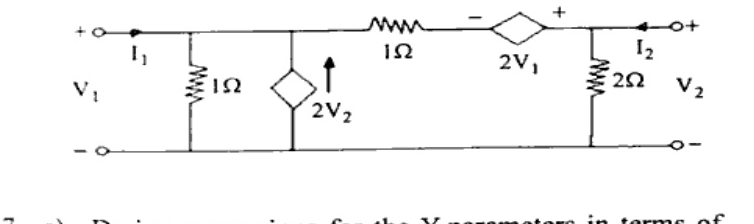
How to answer
- Write port equations $V_1, I_1$ in terms of $V_2, I_2$.
- Apply $V_2=0$ and $I_1=0$ conditions for h-parameters.
- Solve with dependent sources $2V_2$ and $2V_1$.
- Present $h_{11}, h_{12}, h_{21}, h_{22}$.
-
7 MarksaDerive expressions for the Y-parameters in terms of ABCD parameters of a two-port network.
How to answer
- Start from ABCD definitions $V_1=AV_2-BI_2$, $I_1=CV_2-DI_2$.
- Invert to express $I_1, I_2$ in terms of $V_1, V_2$.
- Identify $Y_{11}, Y_{12}, Y_{21}, Y_{22}$ in terms of A,B,C,D.
- State determinant $\Delta=AD-BC$ role.
-
7 MarksbA typical two-port network is characterized by the equation $2V_1 + 4 I_2 = I_1$ $V_2 + 6V_1 = 8 I_2$ Determine:
- i)$y_{11}$
- ii)$z_{12}$
- iii)$h_{21}$
- iv)C
How to answer
- Rewrite given equations in standard y, z, h forms.
- Compute $y_{11}=I_1/V_1|_{V_2=0}$ etc.
- Compute $z_{12}$ and $h_{21}$.
- Compute transmission parameter C.
-
14 MarksWrite a short notes on any Two:
- i)Cut Set Matrix
- ii)Compensation Theorem
- iii)Open Circuit Impedance Parameters
- iv)Terminated Two Port Network
How to answer
- Select any two topics from list.
- Give definition, statement or matrix where applicable.
- Explain with example/diagram.
- State applications.
Go to where you left off?
Quick Add to Notes
Save questions, your own notes and screenshots into notes filed by unit. It takes a free account.
Create free accountHave an account? Log in
Notes Panel