EX-304 · Network Analysis/Unsolved PYQ Paper
EX-304 Network Analysis - Dec 2025 Question Paper
Under each question, How to answer lists the points an answer should cover, outlined by CampusPrep from the syllabus. Check the details against your textbook.
-
7 MarksaExplain the characteristics of basic circuit elements R, L, and C. Discuss linearity, time dependency, and the voltage-current relationships of each element in detail.
How to answer
- Define R, L, C with v-i relations: v=Ri, v=L di/dt, i=C dv/dt
- Linearity: R linear, L/C linear if constant; time-dependency and memory
- Energy storage vs dissipation and initial conditions
-
7 MarksbExplain the concepts of network topology. Define and explain graph, tree, branch, cut-set matrix, and dual networks with suitable examples.
How to answer
- Define network graph, tree, branch with example diagrams
- Define cut-set and cut-set matrix with example
- Define dual networks with construction example
-
7 MarksaExplain the concept of transients in electrical circuits. Derive the transient response of RC and RL circuits for step input excitation.
How to answer
- Define transients: switching, initial/final conditions
- Derive RC step response: vc = Vs(1-e^(-t/RC))
- Derive RL step response: i = Vs/R(1-e^(-Rt/L)) with time constants
-
7 MarksbIdentify the node voltages in the circuit shown in figure.
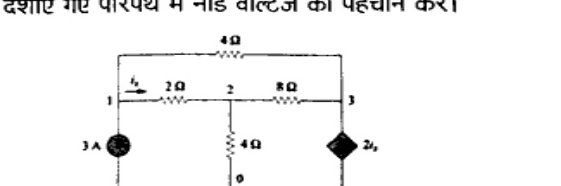
How to answer
- Mark nodes 1,2,3 with 0 as reference ground
- Write KCL nodal equations including 3A source and dependent source
- Solve for node voltages V1, V2, V3
-
7 MarksaExplain the concept of resonance in electrical circuits. Discuss series resonance and parallel resonance with frequency response characteristics.
How to answer
- Define resonance and resonant frequency
- Discuss series resonance: impedance minimum, voltage magnification
- Discuss parallel resonance: admittance minimum, current magnification with frequency response
-
7 MarksbCalculate the mesh current $i_1$ and $i_2$ in the circuit shown in figure.
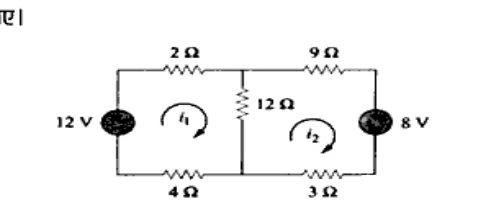
How to answer
- Write KVL mesh equations for i1 and i2 with 12 ohm common resistor
- Solve two simultaneous equations
- Obtain numerical values of i1 and i2 with directions
-
7 MarksaExplain Maximum Power Transfer Theorem. Derive the condition for maximum power transfer in DC and AC circuits.
How to answer
- State Maximum Power Transfer Theorem
- Derive condition for DC: RL = Rth
- Derive condition for AC: ZL = Zth* for maximum average power
-
7 MarksbExplain Millman's theorem and Tellegen's theorem. Discuss their significance in network analysis.
How to answer
- State Millman's theorem with formula for parallel sources
- State Tellegen's theorem: sum v_k i_k = 0
- Discuss significance in network simplification and power balance
-
7 MarksaState and prove the initial value theorem and final value theorem of Laplace transform. Discuss their applications.
How to answer
- State initial value theorem: x(0+)=lim sX(s)
- Prove using Laplace differentiation property
- State and prove final value theorem and mention applications/conditions
-
7 MarksbFind $i_o$ in the circuit shown in figure using Superposition Theorem.
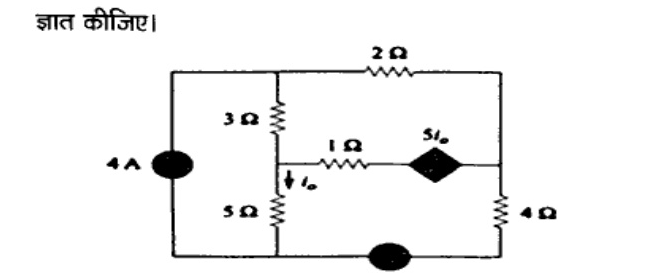
How to answer
- Consider 4A source alone and 20V source alone with dependent source retained
- Calculate partial i_o' and i_o'' using nodal/mesh analysis
- Add algebraically to get total i_o
-
7 MarksaExplain trigonometric and exponential forms of Fourier series. Compare the two representations and discuss their applications.
How to answer
- Write trigonometric Fourier series with a0, an, bn
- Write exponential form with complex coefficients Cn
- Compare: real vs complex, symmetry, applications in spectra and analysis
-
7 MarksbFind out the Laplace transform for the given signal and calculate the ROC. $$x(t) = t e^{-2|t|}$$
How to answer
- Split x(t)=t e^{-2|t|} into t>0 and t<0 parts
- Evaluate Laplace integral to get X(s)
- Determine ROC from convergence of both sides
-
7 MarksaExplain two-port network parameters. Derive the equations for ABCD, and hybrid parameters.
How to answer
- Define Z, Y, ABCD, h two-port equations
- Derive ABCD transmission equations
- Derive hybrid h-parameter equations and mention conversions
-
7 MarksbObtain the Y parameters for the circuit shown in figure.
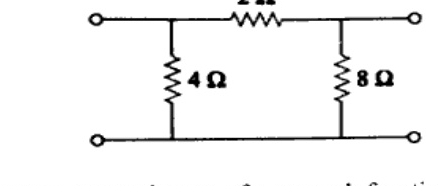
How to answer
- Apply short-circuit tests: V1=0, V2=0
- Calculate Y11, Y12, Y21, Y22 using 4 ohm, 2 ohm, 8 ohm network
- Write 2x2 Y matrix
-
7 MarksaExplain poles and zeros of a network function. Discuss their significance in determining system stability and frequency response.
How to answer
- Define poles and zeros of network function N(s)
- Explain pole locations vs stability
- Explain effect on frequency/magnitude-phase response
-
7 MarksbFind out the Fourier Transform of $x(t)=e^{-at} u(t)$. Also draw the magnitude and phase spectrum of the output.
How to answer
- Evaluate Fourier integral for e^{-at}u(t) to get 1/(a+jw)
- Derive magnitude spectrum 1/sqrt(a^2+w^2)
- Derive phase spectrum -arctan(w/a) and sketch both vs frequency
Go to where you left off?
Quick Add to Notes
Save questions, your own notes and screenshots into notes filed by unit. It takes a free account.
Create free accountHave an account? Log in
Notes Panel