ME-502 · Mechanical Vibrations/Unsolved PYQ Paper
ME-502 Mechanical Vibration - Nov 2023 Question Paper
Under each question, How to answer lists the points an answer should cover, outlined by CampusPrep from the syllabus. Check the details against your textbook.
-
7 MarksaWhat are main causes of vibrations?
How to answer
- Definition of vibration and need to identify excitation sources
- Internal causes: unbalance, misalignment, looseness, bearing defects
- External causes: external excitation, resonance, aerodynamic/hydrodynamic forces
- Examples from machines, vehicles and structures
-
7 MarksbDefine degree of freedom of a system. Give examples of different types of degree of freedom system.
How to answer
- Definition of degree of freedom as number of independent coordinates
- Concept of discrete vs continuous systems
- Examples: single DOF, two DOF, multi DOF
- Illustrative examples: pendulum, spring-mass, beam
-
14 MarksA harmonic force $F_0 \sin \omega t$ acts on a displacement $x_0 \sin\left(\omega t - \pi/3\right)$. If $F_0 = 100 N, x_0 = 0.02 m$ and $\omega = 2\pi$ rad/sec. Find the work done during
- i)First cycle
- ii)The first second
- iii)The first quarter second
How to answer
- Expression for work $dW = F dx = F \dot{x} dt$
- Substitute $F_0\sin\omega t$ and $x_0\sin(\omega t-\pi/3)$
- Integrate over required time limits for cycle, 1 sec, 0.25 sec
- Evaluate numerical values using $F_0=100 N, x_0=0.02 m, \omega=2\pi$
-
14 MarksFind the natural frequency of torsional oscillations for the system shown in Fig.1. Take $G = 0.83\times 10^{11}$ N/m$^2$ and neglect the inertia effect of the shaft.
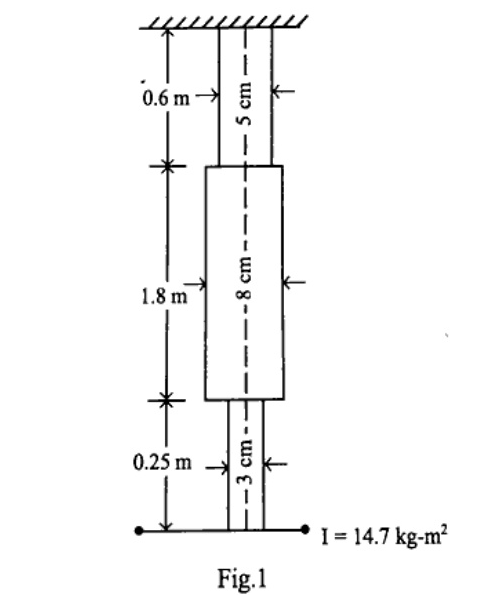
How to answer
- Model as torsional system with shaft stiffnesses in series/parallel
- Torsional stiffness $k_t = GJ/L$ with $J = \pi d^4/32$
- Equivalent stiffness of stepped shaft and mass moment of inertia
- Natural frequency $\omega_n = \sqrt{k_{eq}/I}$
-
7 MarksaWhat is viscous damping? Explain.
How to answer
- Definition of viscous damping: force proportional to velocity
- Damping force $F = c \dot{x}$ and damping coefficient
- Energy dissipation per cycle
- Examples: fluid film, dashpot
-
7 MarksbA damper offers resistance 0.05 N at constant velocity of 0.04 m/sec. The damper is used with k = 9 N/m. Determine the damping and frequency of the system when the mass of system is 0.1 kg.
How to answer
- Damping coefficient from $c = F/v$
- Natural frequency $\omega_n = \sqrt{k/m}$
- Critical damping $c_c = 2m\omega_n$ and damping ratio
- Damped frequency $\omega_d = \omega_n\sqrt{1-\zeta^2}$
-
7 MarksaDefine critical speed of a system.
How to answer
- Definition of critical speed as speed at resonance
- Relation to natural frequency of rotating shaft
- Danger of large deflection at critical speed
- Significance for design and operation
-
7 MarksbThe damped natural frequency of a system as obtained from a free vibration test is 10.5 Hz. During the forced vibration test with constant excitation force the maximum amplitude of vibration is found to be 9.5 Hz. Find the damping factor and it's natural frequency.
How to answer
- Relation $\omega_d = \omega_n\sqrt{1-\zeta^2}$ from free vibration
- Resonance peak frequency $\omega_r = \omega_n\sqrt{1-2\zeta^2}$ = 9.5 Hz
- Solve two equations for damping factor $\zeta$
- Compute undamped natural frequency $\omega_n$
-
14 MarksFind the natural frequency of the car with following conditions: Total mass of car = 300 kg, wheel base = 3.0 m centre of gravity of the car is 1.5 m from the front axle, radius of gyration is 1.0 m and spring constants of front and rear springs are $70\times 10^3$ N/m each.
How to answer
- Two-DOF pitch-bounce model of car with front and rear springs
- Equations for bounce and pitch using CG position and radius of gyration
- Stiffness matrix with $k_f, k_r$ and mass/inertia $m, I = mk^2$
- Eigenvalues give two natural frequencies
-
7 MarksaDiscuss response of human to noise.
How to answer
- Effects of noise on hearing, comfort and health
- Frequency and level dependence of human perception
- Criteria: loudness, annoyance, damage risk
- Permissible exposure limits
-
7 MarksbWhat precautions and remedies are adopted to avoid noise of machines?
How to answer
- Source control: balancing, isolation, maintenance
- Path control: enclosures, absorbers, barriers
- Receiver control: PPE, exposure limits
- Design and maintenance remedies
-
14 MarksWrite short notes on any two:
- a)Energy method of solving vibration problem
- b)Solid and structural damping
- c)Dynamic vibration absorber
- d)Measurement of noise
How to answer
- Select any two topics with definition and principle
- Relevant formulas / working / applications
- Advantages, limitations and examples
- Neat sketch where applicable
Go to where you left off?
Quick Add to Notes
Save questions, your own notes and screenshots into notes filed by unit. It takes a free account.
Create free accountHave an account? Log in
Notes Panel