ME-502 · Mechanical Vibrations/Unsolved PYQ Paper
ME-502 Mechanical Vibration - Jun 2025 Question Paper
Under each question, How to answer lists the points an answer should cover, outlined by CampusPrep from the syllabus. Check the details against your textbook.
-
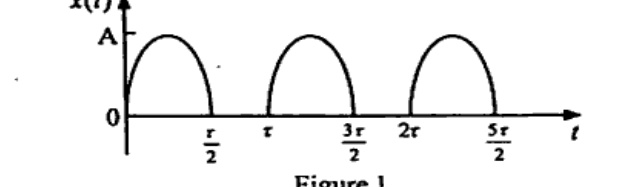
7 MarksaThe impact force created by a forging hammer can be modeled as shown in Fig.1. Determine the Fourier series expansion of the impact force.
How to answer
- Identify periodic impact force $x(t)$ with period $\tau$ from Fig.1: half-sine pulses of amplitude $A$.
- Write Fourier series $x(t)=a_0/2+\sum a_n\cos n\omega t + b_n\sin n\omega t$ with $\omega=2\pi/\tau$.
- Evaluate coefficients by integration over 0 to $\tau$.
- Present final expansion for the repeated half-sine.
-
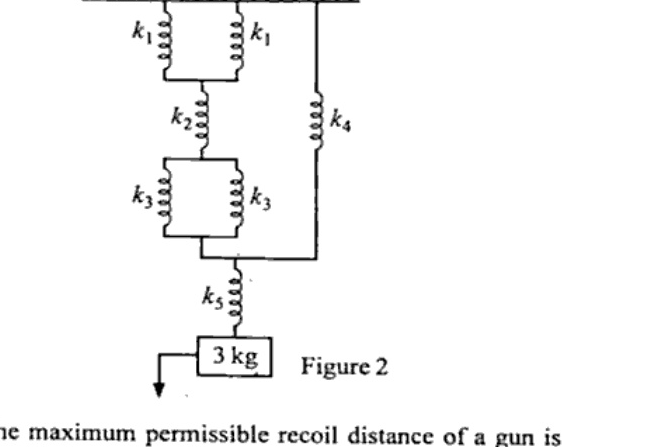
7 MarksbDetermine the natural frequency of undamped single degree of freedom as shown in Fig.2. Assume the values of stiffness $k_1 = 1 N/m, k_2 = 2 N/m, k_3 = 1 N/m, k_4 = 4 N/m, k_5 = 6 N/m$.
How to answer
- Reduce series-parallel spring combination to equivalent stiffness $k_{eq}$.
- Identify $k_1$ in parallel, $k_3$ in parallel, then series-parallel steps with $k_2, k_4, k_5$.
- Use $\omega_n = \sqrt{k_{eq}/m}$ with $m=3\,kg$.
- Substitute $k_1=1, k_2=2, k_3=1, k_4=4, k_5=6\,N/m$ and compute frequency in rad/s and Hz.
-
7 MarksaThe maximum permissible recoil distance of a gun is specified as 0.5 m. If the initial recoil velocity is 10 m/s, find the spring stiffness of the recoil mechanism. Assume that a critically damped dashpot is used in the recoil mechanism and the mass of the gun has to be 500 kg.
How to answer
- Write equation for critically damped system $\zeta=1$ with initial velocity.
- Use $x(t)=(x_0+(v_0+\omega_n x_0)t)e^{-\omega_n t}$ with $x_0=0$.
- Maximize $x(t)$: set $\dot{x}=0$ to get $t_{max}=1/\omega_n$.
- Solve $x_{max}=v_0/(e\omega_n)=0.5$ for $\omega_n$ then $k=m\omega_n^2$.
-
7 MarksbA viscously damped system has a stiffness of 5,000 N/m, critical damping constant of 0.2 Ns/mm, and a logarithmic decrement of 2.0. If the system is given an initial displacement of 0 and velocity of 1 m/s, determine the maximum displacement of the system.
How to answer
- Compute $\omega_n=\sqrt{k/m}$, $c_c$, damping ratio $\zeta$ from logarithmic decrement $\delta=2.0$.
- Find damped natural frequency $\omega_d=\omega_n\sqrt{1-\zeta^2}$.
- Write free response with $x_0=0, \dot{x}_0=1\,m/s$.
- Differentiate and set to zero to obtain $x_{max}$.
-
7 MarksaDefine the term magnification factor. Derive the expression for magnification factor of spring mass damper system subjected to sinusoidal harmonic force $F = F_0 \sin \omega t$.
How to answer
- Define magnification factor as ratio of dynamic to static amplitude.
- Write equation $m\ddot{x}+c\dot{x}+kx=F_0\sin\omega t$.
- Assume steady-state harmonic solution and derive amplitude.
- Express $M=1/\sqrt{(1-r^2)^2+(2\zeta r)^2}$ with $r=\omega/\omega_n$.
-
7 MarksbThe spring of an automobile trailer are compressed 0.1 m under its own weight. Find the critical speed when the trailer is travelling over a road with a profile approximated by a sine wave of amplitude 0.08 m and wave length of 14 meters. What will be the amplitude of vibration at 60 km/hour?
How to answer
- Find $\omega_n=\sqrt{g/\delta_{st}}$ from static deflection 0.1 m.
- Critical speed corresponds to resonance: excitation frequency equals $\omega_n$.
- Relate vehicle speed $V$ to excitation $\omega=2\pi V/\lambda$ with $\lambda=14\,m$.
- Compute vibration amplitude at 60 km/hour using magnification factor for undamped/base excitation.
-
14 MarksA heavy machine, weighting 3000 N, is supported on a resilient foundation. The static deflection of the foundation due to the weight of the machine is found to be 7.5 cm. It is observed that the machine vibrates with an amplitude of 1 cm when the base of the foundation is subjected to harmonic oscillation at the undamped natural frequency of the system with an amplitude of 0.25 cm. Find:
- i)the damping constant of the foundation.
- ii)the dynamic force amplitude on the base, and
- iii)the amplitude of the displacement of the machine relative to the base.
How to answer
- Compute $\omega_n=\sqrt{g/\delta_{st}}$ from static deflection 7.5 cm.
- Use base excitation transmissibility $X/Y$ at $r=1$ to solve for $\zeta$ and $c$.
- Compute transmitted force amplitude $F_T$ using transmissibility.
- Compute relative displacement $Z = X-Y$ phasor magnitude.
-
14 MarksFind the total response of a single-degree-of-freedom system with $m = 10 kg, c = 20 N-s/m, k = 4000 N/m, x_0 = 0.01 m,$ and $\dot{x}_0 = 0$ under the following conditions:
- a)An external force $F_t = F_0 \cos \omega t$ acts on the system with $F_0 = 100 N$ and $\omega = 10 rad/s$.
- b)Free vibration response with $F(t) = 0$.
How to answer
- Compute $\omega_n, \zeta, \omega_d$ from $m,c,k$.
- Write total response = transient + steady-state for forced case.
- Apply $x_0=0.01\,m, \dot{x}_0=0$ to find constants.
- For $F(t)=0$, write underdamped free vibration decay expression.
-
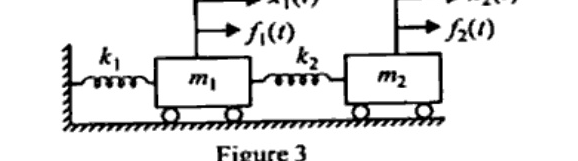
14 MarksFind the natural frequencies and amplitude ratio of the system shown in Fig. 3. with $k_1 = 20 N/m, k_2 = 10 N/m, m_1 = 20 kg$ and $m_2 = 7 kg$.
How to answer
- Write equations of motion for $m_1, m_2$ coupled by $k_2$.
- Assume harmonic solution to get frequency determinant.
- Solve $|K-\omega^2 M|=0$ for $\omega_{n1}, \omega_{n2}$.
- Find amplitude ratios $(X_1/X_2)$ for each mode.
-
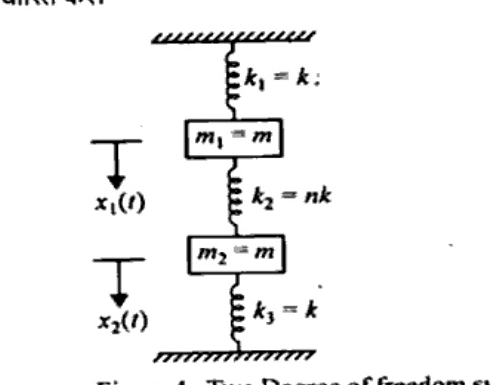
14 MarksDetermine the principal coordinates for the spring-mass system shown in Fig.4.
How to answer
- Write kinetic and potential energies and equations of motion.
- Form mass and stiffness matrices for $x_1, x_2$.
- Find eigenvalues/eigenvectors to get natural frequencies and modal vectors.
- Transform to principal/modal coordinates $q = P^{-1}x$.
-
14 MarksWrite short notes on the following:
- a)Relationship between sound pressure level and sound power level.
- b)Octave Band Analysis
- c)Various hearing conservation and damage risk criterion.
- d)Distinguish between viscous damping and Coulomb damping.
How to answer
- Define SPL vs PWL with reference pressure/power and relation via intensity.
- Explain octave band centre frequencies and filtering for noise analysis.
- List hearing conservation criteria: OSHA, ISO, damage risk levels.
- Contrast viscous (velocity proportional) vs Coulomb (constant friction) damping characteristics.
Go to where you left off?
Quick Add to Notes
Save questions, your own notes and screenshots into notes filed by unit. It takes a free account.
Create free accountHave an account? Log in
Notes Panel