ME-502 · Mechanical Vibrations/Unsolved PYQ Paper
ME-502 Mechanical Vibration - May 2024 Question Paper
Under each question, How to answer lists the points an answer should cover, outlined by CampusPrep from the syllabus. Check the details against your textbook.
-
14 MarksAttempts all question in brief:
- i)A spring mass system has time period of 0.25 sec. What will be time period if spring constant is increased by 50%?
- ii)Obtain the governing equation of motion of a spring mass system by Rayleigh's principle.
- iii)Explain the concept of hysteresis. What is the area under hysteresis curve?
- iv)What is critical damping? Explain its importance.
- v)List four differences between the free vibrations of an under damped system and a system with Coulomb damping.
- vi)What is node? Describe with neat sketch.
- vii)Explain Sound Pressure Level (SPL) in short.
How to answer
- Define time period $T=2\pi\sqrt{m/k}$
- Show $T \propto 1/\sqrt{k}$ so $T_2 = T_1/\sqrt{1.5}$
- Compute numerical value ~0.204 s
- State Rayleigh energy method $T_{max}=V_{max}$ for governing equation
- Define hysteresis, critical damping, Coulomb vs viscous differences, node, SPL
-
7 MarksaA 65 kg industrial sewing machine operates at 125 Hz and has a rotating unbalance of 0.15 kg·m. The machine is mounted on a foundation with a stiffness of $2 \times 10^6$ N/m and a damping ratio of 0.12. Determine the machine's steady amplitude.
How to answer
- Calculate natural frequency $\omega_n=\sqrt{k/m}$ and excitation $\omega=2\pi\times125$
- Calculate frequency ratio $r=\omega/\omega_n$ and $m_0e=0.15$ kg-m
- Use rotating unbalance steady amplitude $X=(m_0e/m)r^2/\sqrt{(1-r^2)^2+(2\zeta r)^2}$
- Substitute $m=65$ kg, $k=2\times10^6$ N/m, $\zeta=0.12$ to get X
-
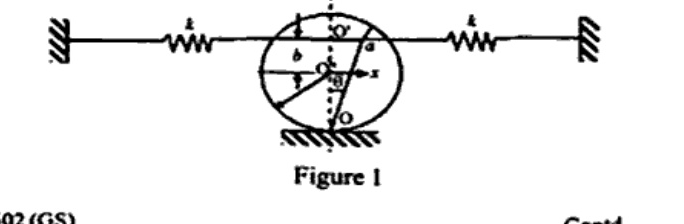
7 MarksbFind the natural frequency of the system shown in Fig.1.
How to answer
- Describe system: rolling disc/cylinder of mass with two horizontal springs attached at height
- Write kinetic energy for translation + rotation with no-slip condition
- Write potential energy of springs
- Apply energy / Rayleigh method to get $\omega_n=\sqrt{k_{eq}/m_{eq}}$
-
7 MarksaExplain the whirling of shaft
How to answer
- Define whirling and critical speed of shaft
- Explain synchronous whirl due to eccentricity and centrifugal force
- Describe below, at and above critical speed behaviour and phase
- Mention effects of damping and unbalance
-
7 MarksbAn air compressor of 450 kg mass operates at a constant speed of 1750 rpm. The rotating parts are well balanced. The reciprocating parts are of 10 kg. The crank radius is 100 mm. If the damper for the mounting introduces a damping factor = 0.15.
- i)Specify the springs for the mounting such that only 20% of the unbalance force is transmitted to the foundation.
- ii)Determine the amplitude of transmitted force.
How to answer
- Compute excitation frequency from 1750 rpm and unbalance force $m_{rec}r\omega^2$
- Use transmissibility $T_r=0.2$ with $\zeta=0.15$ to solve for $r$ and required $k$
- Specify spring stiffness for mounting
- Compute transmitted force amplitude $F_T = T_r \times F_0$
-
7 MarksaWhy can't the concept of logarithmic decrement be used to measure viscous damping ratios greater than or equal to one? Explain.
How to answer
- Explain logarithmic decrement $\delta=\ln(x1/x2)$ requires successive peaks
- Show for $\zeta \ge 1$ system is critically/overdamped with no oscillation
- Conclude no peaks to measure so method fails
- Mention alternative methods for high damping
-
7 MarksbA 40 kg pump is to be placed at the midspan of a 2.5-m long steel ($E = 200 \times 10^9$ N/m$^2$) beam. The pump is to operate at 3000 rpm. For what values of the cross-sectional moment of inertia will the oscillations of the pump be within 3 Hz of resonance?
How to answer
- Compute excitation $\omega$ from 3000 rpm and beam stiffness $k=48EI/L^3$ for midspan load
- Set resonance condition $\omega_n = \sqrt{k/m}$ near $\omega$
- Solve inequality $|f_n - f| \le 3$ Hz for $I$
- Obtain range of cross-sectional moment of inertia to avoid resonance
-
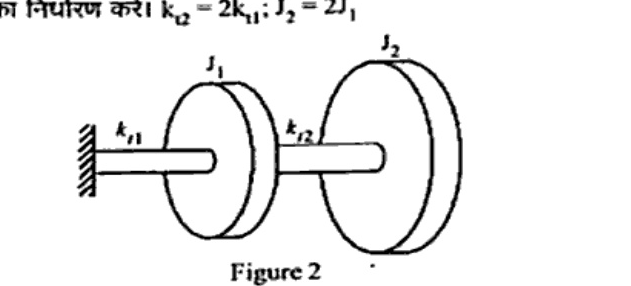
14 MarksDetermine the natural frequencies and normal modes of the torsional system shown in Fig. 2 for and $k_{t2} = 2k_{t1}$; $J_2 = 2J_1$.
How to answer
- Write equations of motion for two-disc torsional system fixed at one end
- Form frequency determinant $|K-\omega^2J|=0$ with $k_{t2}=2k_{t1}, J_2=2J_1$
- Solve for $\omega_{n1}, \omega_{n2}$ in terms of $k_{t1}, J_1$
- Find mode shapes (amplitude ratios) for each natural frequency
-
14 MarksA flow-monitoring device of mass 10 kg is to be installed to monitor the flow of a gas in a manufacturing process. Because of the operation of pumps and compressors, the floor of the plant vibrates with amplitude of 4 mm at a frequency of 2500 rpm. Effective operation of the flow-monitoring device requires that its acceleration amplitude be limited to 5g. What is the equivalent stiffness of an isolator with a damping ratio of 0.05 to limit the transmitted acceleration to an acceptable level? What is the maximum displacement of the flow-monitoring device and what is the maximum deformation of the isolator?
How to answer
- Convert floor vibration 2500 rpm, 4 mm to excitation frequency and displacement
- Use base excitation transmissibility for acceleration with $\zeta=0.05$ and limit $5g$
- Solve for required $r$ and isolator stiffness $k=m\omega_n^2$
- Compute device absolute displacement and relative deformation $Z=Y\sqrt{...}$
-
14 MarksA spring mass damper system is defined by the following parameter m=3 kg, k=100 N/m, C=3 N-s/m. Determine:
- a)Critical damping constant
- b)Damping ratio
- c)Frequency of damped oscillation
- d)Logarithmic decrement
- e)No of cycles after which the initial amplitude is reduced to 20%.
How to answer
- Compute $c_c=2\sqrt{km}=2m\omega_n$
- Compute $\zeta=c/c_c$
- Compute $\omega_d=\omega_n\sqrt{1-\zeta^2}$
- Compute $\delta=2\pi\zeta/\sqrt{1-\zeta^2}$ and cycles $n=\ln(5)/\delta$ for 20% amplitude
-
5 MarksaFind out the increase in sound intensity in dB when the distance from the source is doubled.
How to answer
- Use $\Delta L =10\log_{10}(I_2/I_1)=20\log_{10}(p_2/p_1)$ and $I\propto1/r^2$
- Show doubling distance reduces intensity by factor 4 i.e. -6 dB
- Use $SPL=20\log_{10}(p/p_{ref})$ with $p_{ref}=20\mu Pa$
- Solve $p=p_{ref}10^{SPL/20}$ for 11.23 dB
-
5 MarksbFind the actual pressure for a wave travelling in the air if the SPL is 11.23 dB.
How to answer
- Recall $SPL=20\log_{10}(p/p_0)$, $p_0=20 \mu Pa$
- Rearrange to $p=p_0 10^{SPL/20}$
- Substitute SPL=11.23 dB to get pressure in Pa
-
4 MarkscExplain hearing conservation and damage risk criteria for normal human being.
How to answer
- Define hearing conservation and permissible exposure limits
- Explain damage risk criteria vs frequency, level and duration
- Mention OSHA/ISO 85-90 dBA for 8 hours with exchange rate
- Suggest control measures
Go to where you left off?
Quick Add to Notes
Save questions, your own notes and screenshots into notes filed by unit. It takes a free account.
Create free accountHave an account? Log in
Notes Panel