ME-502 · Mechanical Vibrations/Unsolved PYQ Paper
ME-502 Mechanical Vibration - Dec 2024 Question Paper
Under each question, How to answer lists the points an answer should cover, outlined by CampusPrep from the syllabus. Check the details against your textbook.
-
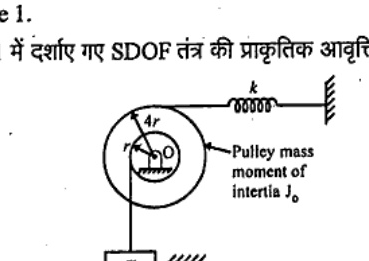
14 MarksFind the natural frequency of the SDOF system shown in the figure 1.
How to answer
- Identify kinetic energy of translating mass m and rotating pulley with Jo
- Identify potential energy of spring with equivalent stretch due to rotation
- Apply energy method / Newton's method to get equivalent mass and stiffness
- Obtain expression for natural frequency $\omega_n = \sqrt{k_{eq}/m_{eq}}$
-
7 MarksaDiscuss and derive the expression for Seismic instrument with help of a sketch.
How to answer
- Sketch seismic mass-spring-damper with base excitation y and mass displacement x
- Define relative displacement z = x - y
- Derive equation of motion $m\ddot{z}+c\dot{z}+kz = -m\ddot{y}$
- Obtain steady-state amplitude and phase for displacement / velocity / acceleration pickup
-
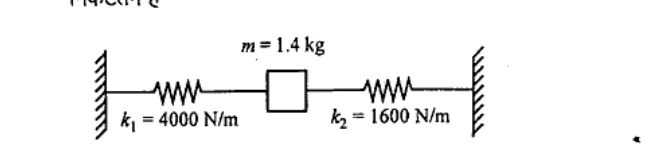
7 MarksbThe natural frequency of the spring mass system shown in the figure 2 is closest to
How to answer
- Recognize springs k1 and k2 in parallel fixed at both ends
- Equivalent stiffness $k_{eq}=k_1+k_2$
- Natural frequency $\omega_n=\sqrt{k_{eq}/m}$
- Substitute m=1.4 kg, k1=4000 N/m, k2=1600 N/m to get value
-
7 MarksaWhat is the whirling of shaft? Derive it and write the physical significance of it.
How to answer
- Define whirling / critical speed of rotating shaft
- Derive equation for deflection with eccentricity and rotation
- Obtain critical speed $\omega_c = \sqrt{k/m}$ condition
- Explain physical significance: resonance, large deflection, phase change
-
7 MarksbA flexible rotor-shaft system comprises of a 10 kg rotor disc placed in the middle of a mass-less shaft of diameter 30 mm and length 500 mm between bearings (shaft is being taken mass-less as the equivalent mass of the shaft is included in the rotor mass) mounted at the ends. The bearings are assumed to simulate simply supported boundary conditions. The shaft is made of steel for which the value of E is $2.1 \times 10^{11}$ Pa. What is the critical speed of rotation of the shaft?
How to answer
- Model as simply supported beam with central mass
- Calculate area moment of inertia $I=\pi d^4/64$ and static deflection $\delta = WL^3/48EI$
- Critical speed $\omega_c = \sqrt{g/\delta}$
- Convert to rpm / rps using given E, d=30 mm, L=500 mm, m=10 kg
-
7 MarksaA vibratory system consists of a mass 12.5 kg, a spring of stiffness 1000 N/m, and a dashpot with damping coefficient of 15 Ns/m. Find the value of critical damping of the system and the value of logarithmic decrement of the vibrating system.
How to answer
- Calculate critical damping $c_c = 2m\omega_n = 2\sqrt{km}$
- Calculate damping ratio $\zeta = c/c_c$
- Calculate damped natural frequency and logarithmic decrement $\delta = 2\pi\zeta/\sqrt{1-\zeta^2}$
- Substitute m=12.5 kg, k=1000 N/m, c=15 Ns/m
-
7 MarksbWrite short notes on vibration isolation, transmissibility, and magnification factor of the vibrating system.
How to answer
- Define vibration isolation and need
- Define transmissibility expression vs frequency ratio
- Define magnification factor expression
- Give plots / isolation region $r>\sqrt{2}$ and examples
-
14 MarksDetermine the natural frequency of torsional vibrations of a shaft with two circular discs of uniform thickness at the ends. The masses of the discs are $M_1 = 500$ kg and $M_2 = 1000$ kg and their outer diameters are $D_1 = 125$ cm and $D_2 = 190$ cm. The length of the shaft is 300 cm and its diameter is 10 cm. Take the Modulus of rigidity for the material of shaft is $G = 0.83 \times 10^{11}$ N/m$^2$.
How to answer
- Calculate mass moments of inertia of discs $I = MR^2/2$
- Calculate torsional stiffness $k_t = GJ/L$ with $J=\pi d^4/32$
- Use two-rotor system frequency $f_n = (1/2\pi)\sqrt{k_t(I_1+I_2)/I_1I_2}$
- Substitute M1=500 kg, M2=1000 kg, D1=125 cm, D2=190 cm, L=300 cm, d=10 cm, G=0.83e11 N/m2
-
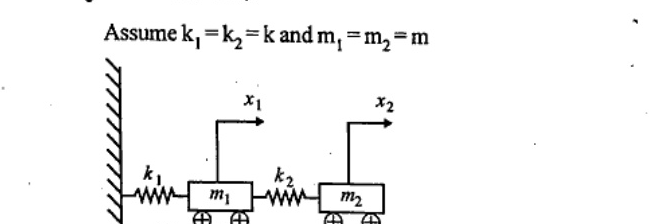
14 MarksFind the natural frequencies and first two normal mode shapes of the system shown in Figure 3. Assume $k_1 = k_2 = k$ and $m_1 = m_2 = m$
How to answer
- Write equations of motion for 2-DOF masses m1, m2
- Assume harmonic solution to get frequency determinant
- Solve for $\omega_1, \omega_2$ with k1=k2=k, m1=m2=m
- Find amplitude ratios for mode shapes
-
7 MarksaDerive an expression for vibration response of a single degree of freedom system if the damping provided is under damped system.
How to answer
- Write SDOF equation $m\ddot{x}+c\dot{x}+kx=0$ with $\zeta<1$
- Assume solution and obtain damped frequency $\omega_d=\omega_n\sqrt{1-\zeta^2}$
- Derive response $x = Xe^{-\zeta\omega_n t}\sin(\omega_d t+\phi)$
- Explain constants from initial conditions
-
7 MarksbWrite short on any three of the following:
- i)Damping ratio
- ii)Under damped
- iii)Critical damped
- iv)Logarithmic decrement
How to answer
- Define damping ratio $\zeta=c/c_c$ and significance
- Explain underdamped $\zeta<1$ oscillatory response
- Explain critically damped $\zeta=1$ fastest non-oscillatory return
- Define logarithmic decrement $\delta=\ln(x1/x2)$ relation to $\zeta$
-
7 MarksaExplain in brief, following terms with respect to noise:
- i)Loudness and equal loudness contours
- ii)Auditory effect of noise
How to answer
- Define loudness and phon / sone concept
- Explain equal loudness contours (Fletcher-Munson)
- Define auditory effects: hearing loss, masking, annoyance
- Give diagram of contours vs frequency
-
7 MarksbWrite the explanation in short:
- i)What is the decibel scale and how is it used?
- ii)What is SPL in noise?
- iii)Does 0db SPL mean no sound pressure
- iv)What is the scale for measuring sound intensity?
How to answer
- Define decibel scale $L=10\log_{10}(I/I_0)$ and use
- Define SPL with reference $20 \mu Pa$
- Clarify 0 dB SPL is threshold of hearing not zero pressure
- State scale for sound intensity measurement
Go to where you left off?
Quick Add to Notes
Save questions, your own notes and screenshots into notes filed by unit. It takes a free account.
Create free accountHave an account? Log in
Notes Panel