ME-502 · Mechanical Vibrations/Unsolved PYQ Paper
ME-502 Mechanical Vibration - Nov 2022 Question Paper
Under each question, How to answer lists the points an answer should cover, outlined by CampusPrep from the syllabus. Check the details against your textbook.
-
7 MarksaA vibratory system consists of a mass $12.5\ \text{kg}$, a spring of stiffness $1000\ \text{N/m}$, and a dashpot with damping coefficient of $15\ \text{Ns/m}$. Find the value of critical damping of the system and the value of logarithmic decrement of the vibrating system.
How to answer
- Define critical damping Cc = 2*m*wn = 2*sqrt(k*m)
- Compute wn = sqrt(k/m), Cc value
- Compute damping ratio zeta = c/Cc
- Logarithmic decrement delta = 2*pi*zeta/sqrt(1-zeta^2)
-
7 MarksbDefine the following terms?
- i)Vector representation of the displacement, velocity, and acceleration of SHM
- ii)Fundamental mode of vibration
- iii)Mathematical definition of Simple Harmonic Motion (SHM)
How to answer
- Define rotating vector for SHM displacement
- Show velocity leads displacement by 90 deg and acceleration by 180 deg
- Define fundamental mode / lowest natural frequency mode shape
- Give mathematical condition d2x/dt2 + omega_n^2 x = 0 for SHM
-
7 Marksa2. a)
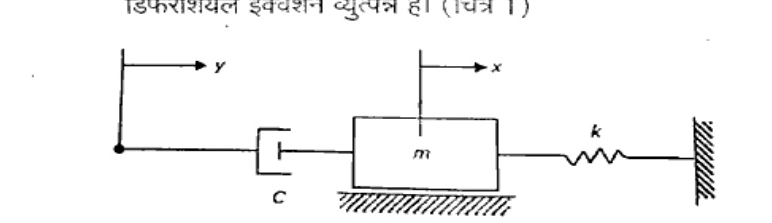
- i)Draw the FBD of the system and derived the differential equation governing by vibrating system is (Figure 1)
- ii)Why we use Viscous damping for modelling the vibrating system. Explain in brief.
How to answer
- Draw FBD of mass m with spring force kx and damper force c*dx/dt
- Apply Newton's second law in x-direction
- Obtain m*x_ddot + c*x_dot + k*x = 0
- Explain linearization and mathematical convenience of viscous damping model
-
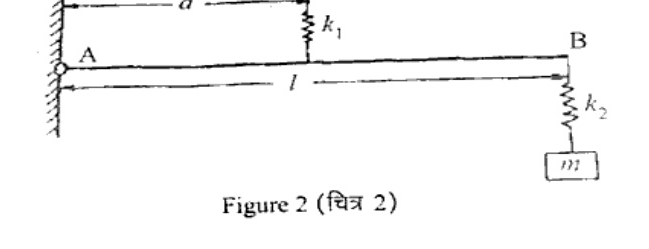
7 MarksbA system is shown in the following figure 2. The bar AB is assumed to be rigid and weightless. The natural frequency of vibration of the system is given by
How to answer
- Identify rigid bar AB pivoted at A with springs k1 at distance a and k2-mass at length l
- Write moment equation about hinge A for small angle
- Obtain equivalent stiffness and natural frequency expression
- State assumptions of small oscillations and weightless bar
-
7 MarksaProve that the critical speed of whirling speed for a rotating shaft is same as the frequency of natural transverse vibration.
How to answer
- Write equation of rotating shaft with eccentricity
- Show deflection grows when rotation equals transverse natural frequency
- Define critical / whirling speed condition
- Conclude critical speed equals natural transverse frequency
-
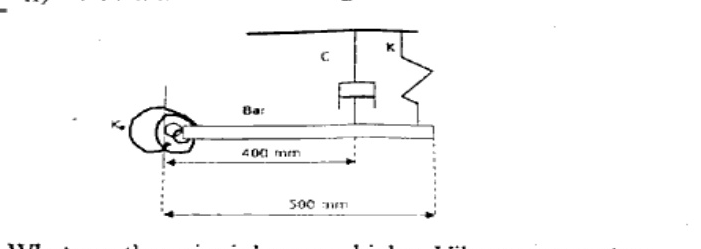
7 MarksbA uniform rigid slender bar of mass $10\ \text{kg}$, hinged at the left end is suspended with the help of spring and damper arrangement as shown in the figure where $K = 2\ \text{kN/m}$, $C = 500\ \text{Ns/m}$ and the stiffness of the torsional spring $k_{\theta}$ is $1\ \text{kN/m/rad}$. Ignore the hinge dimensions.
- i)Find the un-damped natural frequency of oscillations of the bar about the hinge point.
- ii)The damping coefficient in the vibration equation.
How to answer
- Take moment about hinge, include torsional spring k_theta, spring K and damper C
- Find mass moment of inertia of bar about hinge (1/3)mL^2
- Obtain undamped natural frequency sqrt(k_eq/J)
- Extract equivalent viscous damping coefficient from moment equation
-
7 MarksaWhat are the principles on which a Vibrometer and an accelerometer are based? Derive the expression.
How to answer
- Explain seismic instrument with mass-spring-damper base excitation
- Derive transmissibility for displacement pickup (vibrometer)
- Derive for acceleration pickup (accelerometer) with high natural frequency
- State frequency ratio conditions for each instrument
-
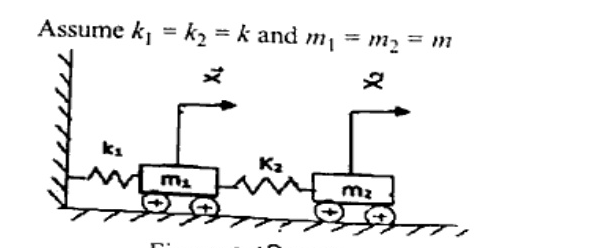
7 MarksbFind the natural frequencies and first two normal mode shapes of the system shown in Figure 3. Assume $k_{1} = k_{2} = k$ and $m_{1} = m_{2} = m$
How to answer
- Write equations of motion for m1, m2 with k1, k2
- Form mass and stiffness matrices, solve determinant |K - omega^2 M|=0
- Obtain two natural frequencies omega1, omega2
- Find amplitude ratios for mode shapes
-
14 MarksFind the lowest natural frequency of vibration of system shown in Figure 4. Assume $E = 1.96 \times 10^{11}\ \text{N/m}^{2}, I = 4 \times 10^{-7}\ \text{m}^{4}$
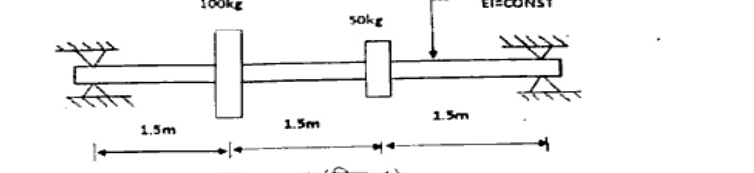
How to answer
- Model shaft as simply supported beam with two concentrated masses
- Use Dunkerley or Rayleigh method for transverse vibration
- Insert E, I, spans 1.5 m each, masses 100 kg and 50 kg
- Compute lowest natural frequency
-
7 MarksaDerive the expression for frequency of free damped vibrations.
How to answer
- Write equation m*x_ddot + c*x_dot + k*x = 0
- Assume solution x = e^(st), find roots with damping ratio
- Obtain damped frequency omega_d = omega_n*sqrt(1-zeta^2)
- Discuss under, critical and overdamped cases
-
7 MarksbIn a spring mass vibrating system, the natural frequency of vibration is $3.56 \text{Hz}$. When the amount of the suspended mass is increased by $5 \text{kg}$, the natural frequency is lowered to $2.9 \text{Hz}$. Determine the original unknown mass and the spring constant.
How to answer
- Write fn = (1/2pi)*sqrt(k/m) for two cases
- Form ratio to eliminate k, solve for unknown mass m
- Compute k from either frequency
- Check units Hz to rad/s
-
14 MarksA right cantilever steel shaft of $0.3\ \text{m}$ effective length has a heavy rotor fixed at its end. The mass of the rotor is $10\ \text{kg}$ and has a radius of gyration of $12\ \text{cm}$ about its axis. The thickness of the rotor is $6\ \text{cm}$. The moment of inertia of the section of the shaft about its neutral axis is $10\ \text{cm}^{4}$. This shaft is to run at $10,000\ \text{rpm}$. Check if this operating speed is safe.
How to answer
- Compute mass moment of inertia of rotor and shaft stiffness 3EI/L^3
- Find transverse natural frequency / critical speed
- Include gyroscopic effect of disc thickness if required
- Compare operating speed 10000 rpm with critical, comment on safety
-
7 MarksaWrite the Logical Explanation with neat sketch if needed:
- i)What is SPL in noise?
- ii)Does 0db SPL mean no sound pressure?
- iii)How loud is 100dB SPL?
How to answer
- Define SPL = 20 log10(p/p_ref) with reference 20 microPa
- Explain 0 dB is threshold of hearing, not zero pressure
- Give scale for 100 dB loudness example
- Add neat sketch of dB scale if needed
-
7 MarksbWhat is octave band analysis of sound?
How to answer
- Define octave band with factor 2 frequency ratio
- Explain filters and centre frequencies
- State use for noise analysis and control
- Give example octave bands
Go to where you left off?
Quick Add to Notes
Save questions, your own notes and screenshots into notes filed by unit. It takes a free account.
Create free accountHave an account? Log in
Notes Panel