CE-403 · Structural Analysis-I/Unsolved PYQ Paper
CE-403 Structural Analysis-I - Nov 2023 Question Paper
Under each question, How to answer lists the points an answer should cover, outlined by CampusPrep from the syllabus. Check the details against your textbook.
-
7 MarksaDerive the expression for strain energy stored in an elastic member of length 'L' and cross-sectional area 'A' subjected to an external gradually applied axial load 'W' which creates extension '$\delta$'.
How to answer
- Define gradually applied axial load W producing extension delta
- Work done = average load x extension = (1/2)W delta
- Use Hooke's law delta = WL/(AE)
- Strain energy U = (1/2)W delta = W^2 L/(2AE) = (1/2) stress x strain x volume
-
7 MarksbWhat is Maxwell's reciprocal deflection theorem?
How to answer
- State Maxwell's reciprocal theorem for linear elastic structure
- Deflection at A due to load at B equals deflection at B due to same load at A
- Condition of linear elasticity and small displacements
- Application to verify compatibility
-
7 MarksaWhat is degree of indeterminacy for the structures? Discuss their classification.
How to answer
- Define degree of static and kinematic indeterminacy
- External vs internal indeterminacy
- Formulas for beams, frames, trusses
- Classification: determinate vs indeterminate structures
-
7 MarksbA beam AB of span 5m fixed at both ends carries a uniformly distributed load of 12 kN/m over the whole span. If the right end B settles down by 12 mm, determine the end moments for the beam and also the vertical reactions at the ends. Take EI = 15000 kNm$^2$.
How to answer
- Calculate fixed end moments for UDL: wL^2/12
- Add moments due to settlement: 6EIΔ/L^2
- Apply equilibrium to find vertical reactions
- Report end moments and reactions with directions
-
7 MarksaDetermine the support moments and reactions for the continuous beam by slope deflection method shown in Fig. 1. Draw also bending moment diagram.
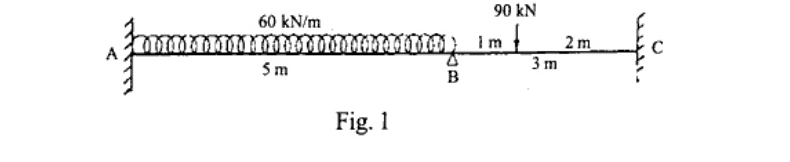
How to answer
- Write slope deflection equations for spans AB and BC
- Apply fixed end moments for UDL and point load
- Apply equilibrium at joint B to solve rotation
- Find support moments, reactions and draw BMD
-
7 MarksbA fixed beam AB of span 8m is subjected to a point load of 64 kN at 2 m from A and a clockwise couple of 20 kNm at midspan as shown in Fig. 2. Find the fixed end moments by using column analogy method.
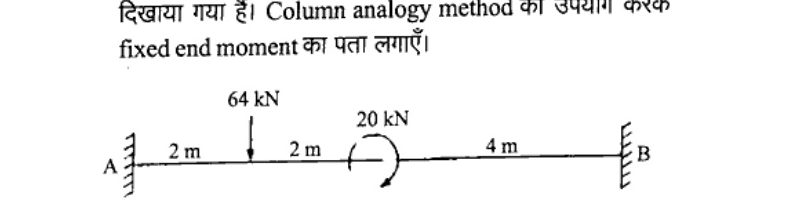
How to answer
- Explain column analogy: analogous column with width 1/EI
- Draw M/EI diagram for simply supported beam with point load and couple
- Find centroid and moment of inertia of analogous section
- Compute fixed end moments as pressure at ends
-
14 MarksA three hinged parabolic arch ACB of span 30m has its supports at depths 4m and 16m below the crown hinge C. The arch carries a point load of 60 kN at a distance of 5 m from C and a point load of 120 kN at a distance of 10 m from C as shown in Fig. 3. Find the support reactions and the bending moment under the loads.
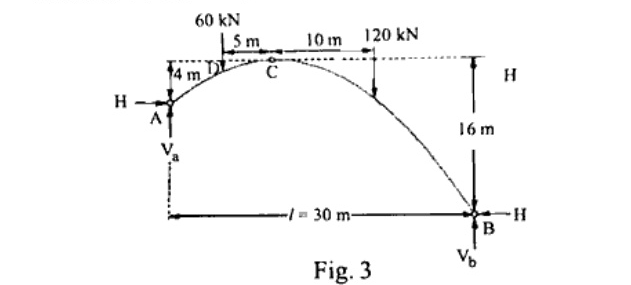
How to answer
- Take moments about A and B and moment zero at crown hinge C
- Solve for horizontal thrust H and vertical reactions Va, Vb
- Compute free beam moment minus H*y at load points
- Report bending moment under 60 kN and 120 kN loads
-
14 MarksTwo-wheel loads 200 kN and 80 kN spaced 0.8 m apart roll on the girder as shown in Fig. 4. Find the maximum positive and negative bending moments that can occur at the section C.

How to answer
- Draw influence line for BM at C for overhanging girder
- Place 200 kN and 80 kN 0.8m apart for max positive ordinates
- Place loads for max negative ordinates
- Compute max positive and negative BM values
-
14 MarksThe bend ABC shown in Fig. 5 carries a concentrated vertical load P at point A. Find the vertical and horizontal deflection of A by using strain energy method. Assume uniform flexural rigidity.
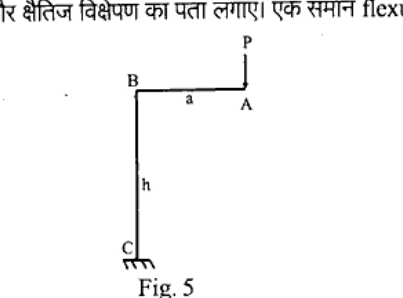
How to answer
- Write bending moment equations for AB (length a) and BC (height h)
- Strain energy U = ∫M^2 dx/(2EI) for both members
- Vertical deflection δv = ∂U/∂P, horizontal deflection δh = ∂U/∂Q with dummy load
- Simplify with uniform EI to get Pa^3/3EI etc.
-
14 MarksDefine the following terms:
- a)Principle of virtual work
- b)Temperature effect on three hinged arches
- c)Effect of rib shortening on two hinged arches
How to answer
- Define virtual work and virtual displacements
- Explain temperature stresses in determinate three-hinged arch
- Explain rib shortening reducing horizontal thrust in two-hinged arch
- Give formulas for temperature and shortening effects
-
14 MarksAnalyse the beam shown in Fig. 6 and draw bending moment diagram using moment distribution method. Find also the reactions at the supports.
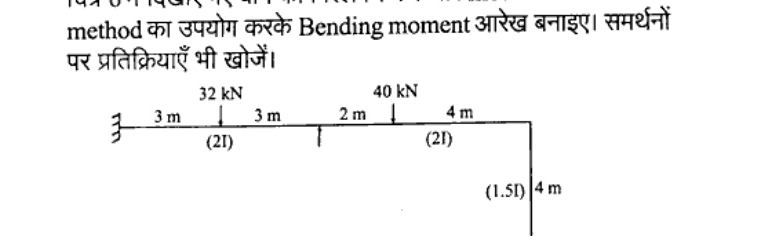
How to answer
- Compute distribution factors with stiffness 4EI/L and 3EI/L considering 2I, 1.5I
- Calculate fixed end moments for 32 kN and 40 kN spans
- Perform moment distribution cycles to get final end moments
- Find reactions from equilibrium and draw BMD
Go to where you left off?
Quick Add to Notes
Save questions, your own notes and screenshots into notes filed by unit. It takes a free account.
Create free accountHave an account? Log in
Notes Panel