CE-403 · Structural Analysis-I/Unsolved PYQ Paper
CE-403 Structural Analysis-I - Jun 2025 Question Paper
Under each question, How to answer lists the points an answer should cover, outlined by CampusPrep from the syllabus. Check the details against your textbook.
-
7 MarksaThe degree of static indeterminacy, $N_s$ and the degree of kinematic indeterminacy, $N_k$ for the plane frame shown below, assuming axial deformations to be negligible, are given by:
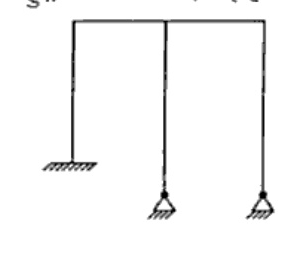
How to answer
- Define degree of static indeterminacy Ns and kinematic indeterminacy Nk for plane frame
- Apply formulas with axial deformations negligible
- Count external and internal indeterminacy from supports and closed loops
- Obtain Ns and Nk values for given fixed and hinged supports
-
7 MarksbWhat do you understand by indeterminacy? Also explain static and kinematic indeterminacy.
How to answer
- Define indeterminacy in structural analysis
- Explain static indeterminacy with external and internal components
- Explain kinematic indeterminacy with joint displacements/rotations
- Give examples/formulas for beams, frames and trusses
-
7 MarksaWhat do you understand by stability of structure?
How to answer
- Define stability of structure
- Distinguish stable, unstable, externally and internally stable
- Explain conditions for geometric stability and equilibrium
- Give examples of stable and unstable arrangements
-
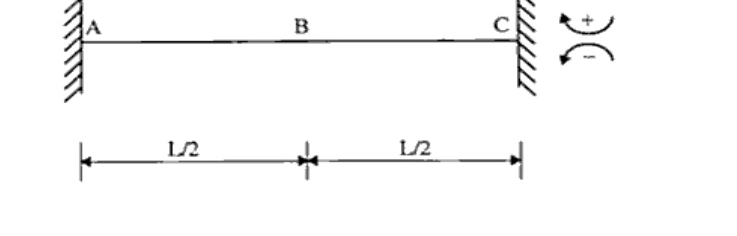
7 MarksbFor the fixed beam shown in the figure, the influence line diagram for the bending moment at the mid-span of the beam is best represented as
How to answer
- Identify fixed beam AC with mid-span point B
- Recall Muller-Breslau principle for influence line for moment
- Describe shape/sign of ILD for mid-span moment in fixed beam
- Select best represented ILD curve
-
7 MarksaWhat is cable? Write assumptions in force analysis of cable.
How to answer
- Define cable as flexible tension-only member
- List assumptions: inextensible/extensible, no bending/shear, load types
- Explain funicular shape under concentrated and distributed loads
- State equilibrium conditions for cable analysis
-
7 MarksbExplain the principles of virtual work applied to deformable bodies.
How to answer
- State principle of virtual work for deformable bodies
- Distinguish virtual displacements and virtual forces
- Write external virtual work equals internal virtual work
- Mention application to deflections and equilibrium
-
7 MarksaWhat is Maxwell reciprocal deflection theorem?
How to answer
- State Maxwell reciprocal deflection theorem
- Define two points and corresponding loads/displacements
- Express symmetry of flexibility coefficients
- Mention conditions and uses
-
7 MarksbDefine
- i)Distribution Factor
- ii)Stiffness Factor
How to answer
- Define distribution factor as ratio of member stiffness to joint stiffness
- Define stiffness factor for members with far end conditions
- Give formulas for prismatic members
- Mention use in moment distribution method
-
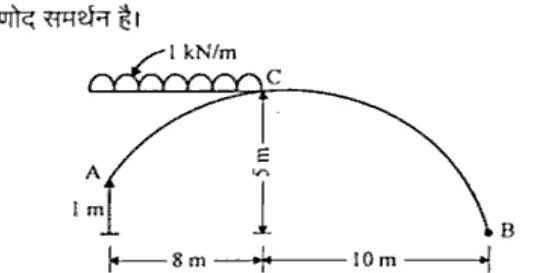
7 MarksaThe horizontal thrust support A in a three hinged arch shown in the given figure is
How to answer
- Identify three-hinged arch geometry and UDL of 1 kN/m
- Take moments about supports to find vertical reactions
- Use moment zero at internal hinge to solve horizontal thrust at A
- Compute thrust value with given spans 8 m and 10 m and rise 5 m
-
7 MarksbState Eddy's theorem in arches.
How to answer
- State Eddy's theorem in words
- Relate bending moment in arch to beam moment and thrust
- Write expression for moment due to horizontal thrust
- Mention use for arch analysis
-
7 MarksaA three-hinged parabolic arch of span '$l$' and rise '$h$' is subjected to a u.d.l. of intensity '$w$'. Then the horizontal thrust at the supports is.
How to answer
- Recall three-hinged parabolic arch under full UDL
- Use equilibrium and zero moment at crown
- Derive horizontal thrust $H = w l^2 / (8h)$
- State thrust at supports
-
7 MarksbIf the deflection at the free end of a uniformly loaded cantilever beam is $15$ mm and the slope of the deflection curve at the free end is $0.02$ radian, then the length of the beam is.
How to answer
- Recall deflection and slope formulas for uniformly loaded cantilever
- Use $\delta = wL^4/(8EI)$ and $\theta = wL^3/(6EI)$
- Eliminate load-stiffness to get $L = (4/3)(\delta/\theta)$
- Substitute $\delta=15$ mm and $\theta=0.02$ rad to get length
-
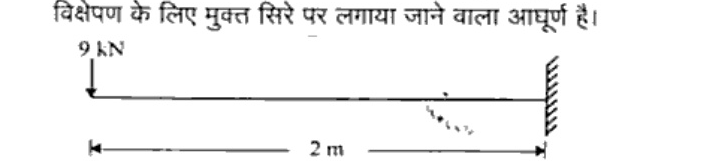
7 MarksaA cantilever beam is shown in the figure. The moment to be applied at free end for zero vertical deflection at the point is.
How to answer
- Draw cantilever with point load 9 kN at free end
- Write deflection at free end due to load and due to moment
- Set total vertical deflection to zero for no deflection condition
- Solve for required end moment
-
7 MarksbA uniformly distributed load of $50$ kN/m and $5$ m long crosses a girder of span $15$ m from left to right. What will be the maximum bending moment at a section $6$ m from left end?
How to answer
- Draw girder span 15 m and section 6 m from left
- Place 5 m UDL to maximize moment using ILD ordinates
- Compute maximum ordinate area for bending moment
- Multiply by $w=50$ kN/m to get maximum bending moment
-
7 MarksaWhat are the assumptions made in the analysis of a simple truss?
How to answer
- Define simple truss as triangulated pin-jointed frame
- List assumptions: pin joints, loads at joints, straight members
- Assume members carry axial force only, neglect self-weight
- Mention small deflections and static determinacy
-
7 MarksbIn the cantilever beam PQR shown in figure below, the segment PQ has flexural rigidity $EI$ and the segment QR has infinite flexural rigidity. The deflection and slope of the beam at '$Q$' are respectively.

How to answer
- Identify cantilever PQR with PQ flexible EI length L and QR rigid length L
- Consider load W at R transferred as point load plus moment at Q
- Compute slope and deflection at Q using cantilever formulas
- Obtain deflection $W(2L)^? $ and slope due to rigid rotation
Go to where you left off?
Quick Add to Notes
Save questions, your own notes and screenshots into notes filed by unit. It takes a free account.
Create free accountHave an account? Log in
Notes Panel