CE-403 · Structural Analysis-I/Unsolved PYQ Paper
CE-403 Structural Analysis-I - Dec 2024 Question Paper
Under each question, How to answer lists the points an answer should cover, outlined by CampusPrep from the syllabus. Check the details against your textbook.
-
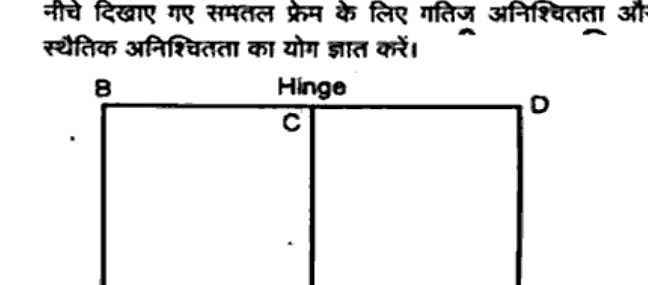
7 MarksaFind out the summation of kinematic indeterminacy and static indeterminacy for the plane frame shown below.
How to answer
- Define external and internal static indeterminacy for plane frame
- Define kinematic indeterminacy with formula considering supports and internal hinges
- Identify supports A, F, E and internal hinge at C from figure
- Compute DS and DK and their summation
-
7 MarksbWhat is Betti's theorem? Derive Maxwell's reciprocal theorem from it.
How to answer
- State Betti's theorem on reciprocal work
- Consider two load systems P and Q with displacements
- Equate virtual work of system 1 through displacements of system 2 and vice versa
- Derive Maxwell's reciprocal deflection theorem as special case
-
7 MarksaWrite a short note on Strain energy.
How to answer
- Define strain energy as work stored in deformation
- Give formula $U = \int M^2dx/2EI + \int N^2dx/2AE + ...$
- Explain for axial, bending, shear and torsion
- Mention Castigliano's theorems application
-
7 MarksbClassify the arches based on material, shapes and structural system.
How to answer
- Classification by material: masonry, steel, RCC, timber
- Classification by shape: circular, parabolic, elliptical, segmental
- Classification by structural system: three-hinged, two-hinged, fixed
- Give examples and sketches
-
7 MarksaWhat do you understand by sway and non sway analysis?
How to answer
- Define sway as lateral displacement of joints
- Define non-sway with prevented side-sidesway
- Explain causes: unsymmetric loading, geometry, settlement
- Mention effect on slope-deflection / moment distribution analysis
-
7 MarksbDistinguish between pin jointed and rigidly jointed structures.
How to answer
- Define pin-jointed: hinges, axial forces only
- Define rigidly jointed: moment transfer, axial+shear+moment
- Compare on rotation, stability, analysis methods
- Give examples: truss vs frame
-
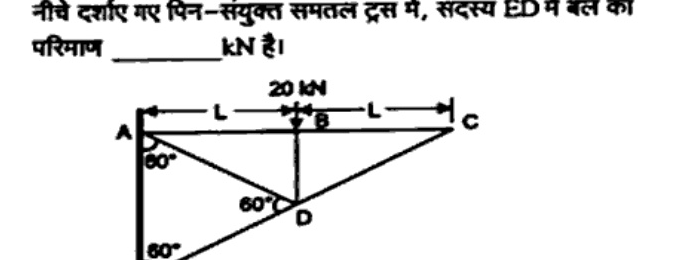
7 MarksaIn the pin-jointed plane truss shown below, magnitude of force in member ED is __________ kN.
How to answer
- Draw FBD and find reactions at wall
- Apply method of joints/sections at D/E
- Use equilibrium $\sum F_x=0, \sum F_y=0$
- Obtain magnitude and nature (tensile/compressive) of force in ED
-
7 MarksbIn construction why are the lintels preferred to arches?
How to answer
- Define lintels and arches functions
- Compare construction ease, formwork, thrust requirement
- Explain material and span limitations
- Conclude why lintels preferred in modern construction
-
7 MarksaA three-hinged parabolic arch ABC has a span of 20 m and a central rise of 4.0 m. The arch has hinges at the ends and at the crown. A train of two point loads of 20 kN and 10 kN, 5 m apart, crosses this arch from left to right, with the 20 kN load leading. The maximum thrust is induced at the supports.
How to answer
- Write horizontal thrust formula for three-hinged parabolic arch
- Draw ILD for thrust $H = M_0/y_c$
- Place 20 kN leading and 10 kN trailing for maximum thrust
- Compute maximum thrust value
-
7 MarksbState Eddy's theorem in arches.
How to answer
- State Eddy's theorem statement
- Relate bending moment to intercept between arch and funicular polygon
- Give expression $M = H \times$ intercept
- Mention use for arch profile
-
7 MarksaA cable carrying a load of 15 kN per metre run of horizontal span, is stretched between two supports 150 m apart. The supports are at the same level and the central dip is 10 m. The difference between the greatest and the least tensions in the cable will be
How to answer
- Compute horizontal reaction $H = wL^2/8h$
- Compute $T_{max} = \sqrt{H^2+V^2}$ at support and $T_{min}=H$ at crown
- Substitute $w=15$ kN/m, $L=150$ m, $h=10$ m
- Find difference $T_{max}-T_{min}$
-
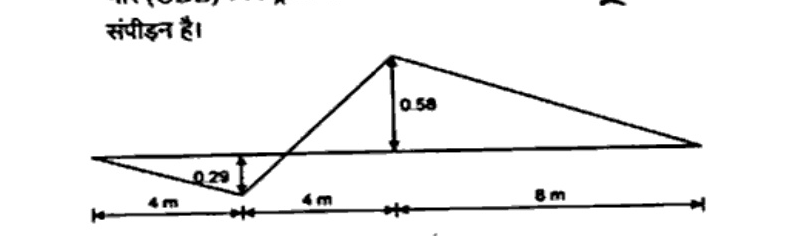
7 MarksbThe Influence Line Diagram (ILD) per a force in a truss member is shown in the figure. If a Uniformly Distributed load (UDL) of intensity of 30 kN/m longer than the span traverses, then the maximum compression in the member is.
How to answer
- Identify negative and positive areas of ILD
- For max compression place UDL on negative area only
- Compute force = intensity $\times$ area of ILD
- Calculate value with $w=30$ kN/m
-
7 MarksaIf the deflection at the free end of a uniformly loaded cantilever beam is 15 mm and the slope of the deflection curve at the free end is 0.02 radian, then the length of the beam is
How to answer
- Recall cantilever UDL formulas $\delta = wL^4/8EI$, $\theta = wL^3/6EI$
- Eliminate $w/EI$ to get $L = (4/3)(\delta/\theta)$
- Substitute $\delta=15$ mm, $\theta=0.02$ rad
- Compute length in mm/m
-
7 MarksbA cantilever beam with a uniform flexural rigidity ($EI = 200 \times 10^6 Nm^2$) is loaded with a concentrated force at its free end. The area of the bending moment diagram corresponding to the full length of the beam is 10000 $Nm^2$. Find out the magnitude of the slope of beam at its free end.
How to answer
- Use moment-area theorem: slope = area of M/EI diagram
- Given area of BMD = 10000 Nm^2, EI = 200x10^6 Nm^2
- Compute $\theta = A/EI$
- Report magnitude at free end
-
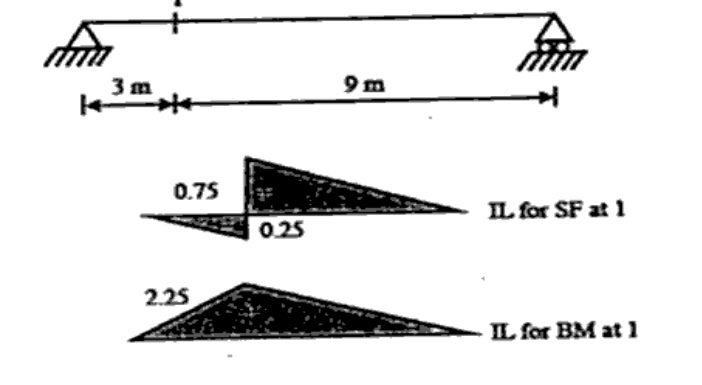
7 MarksaThe given figures show a beam with its influence line for shear force and bending moment at section '1': The values of the shear force and bending moment at section '1' due to a concentrated load of 20 kN placed at mid-span will be
How to answer
- Read ordinates of IL for SF and BM at mid-span (6m from left)
- Multiply ordinates by concentrated load 20 kN
- Compute SF = 20 x ordinate, BM = 20 x ordinate
- State values with units kN and kNm
-
7 MarksbWhat is the advantage of method of section over method of joints?
How to answer
- Define method of joints and method of sections
- Explain section cuts max 3 members vs joint equilibrium
- Advantage: direct force in desired member without solving all joints
- Mention time saving for large trusses
Go to where you left off?
Quick Add to Notes
Save questions, your own notes and screenshots into notes filed by unit. It takes a free account.
Create free accountHave an account? Log in
Notes Panel