CE-403 · Structural Analysis-I/Unsolved PYQ Paper
CE-403 Structural Analysis-I - Nov 2022 Question Paper
Under each question, How to answer lists the points an answer should cover, outlined by CampusPrep from the syllabus. Check the details against your textbook.
-
7 MarksaState and deduce an expression for Maxwell's reciprocal theorem.
How to answer
- State Maxwell's reciprocal theorem for linear elastic structure
- Consider two load systems P1, P2 with corresponding displacements
- Equate work by applying loads in different order using Betti's law
- Deduce expression e.g. delta12 = delta21 / flexibility symmetry f12 = f21
-
7 MarksbState principle of virtual work. Also explain its application to Flexural members.
How to answer
- State principle of virtual work for deformable bodies
- Expression for external virtual work = internal virtual work
- Application to flexural members: rotation and deflection by unit load
- Steps with integral M*m/EI dx example
-
7 MarksaWhat do you understand by indeterminacy? Also explain static and kinematic indeterminacy.
How to answer
- Define indeterminacy / degree of indeterminacy
- Static indeterminacy: external and internal, expressions for beams, frames, trusses
- Kinematic indeterminacy: joint displacements, expressions
- Examples distinguishing static vs kinematic
-
7 MarksbWhat do you understand by sway and non sway analysis?
How to answer
- Define sway: lateral displacement of joints
- Define non-sway: only rotation, no translation
- Conditions causing sway: unsymmetry, lateral load, settlement
- Implication for slope-deflection / moment distribution analysis
-
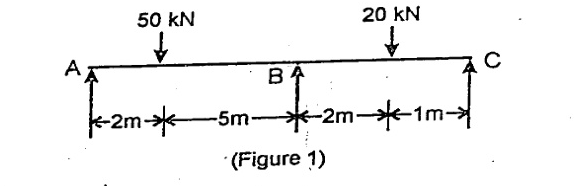
14 MarksA continuous beam ABC. Consists of two spans $AB = 7m$ and $BC = 3m.$ (figure 1). Given as ratio at moment at inertia $I_{AB} / I_{BC} = 2/1.$ Find out the support moments and draw bending moment diagram.
How to answer
- Compute free bending moments and IAB/IBC = 2/1 effect
- Apply Clapeyron / moment distribution / slope-deflection for support moments
- Find reactions and span moments
- Draw bending moment diagram
-
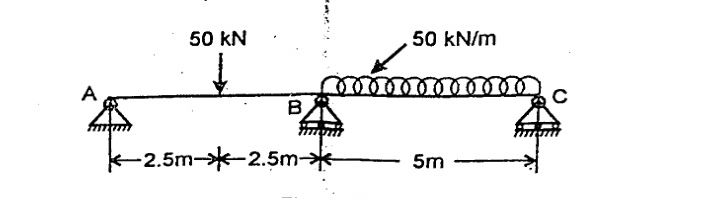
14 MarksAnalyze the continuous beam as shown in figure (2) by the three moment equation. Draw the shear force and bending moment diagram.
How to answer
- Write three-moment equations for spans AB and BC
- Account for point load on AB and UDL on BC with free moment diagrams
- Solve for moments at A, B, C
- Draw shear force and bending moment diagrams
-
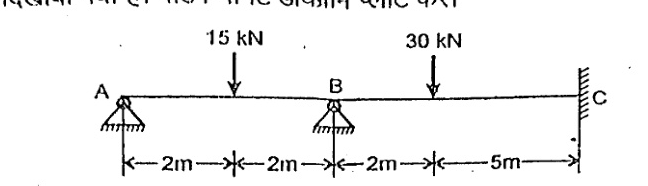
14 MarksAnalyse the beam by slope deflection method, as shown in figure (3). Plot the bending moment diagram.
How to answer
- Identify supports: A hinged, B roller, C fixed; spans and loads
- Write slope-deflection equations with fixed-end moments
- Apply equilibrium at B and fixed condition at C, solve rotations
- Compute end moments and plot bending moment diagram
-
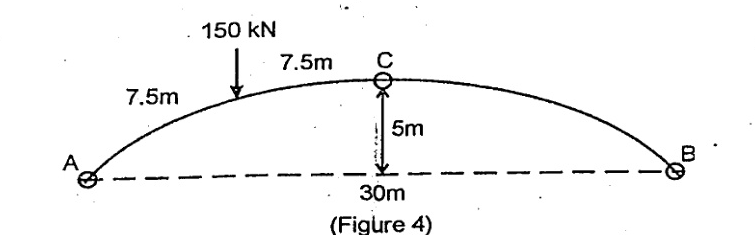
14 MarksFind the support reactions and maximum positive and negative bending moments for the parabolic 3-hinged arch, shown in figure (4). Draw BMD.
How to answer
- Find vertical reactions using equilibrium and moment at crown hinge
- Find horizontal thrust H for parabolic arch
- Compute bending moment equation M(x) and locate max positive/negative
- Draw bending moment diagram
-
7 MarksaWhat is the end moments induced at the ends of a fixed beam AB due to sinking of any one support with respect to the other?
How to answer
- Consider fixed beam AB with relative settlement delta
- Write slope-deflection equations with chord rotation delta/L
- Show end moments M_AB = M_BA = -6EI*delta/L^2
- Note shear and deflected shape
-
7 MarksbWhat are the assumptions made in the analysis of a simple truss?
How to answer
- List assumptions: pin joints, loads at joints, members two-force
- Small deformations, straight members, negligible self-weight
- Explain why assumptions simplify to method of joints/sections
-
14 MarksA continuous beam ABCD consists of three spans and is loaded as shown in figure. End A&D are fixed determine the bending moments at the supports and plot the bending moment diagram by using slope deflection method.
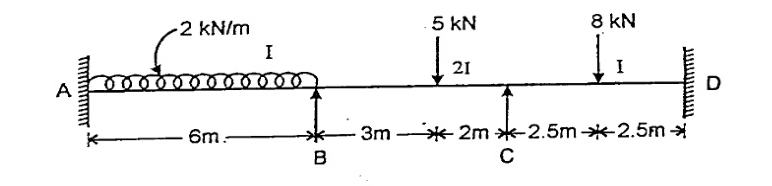
How to answer
- Compute fixed-end moments for UDL on AB and point loads on BC, CD with I, 2I, I
- Write slope-deflection equations for three spans with fixed ends A, D
- Apply joint equilibrium at B and C, solve rotations
- Compute support moments and plot bending moment diagram
Go to where you left off?
Quick Add to Notes
Save questions, your own notes and screenshots into notes filed by unit. It takes a free account.
Create free accountHave an account? Log in
Notes Panel