AL-402 · Analysis & Design of Algorithms/Unsolved PYQ Paper
AL-402 Analysis and Design of Algorithm - Nov 2023 Question Paper
Under each question, How to answer lists the points an answer should cover, outlined by CampusPrep from the syllabus. Check the details against your textbook.
-
7 MarksaDefine time complexity. Describe different notations used to represent time complexity.
How to answer
- Define time complexity as function of input size
- Explain Big-O, Omega, Theta (and little-o) notations
- Give mathematical definitions and examples
- Explain use in worst/best/average case analysis
-
7 MarksbDiscuss Strassen's matrix multiplication as well as classical $O(n^2)$ one. Determine when Strassen's method outperforms the classical one.
How to answer
- Describe classical matrix multiplication O(n^3) method
- Explain Strassen's 7-multiplication divide-and-conquer steps
- Give recurrence and complexity O(n^log2 7)
- Compare crossover point where Strassen outperforms classical
-
7 MarksaExplain partition exchange sort algorithm and trace this algorithm for $n = 8$ elements: 24, 12, 35, 23, 45, 34, 20, 48.
How to answer
- Explain quick sort / partition exchange sort partition logic
- Give algorithm pseudocode and pivot steps
- Trace partitions on given 8 elements
- Show final sorted order and complexity
-
7 MarksbState the Job - Sequencing with deadlines problem. Find an optimal sequence to the $n = 5$ Jobs where profits $(P_1, P_2, P_3, P_4, P_5) = (20, 15, 10, 5, 1)$ and deadlines $(d_1, d_2, d_3, d_4, d_5)=(2, 2, 1, 3, 3)$.
How to answer
- State job sequencing with deadlines formulation
- Sort jobs by profit and apply greedy deadline constraint
- Construct feasible optimal sequence
- Compute maximum profit
-
7 MarksaA thief enters a house for robbing. Thief can carry a maximum weight of 6kg into his bag. There are 3 items in the house with weights $(w_1, w_2, w_3) = (2, 3, 4)$ and profits $(p_1, p_2, p_3) = (1, 2, 5)$ what items should thief can take will get the maximum profit? He either takes or leaves the item.
How to answer
- Identify as 0/1 knapsack with capacity 6kg
- Compute profit/weight or DP table for 3 items
- Select take-or-leave combination with max profit
- State items taken and maximum profit
-
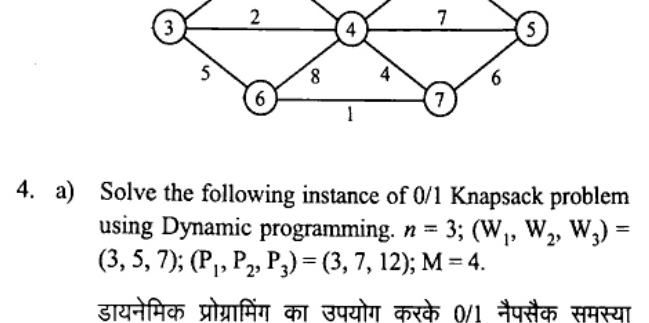
7 MarksbExplain prim's and Kruskal's algorithm shown in figure with the following example.
How to answer
- Explain Prim's growing-tree and Kruskal's sorted-edge rules
- Apply both step-by-step on given 7-node weighted graph
- Show MST edges selected at each step
- Compare total cost and complexity
-
7 MarksaSolve the following instance of 0/1 Knapsack problem using Dynamic programming. $n = 3$; $(W_1, W_2, W_3) = (3, 5, 7)$; $(P_1, P_2, P_3) = (3, 7, 12)$; $M = 4$.
How to answer
- Formulate 0/1 knapsack DP recurrence
- Build DP table for n=3, M=4
- Trace back optimal selection
- State max profit and items selected
-
7 MarksbDesign a three stage system with device types $D_1, D_2$ and $D_3$. The costs are $30, $15 and $20 respectively. The Cost of the system is to be no more than $105. The reliability of each device is 0.9,0.8 and 0.5 respectively.
How to answer
- State reliability design with cost constraint $105
- Use DP for multistage reliability optimization
- Evaluate device counts for D1, D2, D3
- Give max reliability design
-
7 MarksaDiscuss about Multistage graph problem. Also give a suitable algorithm and find its computing time.
How to answer
- Define multistage graph and stages
- Give forward/backward DP algorithm
- Analyze computing time O(V+E)
- Illustrate with example
-
7 MarksbWrite an algorithm to determine the Hamiltonian cycle in a given graph using backtracking.
How to answer
- Explain backtracking state-space formulation
- Give Hamiltonian cycle pseudocode with promising function
- Explain NextValue and backtrack steps
- State time complexity
-
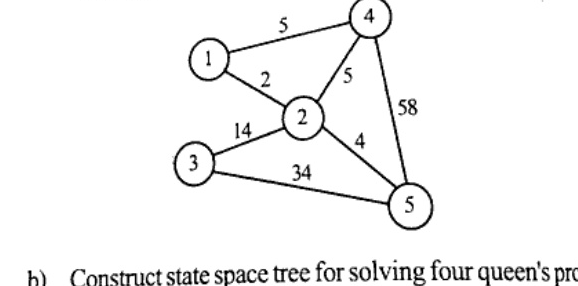
7 MarksaSolve the following instance of travelling sales person problem using Least Cost Branch Bound.
How to answer
- Formulate TSP as LC branch and bound
- Compute reduced cost bounds for nodes
- Expand state space tree to find least cost tour
- Give optimal tour and cost
-
7 MarksbConstruct state space tree for solving four queen's problem using backtracking.
How to answer
- Explain 4-queens backtracking constraints
- Draw state space tree with pruning
- Show feasible placements
- Give solutions
-
7 MarksaExplain the P, NP-Hard and NP-complete classes? Give the relation between them.
How to answer
- Define P, NP, NP-Hard, NP-complete classes
- Give examples of problems in each class
- Explain reducibility and relation diagram
- State P vs NP relationship
-
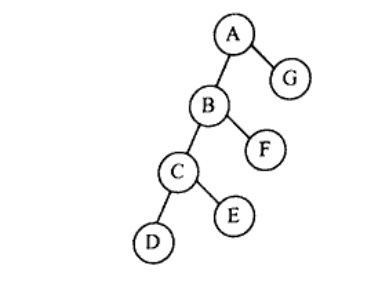
7 MarksbShow the inorder, preorder and postorder for the following tree
How to answer
- Parse given binary tree structure
- List preorder traversal (root-left-right)
- List inorder traversal (left-root-right)
- List postorder traversal (left-right-root)
-
14 MarksWrite short notes on any two of the following
- a)Data Transfer Optimization and Logic Optimization
- b)Differentiate between prim's algorithm and Kruskal's algorithm
- c)Parallel algorithms
- d)Approximation Algorithms
How to answer
- Select any two topics from a-d
- Give definition and key concepts for each
- Explain algorithm/steps with example
- Mention applications/complexity
Go to where you left off?
Quick Add to Notes
Save questions, your own notes and screenshots into notes filed by unit. It takes a free account.
Create free accountHave an account? Log in
Notes Panel