AL-402 · Analysis & Design of Algorithms/Unsolved PYQ Paper
AL-402 Analysis and Design of Algorithm - Dec 2024 Question Paper
Under each question, How to answer lists the points an answer should cover, outlined by CampusPrep from the syllabus. Check the details against your textbook.
-
7 MarksaSolve the following recurrence relation $T(n) = 7T(n/2) + cn^{2}$.
How to answer
- State Master theorem / recursion tree method assumptions
- Expand T(n)=7T(n/2)+c n^2 level by level
- Compare n^{log2 7} vs n^2 to get Theta(n^{log2 7})
- Write final asymptotic solution
-
7 MarksbShow how quick sort sorts the following sequence of keys $65, 70, 75, 80, 85, 60, 55, 50, 45$ Solve the recurrence relation of quick sort using substitution method.
How to answer
- Choose pivot and show partition steps for given keys
- Show recursive quick sort calls and intermediate arrays
- Write quick sort worst/average recurrence
- Solve recurrence by substitution method
-
7 MarksaExplain merge sort algorithm and find the complexity of the algorithm.
How to answer
- Explain divide, conquer and merge steps of merge sort
- Give pseudocode / algorithm
- Derive recurrence T(n)=2T(n/2)+O(n)
- Solve to O(n log n) time and O(n) space
-
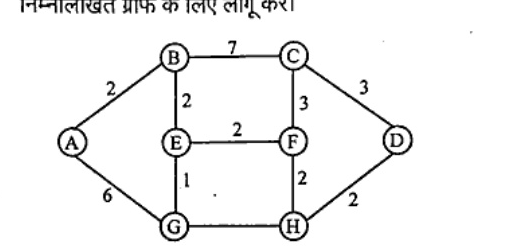
7 MarksbWrite an algorithm for single source shortest path and apply it for the following graph.
How to answer
- State single-source shortest path algorithm (Dijkstra)
- Give pseudocode and initialization steps
- Apply relaxation step by step on given graph
- Report shortest distances / shortest path tree
-
7 MarksaHow the Optimal Merge Pattern algorithm works? Explain with a suitable example.
How to answer
- Define optimal merge pattern objective
- Explain greedy choice using smallest files / min-heap
- Illustrate with suitable numeric example
- Give time complexity analysis
-
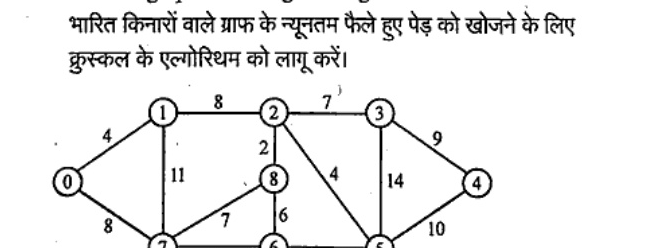
7 MarksbApply Kruskal's algorithm to find the minimum spanning tree of a graph with weighted edges.
How to answer
- State Kruskal's rule: sort edges and avoid cycles
- Sort all weighted edges in increasing order
- Select edges using union-find step by step
- Obtain minimum spanning tree and its total cost
-
7 MarksaWhat is multistage graph problem? Discuss its solution based on dynamic programming approach. Also give a suitable algorithm and find its computing time?
How to answer
- Define multistage graph and stages
- Give DP forward/backward recurrence for cost
- Write algorithm pseudocode
- Analyze computing time O(n+e) / O(stages)
-
7 MarksbCompute the optimal solution for knapsack problem using greedy method $N = 5, M = 10, (p_{1}, p_{2}, p_{3}, p_{4}, p_{5}) = (10, 15, 10, 12, 8), (w_{1}, w_{2}, w_{3}, w_{4}, w_{5}) = (3, 3, 2, 5, 1)$.
How to answer
- Compute profit/weight ratios for N=5 items
- Sort by ratio for fractional knapsack greedy
- Fill capacity M=10 step by step
- Compute maximum profit and optimal solution vector
-
7 MarksaDesign a three stage system with device types $D_{1}, D_{2}$ and $D_{3}$. The costs are $\$30, \$15$ and $\$20$ respectively. The Cost of the system is to be no more than $\$105$. The reliability of each device is $0.9, 0.8$ and $0.5$ respectively.
How to answer
- State reliability design / redundancy optimization model
- Use costs $30,$15,$20 and reliabilities 0.9,0.8,0.5 with budget $105
- Apply DP for three stages to allocate devices
- Give optimal design and maximum reliability
-
7 MarksbBriefly explain the Hamiltonian cycle using backtracking with a example.
How to answer
- Define Hamiltonian cycle problem
- Explain backtracking state-space tree and pruning
- Illustrate with example graph trace
- Give algorithm and complexity
-
14 MarksSolve the following instance of travelling sales person problem using Branch Bound. $$\begin{bmatrix} \infty & 20 & 30 & 10 & 11 \\ 15 & \infty & 16 & 4 & 2 \\ 3 & 5 & \infty & 2 & 4 \\ 19 & 6 & 18 & \infty & 3 \\ 16 & 4 & 7 & 16 & \infty \end{bmatrix}$$
How to answer
- Write given 5x5 cost matrix with infinities
- Perform row and column reduction for root bound
- Branch on edges and compute bounds for nodes
- Trace least-cost tour and give optimal cost
-
7 MarksaExplain the P, NP-Hard and NP-complete classes? Give the relation between them.
How to answer
- Define P, NP, NP-Hard, NP-Complete
- Give example problems for each class
- Explain reducibility and relation diagram
- Discuss P vs NP significance
-
7 MarksbExplain the purpose of design and complexity of parallel algorithms in detail.
How to answer
- Define parallel algorithm model
- Explain purpose: speedup, efficiency, scalability
- Discuss complexity measures: time, processors, cost
- Give examples of design issues
-
14 MarksWrite short notes on any two of the following:
- a)Logic Optimization
- b)Optimal merge patterns
- c)Data Transfer Optimization
- d)8 queen's problem using backtracking
How to answer
- Select any two topics from four options
- Give definition and key concepts for each
- Mention algorithm / steps / applications
- Conclude with example or use-case
Go to where you left off?
Quick Add to Notes
Save questions, your own notes and screenshots into notes filed by unit. It takes a free account.
Create free accountHave an account? Log in
Notes Panel