AL-402 · Analysis & Design of Algorithms/Unsolved PYQ Paper
AL-402 Analysis and Design of Algorithm - Jun 2022 Question Paper
Under each question, How to answer lists the points an answer should cover, outlined by CampusPrep from the syllabus. Check the details against your textbook.
-
7 MarksaExplain the various criteria used for analyzing algorithm.
How to answer
- Define time complexity, space complexity and other criteria
- Explain correctness, optimality, readability and robustness
- Discuss a priori vs a posteriori analysis with example
-
7 MarksbWhat is merge sort? Explain merge sort algorithm for the list: 65, 47, 24, 83, 91, 14, 53, 12
How to answer
- Define merge sort and divide-and-conquer principle
- Write merge sort and merge procedure steps / pseudocode
- Apply step-by-step to list 65, 47, 24, 83, 91, 14, 53, 12
- State time complexity O(n log n)
-
7 MarksaWrite the algorithm for Stassen's matrix multiplication.
How to answer
- State Strassen's divide-and-conquer idea for matrix multiplication
- Give 7 intermediate products M1-M7 formulas
- Give steps to compute result submatrices C11, C12, C21, C22
- Mention complexity O(n^2.81)
-
7 MarksbDefine Kruskal's algorithm and also write down the steps for the Kruskal's algorithm in detail.
How to answer
- Define Kruskal's algorithm for minimum spanning tree
- Steps: sort edges, initialize disjoint sets, select min edge avoiding cycle
- Explain union-find operations
- Give complexity O(E log E)
-
7 MarksaExplain how job sequencing with deadline can be solved using deadlines.
How to answer
- Define job sequencing with deadlines, profit objective
- Explain greedy sorting by profit and slot allocation
- Describe feasibility check using deadlines
- Illustrate with example schedule
-
7 MarksbExplain minimum spanning tree using Prim's algorithm for the given graph below.
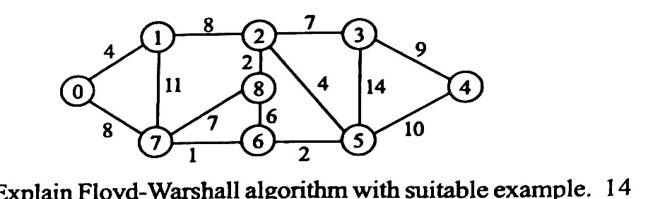
How to answer
- State Prim's algorithm principle starting from arbitrary vertex
- Show iterative selection of minimum fringe edge step-by-step on given graph
- Construct MST and compute total cost
- State complexity O(V^2) / O(E log V)
-
14 MarksExplain Floyd-Warshall algorithm with suitable example.
How to answer
- Explain all-pairs shortest path dynamic programming recurrence
- Give Floyd-Warshall pseudocode with k,i,j loops
- Work out suitable example with distance matrix iterations
- State complexity O(n^3)
-
7 MarksaFind optimal solution for 0/1 Knapsack problem $(w_1, w_2, w_3, w_4) = (10, 10, 12, 18); (P_1, P_2, P_3, P_4) = (2, 4, 6, 0)$ and $M = 15$.
How to answer
- List weights (10,10,12,18), profits (2,4,6,0), capacity M=15
- Evaluate feasible 0/1 subsets / DP table
- Select optimal feasible set maximizing profit
- State optimal profit and selected items
-
7 MarksbExplain in detail 8-Queens problem.
How to answer
- State 8-Queens constraints: row, column, diagonal attacks
- Explain backtracking state-space tree formulation
- Describe placement and backtrack steps with example
- Mention solution existence and complexity
-
7 MarksaWrite about different types of bounding functions with example.
How to answer
- Define bounding function in branch and bound
- Explain lower/upper bound for minimization/maximization
- Give examples e.g. knapsack, TSP bounding
- Compare different types
-
7 MarksbFind the optimal solution using least cost branch and bound with $n = 4, m = 15$. $(w_1, w_2, w_3, w_4)=(3,5,6,9); (P_1,P_2,P_3,P_4)=(15,15,17,23)$
How to answer
- Compute profit/weight ratios and initial bound
- Expand least-cost branch and bound tree for n=4, m=15
- Prune infeasible / bounded nodes
- Report optimal 0/1 selection and max profit
-
14 MarksDiscuss in detail P, NP, NP complete and NP Hard problems with examples.
How to answer
- Define classes P, NP, NP-complete, NP-hard
- Explain polynomial verification and reduction concept
- Give examples e.g. sorting in P, SAT, TSP, clique
- Show relationship diagram between classes
-
14 MarksWrite short notes on any three of the following.
- a)Binary search trees
- b)Huffman coding
- c)Multistage graph
- d)Hamiltonian cycle
- e)Quick sort.
How to answer
- Select any three topics from a-e
- For each: definition, working principle / algorithm steps
- Give example / diagram / complexity where applicable
- Conclude with applications
Go to where you left off?
Quick Add to Notes
Save questions, your own notes and screenshots into notes filed by unit. It takes a free account.
Create free accountHave an account? Log in
Notes Panel