AL-402 · Analysis & Design of Algorithms/Unsolved PYQ Paper
AL-402 Analysis and Design of Algorithm - Jun 2025 Question Paper
Under each question, How to answer lists the points an answer should cover, outlined by CampusPrep from the syllabus. Check the details against your textbook.
-
7 MarksaSolve the following recurrence relation using recursion tree method: $$T(n) = 2T(n/2) + n$$ $$T(1) = O(1)$$
How to answer
- Define recursion tree with root cost n and branching factor 2
- Expand levels: level i has 2^i nodes each cost n/2^i, total n per level
- Number of levels log n with leaf cost O(1)
- Sum total cost n log n to get T(n) = O(n log n)
-
7 MarksbShow the following recurrence relation using Master's theorem: $$T(n) = 2T(n/2) + n \log n$$
How to answer
- State Master's theorem cases for T(n)=aT(n/b)+f(n)
- Identify a=2, b=2, f(n)=n log n
- Compare f(n) with n^{log_b a}=n
- Conclude case and final Theta bound
-
7 MarksaFind the number of comparisons made by the sequential search for the worst and best case.
How to answer
- State sequential search scanning from first element
- Best case: key at first position gives 1 comparison
- Worst case: key at last or absent gives n comparisons
- Give O(1) best and O(n) worst
-
7 MarksbApply Quick sort on the array given below: 15, 31, 1, 9, 80, 12, 14, 7, 24
How to answer
- Choose pivot and partition step
- Show recursive partitions for given array
- Trace swaps and pivot positions
- Give final sorted array
-
7 MarksaList various problems that can be solved using the Greedy algorithm approach.
How to answer
- Define greedy choice property
- List problems: fractional knapsack, MST, Huffman, activity selection, Dijkstra
- Brief condition for applicability
- Give examples
-
7 MarksbWrite Kruskal's algorithm to find MST for a given graph. Also discuss about its time complexity.
How to answer
- Write steps: sort edges, initialize disjoint sets, pick safe edge
- Explain cycle avoidance using union-find
- Analyze sorting O(E log E) dominating
- Give total time complexity O(E log V)
-
7 MarksaWrite Dijkstra's Algorithm for the solution of single source shortest path problem.
How to answer
- Initialize distance, visited set with source 0
- Repeatedly relax edges from min-distance vertex
- Update predecessors for shortest paths
- Give O(V^2) / O(E log V) complexity
-
7 MarksbExplain fractional Knapsack problem in detail.
How to answer
- Define fractional knapsack with capacity and profit/weight
- Explain greedy by profit/weight ratio sorting
- Describe steps with fractional allowance
- Give example and O(n log n) time
-
7 MarksaWhat is 0/1 Knapsack problem? Is Greedy method effective to solve 0/1 Knapsack problem.
How to answer
- Define 0/1 knapsack with binary choice constraint
- Contrast with fractional version
- Explain why greedy fails with counterexample
- State need for DP / branch and bound
-
7 MarksbIs there anything common between dynamic programming and divide and conquer? What is the main difference between the two?
How to answer
- State common divide-and-conquer structure
- Explain overlapping subproblems and memoization in DP
- Contrast optimal substructure usage
- Give examples of each
-
7 MarksaObtain any two solutions to 4-queens problem. Establish the relationship between them.
How to answer
- Explain 4-queens constraints: row, column, diagonal
- Show two solutions e.g. [2,4,1,3] and [3,1,4,2]
- Draw 4x4 board placements
- Establish symmetry / complement relationship
-
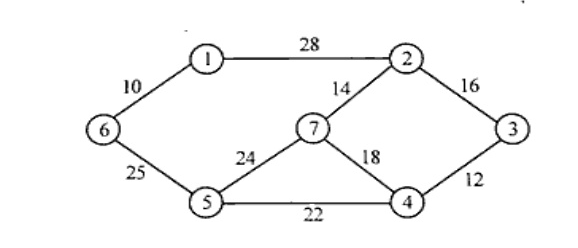
7 MarksbConstruct the minimum spanning tree for the given graph using Kruskal's Algorithm:
How to answer
- List all edges sorted by weight: 10,12,14,16,18,22,24,25,28
- Iteratively add safe edges avoiding cycles using Kruskal
- Construct MST with 6 edges
- Compute total minimum cost
-
7 MarksaWrite an algorithm for the implementation of binary search method.
How to answer
- State divide and conquer with low, high, mid
- Give pseudocode with comparison and recursion/iteration
- Explain O(log n) time on sorted array
- Mention termination conditions
-
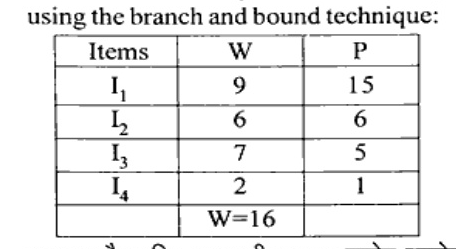
7 MarksbSolve the following instance of Knapsack problem by using the branch and bound technique:
How to answer
- Compute profit/weight ratios and sort items
- Build branch and bound state space tree with bounds
- Prune infeasible / non-promising nodes with W=16
- Report optimal 0/1 selection and max profit
-
7 MarksaExplain the class NP-complete with example.
How to answer
- Define NP-complete as NP and NP-hard
- Explain polynomial reduction concept
- Give examples: SAT, TSP, knapsack, clique
- Mention verification in polynomial time
-
7 MarksbThere are 8, 15, 13 and 14 number of nodes in 4 different trees. Which of them could have formed a Full Binary Tree?
How to answer
- Define full binary tree: each node 0 or 2 children
- Use property n = 2h+1 -1 i.e. odd number of nodes
- Check 8,15,13,14 for odd / 2^k-1 form
- Conclude only 15 can form full binary tree
Go to where you left off?
Quick Add to Notes
Save questions, your own notes and screenshots into notes filed by unit. It takes a free account.
Create free accountHave an account? Log in
Notes Panel