AL-402 · Analysis & Design of Algorithms/Unsolved PYQ Paper
AL-402 Analysis and Design of Algorithm - Jun 2023 Question Paper
Under each question, How to answer lists the points an answer should cover, outlined by CampusPrep from the syllabus. Check the details against your textbook.
-
7 MarksaDescribe the performance analysis of an algorithm in detail.
How to answer
- Define time and space complexity, a priori vs a posteriori analysis
- Explain asymptotic notations O, Omega, Theta with definitions
- Discuss best, average, worst case and performance measurement steps
- Give example of counting steps / frequency count
-
7 MarksbConsider the following recurrence $T(n)=3T(n/3) + n$ obtain asymptotic bound using substitution method.
How to answer
- Guess asymptotic bound e.g. $T(n)=O(n^{\log_3 3})$
- Assume inductive hypothesis $T(k) \le c k^{\log}$ for $k<n$
- Substitute into $T(n)=3T(n/3)+n$ and solve for c
- Conclude Theta bound and verify base case
-
7 MarksaWrite Divide - And - Conquer recursive Quick sort algorithm and analyze the algorithm for average time complexity.
How to answer
- Write Divide-and-Conquer Quick sort partition + recursive calls
- Set up recurrence for average case
- Solve to get $O(n \log n)$ average complexity
- Discuss pivot choice and partitioning cost
-
7 MarksbApply the Greedy method to solve Knapsack problem for given instance. Where $n = 3$, $m = 20$, $(p_1, p_2, p_3) = (25, 24, 15)$ and weight $(w_1, w_2, w_3) = (18, 15, 10)$
How to answer
- Compute profit/weight ratios for $n=3$ items
- Sort by ratio and take fractionally up to $m=20$
- Compute total profit $\sum p_i x_i$
- Show greedy selection steps
-
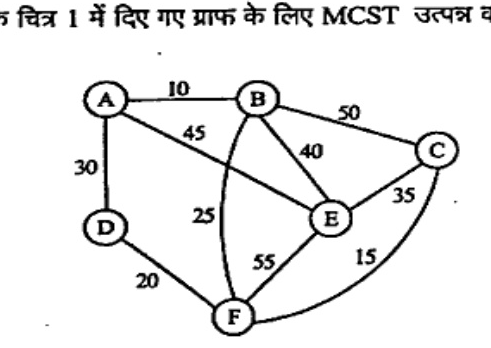
7 MarksaWrite Kruskal's Algorithm. Generate the MCST for the graph given in Figure 1 by applying Kruskal's algorithm.
How to answer
- Write Kruskal's algorithm steps with sort + union-find
- Sort edges of Figure 1 by weight
- Select edges avoiding cycle step by step
- Draw final MCST and compute total cost
-
7 MarksbObtain a set of optimal Huffman codes for the seven messages (M1, ... , M7) with relative frequencies $(q1, ... , q7) = (4, 5, 7, 8, 10, 22, 15)$. Draw the decode tree for this set of codes.
How to answer
- Sort frequencies (4,5,7,8,10,22,15) ascending
- Repeatedly merge two smallest to build Huffman tree
- Assign 0/1 codes and list optimal codes
- Draw decode tree with M1..M7 leaves
-
7 MarksaSolve the following 0/1 Knapsack problem using dynamic programming $P = (11, 21, 31, 33)$, $W = (2, 12, 23, 15)$, $C = 42$, $n = 4$.
How to answer
- Formulate 0/1 knapsack DP table for P=(11,21,31,33), W=(2,12,23,15), C=42
- Fill DP recurrence $V[i][w]=max$
- Trace back optimal subset
- State max profit and selected items
-
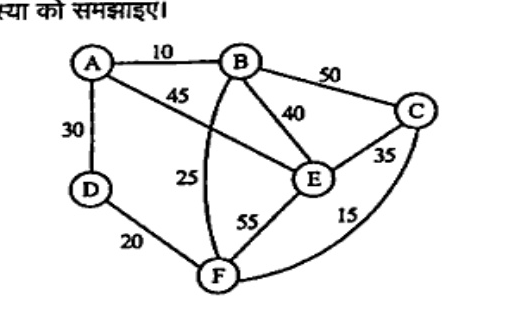
7 MarksbExplain Floyd Warshall algorithm problem with the graph given in figure.
How to answer
- State Floyd-Warshall all-pairs shortest path recurrence
- Initialize distance matrix from given graph
- Iterate k = A..F updating distances
- Show final shortest distances
-
7 MarksaWhat is multistage graph problem? Discuss its solution based on dynamic programming approach. Also give a suitable algorithm and find its computing time?
How to answer
- Define multistage graph and stages
- Give forward/backward DP recurrence for min cost
- Write algorithm and analyze $O(|V|+|E|)$ time
- Illustrate with example
-
7 MarksbFind a solution to the 8-Queens problem using backtracking strategy. Draw the solution space using necessary bounding function.
How to answer
- Explain backtracking with bounding function and state space tree
- Place queens row by row checking column/diagonal
- Show one 8-queens solution vector
- Draw pruned solution space tree
-
7 Marksa
Solve the traveling salesperson problem using branch and bound technique.
A B C A 0 3 4 B 6 0 4 C 3 5 0 How to answer
- Write cost matrix for A,B,C
- Expand branch-and-bound state space with lower bounds
- Prune and select minimum cost tour
- State optimal TSP tour and cost
-
7 MarksbWhat is Backtracking? Discuss any one problem solved by backtracking. Also give its advantages and disadvantages.
How to answer
- Define backtracking as DFS with backtrack on dead end
- Explain one example e.g. N-Queens / sum of subsets / graph coloring
- List advantages: pruning, memory efficient
- List disadvantages: exponential worst case
-
7 MarksaCompare and contrast NP-Hard and NP-Complete classes.
How to answer
- Define NP-Hard and NP-Complete with reducibility
- Compare on definition, relation, solvability
- Give examples: SAT, TSP, clique
- Conclude NP-Complete subset of NP-Hard
-
7 MarksbCreate a B-tree for the following list of elements $L = \{86, 50, 40, 3, 94, 10, 70, 90, 110, 113, 116\}$ given minimization factor $t = 3$, minimum degree $= 2$ and maximum degree $= 5$.
How to answer
- State B-tree properties for t=3, min degree 2, max degree 5
- Insert keys {86,50,40,3,94,10,70,90,110,113,116} stepwise with splits
- Show intermediate nodes after each split
- Draw final B-tree
-
14 MarksWrite short notes on any two of the following:
- a)Reliability design
- b)Correctness proof of Greedy algorithms
- c)Design and complexity of Parallel Algorithms
- d)Graph coloring problem
How to answer
- Select any two topics from a-d
- Give definition and key concepts for each
- Explain algorithm / proof / design with example
- Add diagram or applications where relevant
Go to where you left off?
Quick Add to Notes
Save questions, your own notes and screenshots into notes filed by unit. It takes a free account.
Create free accountHave an account? Log in
Notes Panel