ME-703 (A) · Operation Research & Supply Chain/Unsolved PYQ Paper
ME-703-A Operation Research & Supply Chain - Dec 2025 Question Paper
Under each question, How to answer lists the points an answer should cover, outlined by CampusPrep from the syllabus. Check the details against your textbook.
-
7 MarksaSolve the following LPP by Simplex method. $Z_{min} = x_1 - 3x_2 + 2x_3$ Subject to, $3x_1 - x_2 + 2x_3 \le 7$ $-2x_1 + 4x_2 \le 12$ $4x_1 + 3x_2 + 8x_3 \le 10$
How to answer
- Convert to standard form with slack variables for maximization of -Z
- Construct initial simplex tableau and identify entering/leaving variables
- Iterate simplex pivots until optimality condition satisfied
- Read optimal x1, x2, x3 and Z_min value
-
7 MarksbDetermine an initial basic feasible solution to the following transportation problem by using Vogel's approximation method.
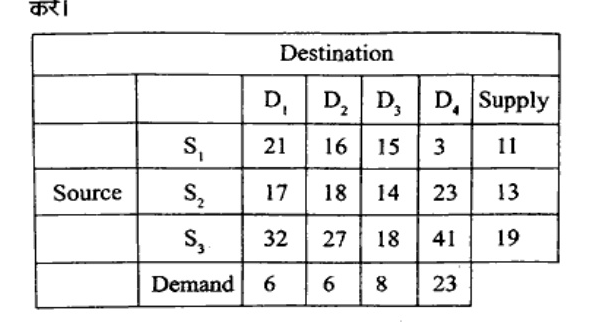
How to answer
- Compute row and column penalties (Vogel's) from cost matrix
- Allocate to highest penalty cell with min cost exhausting supply/demand
- Recalculate penalties after each allocation
- Obtain IBFS and compute total transportation cost
-
7 MarksaGive the mathematical formulation of an assignment problem. How does it differ form a transportation problem?
How to answer
- Define decision variables x_ij and cost c_ij with objective minimize sum
- State assignment constraints: one job per person and vice versa, x_ij = 0/1
- Explain square matrix, supply=demand=1 properties
- Contrast with transportation: general m x n, fractional flows vs 1-to-1 assignment
-
7 MarksbDescribe the flow of materials, money, and information in a typical supply chain with an example.
How to answer
- Define supply chain stages from supplier to customer
- Explain forward material flow and reverse returns
- Explain reverse money flow and forward information flow
- Give example e.g. manufacturer-retailer with order, delivery, payment
-
7 MarksaExplain the role of Information Technology (IT) and information sharing in improving supply chain performance.
How to answer
- Define IT and information sharing in SCM context
- Explain visibility, coordination, bullwhip reduction
- Give technologies: ERP, EDI, RFID, SCM software
- Link to performance metrics: cost, lead time, service level
-
7 MarksbDescribe the effect of variability from multiple suppliers on supply chain performance.
How to answer
- Define supplier variability: lead time, quality, quantity
- Explain impact on safety stock, stockouts, production disruption
- Explain cost and reliability effects on chain performance
- Mention mitigation: dual sourcing, contracts, collaboration
-
7 MarksaA company uses 24000 units of a raw material which costs Rs.12.50 per unit. Placing each order costs Rs.22.50 and the carrying cost is 5.4% per year of the average inventory. Find the economic order quantity and the total inventory cost (including the cost of material).
How to answer
- State EOQ formula Q* = sqrt(2DS/H)
- Compute carrying cost H = 5.4% of Rs.12.50 and annual demand
- Calculate EOQ quantity and number of orders
- Compute total cost = material + ordering + carrying cost
-
7 MarksbWhat is ABC analysis in inventory control? Describe it in detail with the help of graph.
How to answer
- Define ABC classification based on annual consumption value
- Explain A-B-C categories with % items vs % value
- Describe Pareto curve graph with cumulative %
- Explain control policies for each class
-
7 MarksaWhat is Just-In-Time (JIT) manufacturing? Explain its relationship with Lean Manufacturing principles.
How to answer
- Define JIT as pull system producing only on demand
- Explain waste elimination, small lots, kanban, setup reduction
- Relate to Lean principles: value, flow, pull, perfection
- Mention benefits and prerequisites
-
7 MarksbCustomers arrive at a box office window, being managed by a single individual, according to a poisson input process with mean rate of 30 per hour. The time required to serve a customer has an exponential distribution with a mean of 90 seconds. Find the average waiting time of a customer. Also determine the average number of customers in the system and average queue length.
How to answer
- Identify M/M/1 model with lambda=30/hr, mu=40/hr from 90 sec
- Apply Wq = lambda/(mu(mu-lambda)) for waiting time
- Compute Ls = lambda/(mu-lambda) and Lq
- Convert to minutes and interpret utilization rho
-
7 Marksa
Solve the following game graphically.
Player B
Player A $B_1$ $B_2$ $A_1$ 1 -3 $A_2$ 3 5 $A_3$ -1 6 $A_4$ 4 1 $A_5$ 2 2 $A_6$ -5 0 How to answer
- Check for saddle point and dominance to reduce matrix
- Plot payoff lines for A strategies vs B mix on graph
- Identify upper/lower envelope and minimax point
- Solve 2x2 reduced game for optimal mixes and value
-
7 MarksbWhat is optimal strategy? Discuss rectangular games without saddle points.
How to answer
- Define optimal strategy and value of game
- Define saddle point and minimax-maximin criterion
- Explain solution of rectangular games without saddle point via mixed strategies
- Mention dominance, graphical and LP methods
-
7 MarksaThe table gives precedence relationships and the duration of various activities.
- i)Draw the PERT network
- ii)Identify critical path, considering the schedule project duration is 57 days.
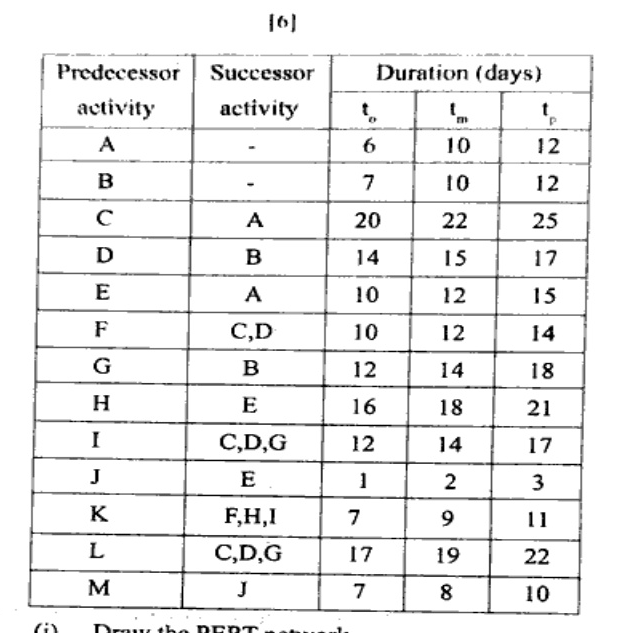
How to answer
- Compute expected time te = (to+4tm+tp)/6 and variance for each activity
- Construct PERT network from predecessor-successor table
- Perform forward/backward pass to find earliest/latest times and slack
- Identify critical path and compare duration with 57 days schedule
-
7 MarksbExplain the rules of network construction and Fulkerson's rule for numbering the events.
How to answer
- State basic rules: single start/end, no loops, activity by one arrow
- Explain dummy activities and precedence representation
- Explain Fulkerson's numbering steps forward from start
- Mention check for dangling and crossing errors
-
14 MarksWrite short notes on any two:
- a)Meta-heuristics in modern engineering optimization.
- b)VED analysis.
- c)Supply contracts and revenue sharing models in SCM.
- d)Special cases in Linear Programming.
How to answer
- Select any two topics with definition and key concepts
- Explain principles, formulas or models with steps
- Give example or application in OR/SCM
- Conclude with advantages/limitations
Go to where you left off?
Quick Add to Notes
Save questions, your own notes and screenshots into notes filed by unit. It takes a free account.
Create free accountHave an account? Log in
Notes Panel