ME-703 (A) · Operation Research & Supply Chain/Unsolved PYQ Paper
ME-703-A Operation Research and Supply Chain - Nov 2023 Question Paper
Under each question, How to answer lists the points an answer should cover, outlined by CampusPrep from the syllabus. Check the details against your textbook.
-
14 MarksA small manufacturer employs 5 skilled men and 10 semi-skilled men and makes an article in two qualities, a deluxe model and an ordinary model. The making of a deluxe model requires 2 hours work by a skilled man and 2 hours work by a semi-skilled man. The ordinary model requires 1 hour work by a skilled man and 3 hours work by a semi-skilled man. By union rules no man can work more than 8 hours per day. The manufacturer's clear profit of the deluxe model is Rs. 10 and of the ordinary model Rs. 8. Formulate the model of the problem.
How to answer
- Define decision variables for deluxe and ordinary models
- Formulate objective function for profit maximization: Max Z = 10x1 + 8x2
- Formulate skilled and semi-skilled hour constraints with 40 and 80 hours availability
- Add non-negativity constraints x1, x2 >= 0
-
14 MarksSolve by Simplex method: Maximize $Z = 2x_1 + x_2$ Subject to $x_1 + 2x_2 \le 10$ $x_1 + x_2 \le 6$ $x_1 - x_2 \le 2$ $x_1 - 2x_2 \le 1$ $x_1, x_2 \ge 0$
How to answer
- Convert inequalities to standard form with slack variables
- Construct initial simplex tableau
- Iterate pivot operations to optimality
- State optimal values of $x_1, x_2$ and max $Z$
-
7 MarksaCan degeneracy occur in a transportation problem? Justify your answer.
How to answer
- Define degeneracy in transportation problem (m+n-1 allocations)
- Explain when degeneracy occurs at initial and optimal stages
- Justify with condition and resolution using epsilon
-
7 MarksbFind the initial basic feasible solution to the following transportation problem by North-West corner rule.
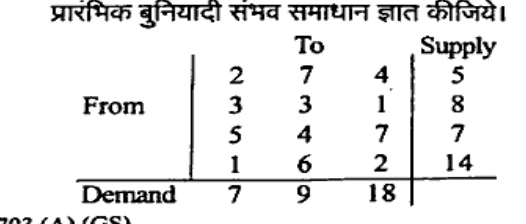
How to answer
- Tabulate cost, supply and demand
- Apply North-West corner allocations sequentially
- Compute number of allocations and total cost
- State initial basic feasible solution
-
7 MarksaExplain what is Bull-whip effect in SCM?
How to answer
- Define bullwhip effect and its origin in SCM
- Explain causes like demand distortion and order batching
- Describe consequences on inventory and costs
-
7 MarksbDiscuss what is cross docking? What are its disadvantages?
How to answer
- Define cross docking concept
- Explain working with example
- List disadvantages like coordination need and capital cost
-
14 MarksA company uses 1,200 units per month of an electronic component each costing Rs. 3. Placing each order costs Rs. 60 and the carrying cost is 8% per year of the average inventory.
- i)Find EOQ
- ii)If the company gets 5% discount on single order, should it accept the discount offer.
- iii)Find discount percentage which matches EOQ ordering for a single order.
How to answer
- Compute annual demand, ordering and carrying costs and EOQ formula
- Evaluate total cost with and without 5% discount
- Decide on discount acceptance and find break-even discount percentage
-
7 MarksaHow competitive advantages can be achieved using MRP?
How to answer
- Define MRP and its functions
- Explain how MRP reduces inventory and lead time
- Link to competitive advantage with example
-
7 MarksbHow SCM is linked with e-business? Explain.
How to answer
- Define SCM and e-business linkage
- Explain information sharing and integration
- Give examples of e-procurement and e-logistics
-
7 MarksaDefine a queue and explain the various queue disciplines.
How to answer
- Define queue and queuing system elements
- List disciplines: FCFS, LCFS, SIRO, priority
- Explain each with example
-
7 MarksbIn a bank, 20 customers on the average, are served by a cashier in an hour. If the service time has exponential distribution. What is the probability that it will take more than 15 minutes to serve a customer.
How to answer
- Identify service rate mu = 20 per hour exponential
- Apply exponential probability P(T > t) = e^{-mu t}
- Compute for t = 15 minutes = 0.25 hour
-
7 MarksaWhat does a critical path actually signify? In what ways does it differ from any other path.
How to answer
- Define critical path and its zero slack property
- Explain significance for project duration
- Differentiate from non-critical paths with float
-
7 MarksbPERT calculations yield a project length of 60 weeks with variance of 9. Within how many weeks would you expect the project to be completed with probability of 0.99?
How to answer
- Note mean = 60 weeks, variance = 9 so sigma = 3
- Use normal deviate for 0.99 probability Z ~ 2.33
- Compute X = mean + Z*sigma
Go to where you left off?
Quick Add to Notes
Save questions, your own notes and screenshots into notes filed by unit. It takes a free account.
Create free accountHave an account? Log in
Notes Panel