ME-703 (A) · Operation Research & Supply Chain/Unsolved PYQ Paper
ME-703-A Operation Research and Supply Chain - Dec 2024 Question Paper
Under each question, How to answer lists the points an answer should cover, outlined by CampusPrep from the syllabus. Check the details against your textbook.
-
14 MarksA small manufacturer employs 15 skilled men and 30 semi-skilled men and makes an article in two qualities, a deluxe model and an ordinary model. The making of a deluxe model requires 2 hours work by a skilled man and 4 hours work by a semi skilled man. The ordinary model requires 1 hour work by a skilled man and 5 hours work by a semi skilled man. By union rules no man can work more than 8 hours per day. The manufacturer's clear profit of the deluxe model is Rs. 20 and of the ordinary model Rs. 10. Formulate the model of the problem.
How to answer
- Define decision variables for deluxe and ordinary models
- State objective to maximize profit: Z = 20x1 + 10x2
- Formulate skilled-men hours constraint and semi-skilled-men hours constraint using 8 hours x men
- Add non-negativity constraints
-
14 MarksSolve the following problem by simplex method: Maximize $Z = 20x_{1} + 25x_{2}$ Subject to $12x_{1} + 16x_{2} \le 100$ $16x_{1} + 8x_{2} \le 80$ $x_{1}, x_{2} \ge 0$
How to answer
- Convert to standard form with slack variables
- Prepare initial simplex tableau
- Iterate pivot on key column/row to improve Z
- Check optimality and read x1, x2 and max Z
-
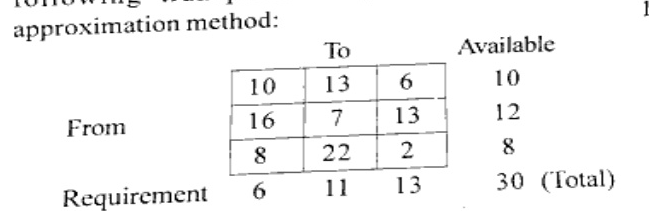
14 MarksDetermine the Initial basic feasible solution to the following transportation problem using Vogel's approximation method:
How to answer
- Check balanced supply = demand = 30
- Compute row and column penalties and allocate to least cost
- Repeat penalties until all supply/demand satisfied
- Report allocated cells and initial transportation cost
-
7 MarksaExplain flow of material money and information in SCM.
How to answer
- Define SCM and its three flows
- Explain material flow forward from supplier to customer
- Explain money flow backward and information flow both ways
- Give diagram/example of flows
-
7 MarksbDiscuss importance of inbound logistics in SCM.
How to answer
- Define inbound logistics
- Explain role in sourcing, procurement, inventory
- Link to cost, quality and continuity of supply
- Give SCM benefits
-
7 MarksaWhat is Bull-Whip effect? Explain.
How to answer
- Define Bull-Whip effect
- Explain demand amplification upstream
- List causes: batching, price fluctuation, rationing
- Mention remedies
-
7 MarksbDiscuss importance of outsourcing in SCM.
How to answer
- Define outsourcing in SCM context
- Explain cost, focus, flexibility benefits
- Discuss risks and control aspects
- Give examples
-
14 MarksA stockist has to supply 420 units of a product every Monday to his customers. He gets the product at Rs. 50 per unit from the manufacturer. The cost of ordering and transportation from the manufacturer is Rs. 80 per order. The cost of carrying inventory is 8.0% per year of the cost of the product. Find.
- i)The economic lot size
- ii)The total optimal cost
- iii)The total weekly profit if the item is sold for Rs. 50 per unit
How to answer
- Compute annual demand D from 420 units per week
- Apply EOQ formula sqrt(2DS/H) with H = 8% of Rs. 50
- Compute total optimal cost including ordering + carrying
- Compute weekly profit as sales minus purchase and inventory costs
-
7 MarksaOn an average 8 customers reach a telephone booth every hour to make calls. Determine the probability that exactly 6 customers will reach 40 minute period, assuming that arrivals follow Poisson distribution.
How to answer
- Compute mean arrival for 40 min: lambda*t = 8*(2/3)
- Write Poisson pmf P(x)=e^-m m^x/x!
- Substitute m and x=6 and calculate
- State probability value
-
7 MarksbExplain dominance rule.
How to answer
- Define dominance in game theory
- Explain row vs column dominance rules
- Explain deletion of dominated strategies
- Give small example of reduction
-
7 MarksaDiscuss applications of PERT/CPM in project planning and explain the difference between them.
How to answer
- Define PERT and CPM
- List applications in scheduling, crashing, resource planning
- Compare on activity time, orientation, uncertainty
- Give table of differences
-
7 MarksbHow will you find the probability of completing a PERT project by a particular due date?
How to answer
- Find critical path mean and variance from expected times
- Compute Z = (Due date - expected duration)/sigma
- Use normal distribution table for probability
- Interpret probability of completion
Go to where you left off?
Quick Add to Notes
Save questions, your own notes and screenshots into notes filed by unit. It takes a free account.
Create free accountHave an account? Log in
Notes Panel