ME-703 (A) · Operation Research & Supply Chain/Unsolved PYQ Paper
ME-703-A Operation Research and Supply Chain - May 2024 Question Paper
Under each question, How to answer lists the points an answer should cover, outlined by CampusPrep from the syllabus. Check the details against your textbook.
-
14 MarksOld hens can be bought of Rs. 6 each but young ones cost Rs. 12 each. The old hens lay 4 eggs per week and young ones 6 eggs per week, each egg buying worth Rs. 2. A hen costs Rs. 4 per week to feed. If a person has only Rs. 100 to spend on the hens how many of each kind should he buy to get a profit of more than Rs. 10 per week assuming that he cannot house more than 30 hens?
How to answer
- Define decision variables for old hens and young hens
- Formulate objective for weekly profit and constraints for cost, housing and profit
- Solve LPP graphically or by simplex to find numbers to buy
-
14 MarksSolve the following problem by the simplex method: Maximize $X = 3x_1 + 2x_2$ Subject to $x_1 + x_2 \le 8$ $x_1 - x_2 \le 2$
How to answer
- Convert to standard form with slack variables
- Construct initial simplex tableau
- Iterate pivot operations to optimality
- State optimal $x_1, x_2$ and max $X$
-
14 MarksFind the initial basic feasible solution of the following transportation problem by Vogel's Approximation Method:
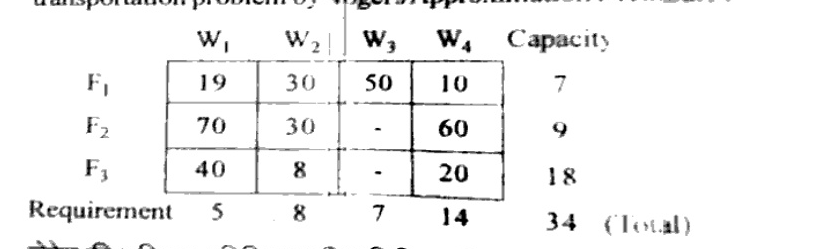
How to answer
- Check balanced transportation problem total 34
- Calculate row and column penalties
- Allocate by highest penalty and repeat
- State initial basic feasible solution and cost
-
7 MarksaDiscuss expenditure and opportunities in SCM.
How to answer
- Define SCM expenditure areas
- List cost drivers and opportunities
- Link to efficiency and competitiveness
-
7 MarksbExplain the importance of outbound logistics in SCM.
How to answer
- Define outbound logistics
- Explain role in distribution and customer service
- State importance for cost and delivery performance in SCM
-
7 MarksaWhat is Bull-Whip Effect? Explain.
How to answer
- Define Bull-Whup/Bullwhip effect
- Explain causes like demand distortion and order batching
- Describe consequences and remedies
-
7 MarksbWhat is cross docking? Explain its importance.
How to answer
- Define cross docking
- Explain working with example
- State importance for inventory and transportation cost
-
14 MarksA stockist has to supply 12,000 units of a product per year to his customer. The demand is fixed and known and the shortage cost is assumed is to be infinite. The inventory holding cost is Rs. 0.40 per unit per month and the ordering cost per order is Rs. 400. Determine:
- i)The optimum lot size
- ii)Optimum scheduling period
- iii)Minimum total variable yearly cost
How to answer
- State EOQ formula with given demand and costs
- Compute optimum lot size $Q^* = \sqrt{2DC_h^{-1}}$
- Compute scheduling period and minimum total variable yearly cost
-
7 MarksaIn a bank 30 customers on the average are served by a cashier in an hour. If the service time has exponential distribution what is the probability that:
- i)It will take more than 12 minutes to serve a customer.
- ii)A customer shall be free with 6 minutes.
How to answer
- Compute mean service rate $\mu = 30$ per hour
- Use exponential CDF $P(T>t)=e^{-\mu t}$ for 12 minutes
- Compute $P(T\le 6 min)$ for free within 6 minutes
-
7 MarksbExplain pure and mixed strategies in Game? Enlist basic assumptions.
How to answer
- Define pure strategy with example
- Define mixed strategy with probabilities
- List basic assumptions of game theory
-
7 MarksaDiscuss the similarities and difference of CPM and PERT.
How to answer
- Define CPM and PERT
- List similarities like network and critical path
- List differences in time estimates and application
-
7 MarksbExplain the terms:
- i)Optimistic time
- ii)Pessimistic time
- iii)Most likely time
How to answer
- Define optimistic time
- Define pessimistic time
- Define most likely time and expected time formula
Go to where you left off?
Quick Add to Notes
Save questions, your own notes and screenshots into notes filed by unit. It takes a free account.
Create free accountHave an account? Log in
Notes Panel