ME-304 · Strength of Material/Unsolved PYQ Paper
ME-304 Strength of Material - Jun 2025 Question Paper
Under each question, How to answer lists the points an answer should cover, outlined by CampusPrep from the syllabus. Check the details against your textbook.
-
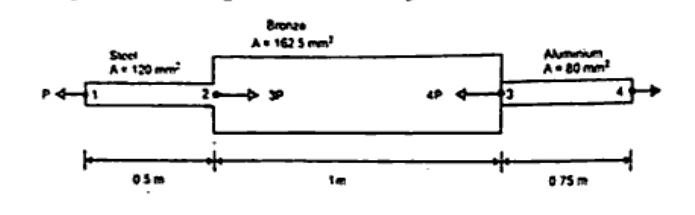
7 MarksaA bar is made of three segments of different sizes and materials as is subjected to axial loads at different positions. Determine the largest value of $P$ that will not exceed an overall axial deformation of $1.5\text{ mm}$ or the stresses : $140\text{ MPa}$ in steel, $120\text{ MPa}$ in the bronze and $80\text{ MPa}$ in the aluminium. Assume no lateral deformation. Consider $E_s = 200\text{ GPa}$, $E_a = 70\text{ GPa}$ and $E_b = 83\text{ GPa}$.
How to answer
- Determine axial internal forces in each of the three sections in terms of P using equilibrium/sections.
- Calculate allowable load P based on stress limits for steel, bronze, and aluminium.
- Formulate total elongation equation as sum of individual elongations in terms of P and equate to 1.5 mm.
- Select the minimum value of P among all four constraints as the maximum safe load.
-
7 MarksbDerive a relation for change in length of a uniformly varying circular bar subjected to an axial load 'P'.
How to answer
- Draw diagram of linearly tapering circular bar with diameters d1 and d2 and length L.
- Express diameter at distance x from one end: d(x) = d1 + (d2 - d1)(x/L).
- Write formula for extension of elementary slice dx: d(delta) = P dx / (A(x) * E).
- Integrate from x = 0 to L to obtain delta = 4PL / (pi * E * d1 * d2).
-
7 MarksaA simply supported cast-iron square beam of $800\text{ mm}$ length and $15\text{ mm} \times 15\text{ mm}$ in section fails on applying a load of $360\text{ N}$ at the midspan. Find the maximum uniformly distributed load that can be applied safely to a $40\text{ mm}$ wide, $75\text{ mm}$ deep and $1.6\text{ m}$ long cantilever made of the same material.
How to answer
- Calculate maximum bending moment for simply supported beam: M1 = (W * L1) / 4.
- Calculate section modulus Z1 = (b1 * d1^2) / 6 and find ultimate bending stress sigma_b.
- Equate failure stress to cantilever bending stress using section modulus Z2 = (b2 * d2^2) / 6.
- Determine maximum allowable moment M2 = w * L2^2 / 2 and solve for maximum UDL w.
-
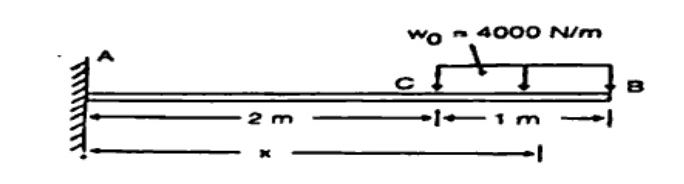
7 MarksbDetermine the maximum deflection for the cantilever beam loaded as shown in the figure, if the cross-section is a rectangle $50\text{ mm}$ wide by $150\text{ mm}$ deep. Use $E = 69\text{ GPa}$.
How to answer
- Calculate moment of inertia I = b*d^3 / 12 and flexural rigidity EI.
- Set up deflection formula using Macaulay's method, moment-area method, or superposition.
- Compute slope and deflection at point C (end of unloaded section) due to the load on CB.
- Add deflection of segment CB relative to tangent at C to determine total tip deflection at B.
-
7 MarksaCompare the weights of equal length of a solid and hollow shaft to transmit a given torque for the same maximum stress if the inside diameter of the shaft is three fourth of the outside.
How to answer
- State torsion formulas for solid and hollow shafts: T = (pi/16) * tau * D_s^3 and T = (pi/16) * tau * D_h^3 * (1 - k^4), where k = d_i / D_h = 0.75.
- Equate torque capacities to relate D_s and D_h: D_s^3 = D_h^3 * (1 - k^4).
- Write ratio of weights: W_h / W_s = (D_h^2 - d_i^2) / D_s^2 = D_h^2(1 - k^2) / D_s^2.
- Substitute D_s in terms of D_h and evaluate numerical ratio.
-
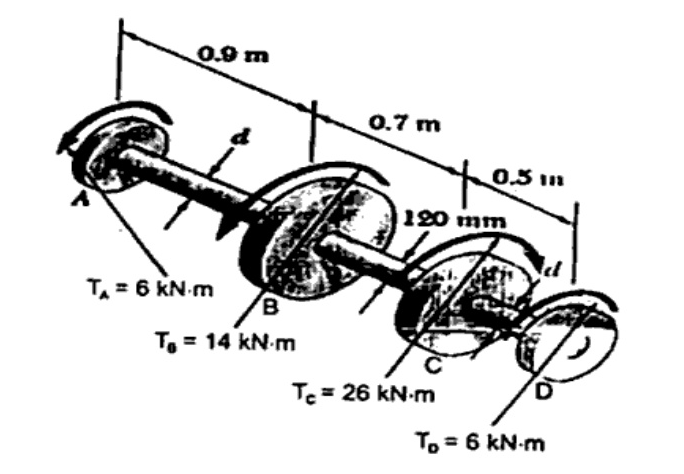
7 MarksbShaft BC is hollow with inner and outer diameters of $90\text{ mm}$ and $120\text{ mm}$, respectively. Shafts AB and CD are solid and of diameter $d$. For the loading shown, determine i) The maximum and minimum shearing stress in shaft BC. ii) The required diameter $d$ of shafts AB and CD if the allowable shearing stress in these shafts is $65\text{ MPa}$.
-
7 MarksaPrinciple stresses in a mild steel body are $50\text{ MPa}$ tensile and $95\text{ MPa}$ compressive, third principle stress being zero. Determine the factor of safety based on elastic limit, if the criterion of failure is maximum shear stress theory. The elastic limit in simple tension as well as in compression is $210\text{ MPa}$. What will be the factor of safety if the stress with $95\text{ MPa}$ is also tensile instead of compressive?
How to answer
- State Tresca's maximum shear stress failure theory: max(|sigma1 - sigma2|, |sigma2 - sigma3|, |sigma3 - sigma1|) = sigma_y / FOS.
- Case 1: sigma1 = 50 MPa, sigma2 = -95 MPa, sigma3 = 0. Maximum difference is 50 - (-95) = 145 MPa. Calculate FOS1 = 210 / 145 = 1.45.
- Case 2: sigma1 = 50 MPa, sigma2 = 95 MPa, sigma3 = 0. Maximum difference is 95 - 0 = 95 MPa. Calculate FOS2 = 210 / 95 = 2.21.
-
7 MarksbExplain the theory of failure for i) Ductile materials ii) Brittle materials
How to answer
- Explain failure in ductile materials via yielding (shear slip): Tresca's maximum shear stress theory and von Mises' distortion energy theory.
- State yield criteria and conditions of applicability for ductile materials.
- Explain failure in brittle materials via fracture (tensile separation): Rankine's maximum principal stress theory and Mohr-Coulomb failure criterion.
- State why maximum principal stress governs brittle materials due to weak tensile strength.
-
7 MarksaWhat is meant by equivalent length of columns? What are its values for different end conditions of columns?
How to answer
- Define equivalent (effective) length as the length of an equivalent pin-ended column having the same buckling load.
- State that it represents the distance between two successive points of contraflexure (inflection points).
- Tabulate effective lengths (L_e) for standard cases: Both ends hinged (L_e = L), One fixed and other free (L_e = 2L), Both ends fixed (L_e = L/2), One fixed and other hinged (L_e = L / sqrt(2)).
- Provide sketches showing deflected shapes and inflection points.
-
7 MarksbA aluminum strut $1.8\text{ m}$ long has a rectangular section $20\text{ mm}$ by $50\text{ mm}$. A bolt through each ends keeps the strut in position so that in acts as a hinged column about an axis perpendicular to the $50\text{ mm}$ dimension and as a fixed-ended column about an axis perpendicular to the $20\text{ mm}$ dimension. Determine the safe central load, using a factor of safety of $2$ and $E = 71\text{ GPa}$.
How to answer
- Identify the two principal axes of the cross section: x-axis parallel to 50 mm, y-axis parallel to 20 mm.
- Calculate I_xx = (50 * 20^3) / 12 and I_yy = (20 * 50^3) / 12.
- Determine effective lengths for each axis based on end conditions: L_ex = L (hinged) and L_ey = L/2 (fixed).
- Calculate Euler critical load for both axes: P_cr_x and P_cr_y.
- Take the lower of the two critical loads and divide by factor of safety (2) to find the safe load.
-
7 Marksai) What do you mean by principal planes and principal stresses? ii) What is Mohr's stress circle? How is it useful in the solution of stress-analysis problems?
How to answer
- Define principal planes as planes where shear stress is zero.
- Define principal stresses as normal stresses acting on principal planes (maximum and minimum normal stresses).
- Define Mohr's circle as a graphical representation of plane stress transformation equations.
- Explain usefulness: directly finding normal/shear stresses on any oblique plane, finding principal stresses, finding maximum shear stress and their orientations.
-
7 MarksbA piece of material is subjected to two perpendicular tensile stresses of $100\text{ MPa}$ and $60\text{ MPa}$. Determine the plane on which the resultant stress has maximum obliquity, with the normal. Also, find the resultant stress on this plane.
How to answer
- State formula for maximum angle of obliquity: sin(phi_max) = (sigma_1 - sigma_2) / (sigma_1 + sigma_2) = (100 - 60) / (100 + 60) = 40 / 160 = 0.25.
- Calculate phi_max = arcsin(0.25) = 14.48 degrees.
- Determine the orientation of plane of maximum obliquity: theta = 45 degrees + phi_max / 2.
- Calculate resultant stress on this plane using sigma_R = sqrt(sigma_1 * sigma_2) = sqrt(100 * 60) = 77.46 MPa.
-
7 Marksai) Prove that a hollow shaft of the same weight and material as that of a solid shaft can resist more torque. ii) For what type of materials maximum principal stress theory is suitable?
How to answer
- Equal weight implies equal cross-sectional area: A_s = A_h => D_s^2 = D_o^2 - D_i^2 = D_o^2(1 - k^2).
- Express torque capacity ratio for same max shear stress: T_h / T_s = Z_ph / Z_ps.
- Show that T_h / T_s = (1 + k^2) / sqrt(1 - k^2) > 1, proving hollow shaft is stronger in torsion.
- For part (ii): State that maximum principal stress theory (Rankine's theory) is suitable for brittle materials (e.g., cast iron) that are weak in tension.
-
7 MarksbDetermine the shortest length for a pin-jointed steel column of cross-section $75\text{ mm} \times 48\text{ mm}$ using Euler's formula. Take critical stress value as $220\text{ MPa}$ and $E = 205\text{ GPa}$.
How to answer
- Calculate minimum radius of gyration: k_min = d / sqrt(12) = 48 / sqrt(12) = 13.856 mm.
- Use Euler's critical stress equation: sigma_cr = (pi^2 * E) / (L / k_min)^2.
- Rearrange to solve for slenderness ratio lambda: lambda = sqrt(pi^2 * E / sigma_cr).
- Compute lambda and calculate shortest length L = lambda * k_min.
-
7 MarksaWhat is volumetric strain? Show that it is the algebraic sum of three mutually perpendicular strains.
How to answer
- Define volumetric strain as the ratio of change in volume to the original volume (epsilon_v = delta V / V).
- Consider a rectangular element of sides x, y, z so that original volume V = x * y * z.
- Write deformed volume: V' = (x + delta x)(y + delta y)(z + delta z) = x y z (1 + epsilon_x)(1 + epsilon_y)(1 + epsilon_z).
- Expand the product and neglect higher-order small terms: V' approximately equals V (1 + epsilon_x + epsilon_y + epsilon_z).
- Conclude epsilon_v = (V' - V) / V = epsilon_x + epsilon_y + epsilon_z.
-
7 MarksbWhat are the types of failures? List out different theories of failure.
How to answer
- Classify primary types of structural/material failure: yielding (excessive plastic deformation), fracture (brittle cleavage or ductile tearing), and buckling/instability.
- List the five major theories of failure:
- 1. Maximum Principal Stress Theory (Rankine's Theory)
- 2. Maximum Shear Stress Theory (Guest & Tresca's Theory)
- 3. Maximum Principal Strain Theory (Saint-Venant's Theory)
- 4. Total Strain Energy Theory (Haigh's Theory)
- 5. Maximum Distortion Energy Theory (von Mises & Hencky's Theory).
Go to where you left off?
Quick Add to Notes
Save questions, your own notes and screenshots into notes filed by unit. It takes a free account.
Create free accountHave an account? Log in
Notes Panel