ME-304 · Strength of Material/Unsolved PYQ Paper
ME-304 Strength of Material - Jun 2023 Question Paper
Under each question, How to answer lists the points an answer should cover, outlined by CampusPrep from the syllabus. Check the details against your textbook.
-
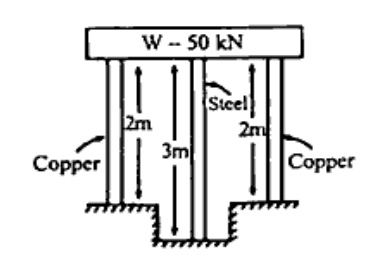
14 MarksTwo copper rods and one steel rod lie in a vertical plane and together support a load of $50\text{ kN}$ as shown in figure. Each rod is $25\text{ mm}$ in diameter, length of steel rod is $3\text{ m}$ and length of each copper rod is $2\text{ m}$. If modulus of elasticity of steel is twice that of copper, make calculations for the stress induced in each rod. It may be presumed that each rod deforms by the same amount.
How to answer
- Express strain compatibility: $\delta_s = \delta_c \Rightarrow \frac{\sigma_s L_s}{E_s} = \frac{\sigma_c L_c}{E_c}$
- Relate stresses: $\sigma_s = \sigma_c \cdot \frac{L_c}{L_s} \cdot \frac{E_s}{E_c} = \sigma_c \cdot \frac{2}{3} \cdot 2 = \frac{4}{3}\sigma_c$
- Write equilibrium equation: $2 P_c + P_s = 50\text{ kN} \Rightarrow (2\sigma_c + \sigma_s)A = 50 \times 10^3\text{ N}$
- Compute cross-sectional area $A = \frac{\pi}{4} (25)^2\text{ mm}^2$
- Solve for $\sigma_c$ and $\sigma_s$ in $\text{N/mm}^2$ or $\text{MPa}$
-
14 MarksA simply supported beam of $5\text{ m}$ span carries a uniformly distributed load of $10\text{ kN}$ per metre run and a point load of $10\text{ kN}$ at $2\text{ m}$ from left support. Determine the magnitude and location of the peak bending moment. Proceed to determine suitable section of this beam if the maximum allowable stress is limited to $8\text{ N/mm}^2$. Take depth twice the width.
How to answer
- Calculate support reactions $R_A$ and $R_B$ using static equilibrium equations
- Find shear force expression $V(x)$ and locate point where $V(x) = 0$
- Calculate the maximum bending moment $M_{\max}$ at this location
- Use flexure formula: $Z_{req} = \frac{M_{\max}}{\sigma_{allow}}$
- Substitute $d = 2b$ into $Z = \frac{b d^2}{6}$ to obtain $b$ and $d$
-
14 MarksCalculate the maximum torque that can be transmitted by a $35\text{ cm}$ diameter shaft if the twist in the shaft is not to exceed $1\text{ degree}$ in $525\text{ cm}$ of its length and also the shear stress is limited to $50\text{ MPa}$. Take modulus of rigidity for the shaft material as $85\text{ GPa}$.
How to answer
- Calculate polar section modulus $Z_p = \frac{\pi D^3}{16}$ and polar moment of inertia $J = \frac{\pi D^4}{32}$
- Determine torque based on shear strength: $T_1 = \frac{\pi}{16} \tau D^3$
- Convert twist angle to radians: $\theta = 1 \times \frac{\pi}{180}\text{ rad}$
- Determine torque based on stiffness/rigidity: $T_2 = \frac{G J \theta}{L}$
- Select the smaller of $T_1$ and $T_2$ as the maximum permissible torque
-
14 MarksA shaft is subjected to a max. torque of $10\text{ kN}\cdot\text{m}$ and bending moment $7.5\text{ kN}\cdot\text{m}$ at a particular section. If the allowable equivalent stress in simple tension is $160\text{ MN/m}^2$. Determine the diameter of the shaft according to different theories. Take Poisson's ratio as 0.24.
How to answer
- Calculate bending stress $\sigma_b = \frac{32M}{\pi d^3}$ and torsional shear stress $\tau = \frac{16T}{\pi d^3}$
- Determine principal stresses: $\sigma_{1,2} = \frac{16}{\pi d^3}\left(M \pm \sqrt{M^2+T^2}\right)$
- Apply Maximum Principal Stress Theory (Rankine's Theory) to find $d$
- Apply Maximum Shear Stress Theory (Tresca/Guest's Theory) to find $d$
- Apply Maximum Strain Theory (St. Venant's Theory) with $\mu = 0.24$ to find $d$
- Apply Distortion Energy Theory (von Mises) to find $d$
-
7 MarksaA slender pin ended aluminium column $1.8\text{ m}$ long and of circular cross-section is to have an outside diameter of $50\text{ mm}$. Calculate the necessary internal diameter to prevent failure by buckling if the actual load applied is $13.6\text{ kN}$ and the critical load applied is twice the actual load. Take E for aluminium as $70\text{ GN/m}^2$.
How to answer
- Determine critical load: $P_{cr} = 2 \times 13.6\text{ kN} = 27.2\text{ kN} = 27200\text{ N}$
- Use Euler's formula for pin-ended column ($L_e = L = 1.8\text{ m}$): $I = \frac{P_{cr} L^2}{\pi^2 E}$
- Compute required moment of inertia $I$
- Equate $I = \frac{\pi}{64}(D_o^4 - D_i^4)$ with $D_o = 50\text{ mm}$
- Solve for internal diameter $D_i$
-
7 MarksbDerive the formula for euler's crippling load for a long column whose both ends are fixed.
How to answer
- Draw diagram of fixed-ended column with end fixing moments $M_0$ and axial load $P$
- Set up the differential equation of deflection: $EI \frac{d^2y}{dx^2} = M_0 - Py$
- Write general solution: $y = A \cos(kx) + B \sin(kx) + \frac{M_0}{P}$, where $k = \sqrt{\frac{P}{EI}}$
- Apply boundary conditions: at $x=0, y=0$ and $\frac{dy}{dx}=0$; at $x=L, y=0$ and $\frac{dy}{dx}=0$
- Solve characteristic equation to obtain $kL = 2\pi$
- Deduce Euler's formula: $P_{cr} = \frac{4\pi^2 EI}{L^2}$
-
7 MarksaA cantilever beam having length "L" is subjected to UDL of intensity "W". Find the free end deflection using Macaulay's method.
How to answer
- Sketch cantilever beam with fixed end at $x=0$ (or $x=L$) carrying UDL $w$ (printed as "W") over length $L$
- Write bending moment equation at section $x$: $EI \frac{d^2y}{dx^2} = -\frac{w(L-x)^2}{2}$ or using fixed support at origin
- Integrate once to obtain slope equation: $EI \frac{dy}{dx}$
- Apply boundary condition for slope at fixed end ($x=0, \frac{dy}{dx}=0$) to evaluate integration constant $C_1$
- Integrate second time to get deflection equation $EI y$
- Apply boundary condition for deflection at fixed end ($x=0, y=0$) to evaluate $C_2$
- Evaluate maximum deflection at free end: $y_{max} = \frac{w L^4}{8EI}$
-
7 MarksbDerive the torsion equation, also write the assumptions made.
How to answer
- List key assumptions (material is homogeneous and isotropic, plane cross-sections remain plane and circular, twist is uniform, stress within elastic limit)
- Consider a circular shaft subjected to torque $T$; derive relationship between shear strain and angle of twist: $\gamma = \frac{r\theta}{L}$
- Apply Hooke's law in shear: $\tau = G \gamma = \frac{G r \theta}{L} \Rightarrow \frac{\tau}{r} = \frac{G\theta}{L}$
- Consider an elemental ring of radius $r$ and area $dA$, express resistance torque $dT = \tau \cdot r \cdot dA = \frac{G\theta}{L} r^2 dA$
- Integrate over total area: $T = \frac{G\theta}{L} \int r^2 dA = \frac{G\theta}{L} J$
- Combine to obtain standard torsion equation: $\frac{T}{J} = \frac{\tau}{R} = \frac{G\theta}{L}$
-
7 MarksaExplain any three theories of failure along with their graphical representation.
How to answer
- Select any three theories (e.g., Rankine, Tresca, von Mises)
- State criterion/statement for each selected theory
- Write the governing mathematical condition in terms of principal stresses ($\sigma_1, \sigma_2$) and yield strength ($\sigma_y$)
- Sketch the 2D yield locus/envelope in the $\sigma_1 - \sigma_2$ plane for each theory (square, hexagon, ellipse)
- State suitability and typical materials (brittle vs. ductile)
-
7 MarksbExplain Mohr's circle method for compound stress problems.
How to answer
- Define Mohr's circle for 2D plane stress state ($\\\sigma_x, \sigma_y, \tau_{xy}$)
- List sign conventions for normal and shear stresses
- Provide step-by-step construction: plot points $(\sigma_x, -\tau_{xy})$ and $(\sigma_y, \tau_{xy})$, locate center $C\left(\frac{\sigma_x+\sigma_y}{2}, 0\right)$ and radius $R = \sqrt{\left(\frac{\sigma_x-\sigma_y}{2}\right)^2 + \tau_{xy}^2}$
- Show how to find principal stresses $\sigma_1, \sigma_2$ and maximum in-plane shear stress $\tau_{max}$
- Explain determination of normal and shear stresses on any plane inclined at angle $\theta$
-
14 MarksWrite Short notes on the following:
- a)Bulk Modulus
- b)Elastic Curve
- c)Principal Strain
- d)Middle-Third Rule
How to answer
- Bulk Modulus ($K$): definition as ratio of volumetric stress to volumetric strain ($K = -\frac{\Delta p}{\Delta V / V}$), relation with $E$ and Poisson's ratio
- Elastic Curve: definition as the deflection curve representing the neutral axis of the beam under flexure, governed by $EI \frac{d^2y}{dx^2} = M$
- Principal Strain: definition as normal strains along planes where shear strains are zero, formula for $\epsilon_{1,2}$ in terms of $\epsilon_x, \epsilon_y, \gamma_{xy}$
- Middle-Third Rule: condition for eccentric loading on rectangular columns/foundations to avoid tension, load must lie within central core/kern of width $b/3$
Go to where you left off?
Quick Add to Notes
Save questions, your own notes and screenshots into notes filed by unit. It takes a free account.
Create free accountHave an account? Log in
Notes Panel