ME-304 · Strength of Material/Unsolved PYQ Paper
ME-304 Strength of Material - Jun 2024 Question Paper
Under each question, How to answer lists the points an answer should cover, outlined by CampusPrep from the syllabus. Check the details against your textbook.
-
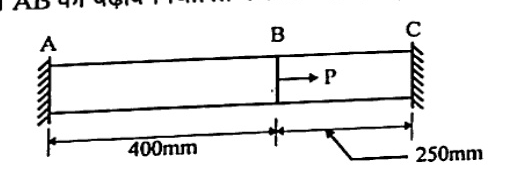
14 MarksA square bar of $25\text{ mm}$ side is held between two rigid plates and loaded by an axial pull equal to $300\text{ kN}$ as shown in figure. Determine the reactions at end A and C and elongation of the portion AB. Take $E = 2 \times 10^5\text{ N/mm}^2$.
How to answer
- Formulate equilibrium equation: $R_A + R_C = 300\text{ kN}$
- Write compatibility condition: total elongation between fixed rigid supports is zero ($\delta_{AB} + \delta_{BC} = 0$)
- Express displacement of each segment using $\frac{P L}{A E}$ considering signs of internal forces
- Solve for support reactions $R_A$ and $R_C$
- Calculate elongation of portion AB
-
14 MarksA simply supported beam $1\text{m}$ long and $20\text{ mm} \times 20\text{ mm}$ in cross-section fails when a central load of $600\text{N}$ is applied to it. What intensity of uniformly distributed load would cause failure of a cantilever beam $2\text{m}$ long $\times 40\text{ mm}$ wide $\times 80\text{ mm}$ deep made of the same material?
How to answer
- Calculate maximum bending moment for simply supported beam: $M_1 = \frac{W_1 L_1}{4}$
- Calculate section modulus $Z_1 = \frac{b_1 d_1^2}{6}$ and determine failure bending stress $\sigma_f = M_1 / Z_1$
- Calculate section modulus of cantilever beam $Z_2 = \frac{b_2 d_2^2}{6}$
- Determine maximum failure bending moment for cantilever: $M_2 = \sigma_f \times Z_2$
- Equate to cantilever maximum bending moment formula $M_2 = \frac{w L_2^2}{2}$ and solve for UDL intensity $w$
-
14 MarksA solid shaft is subjected to a bending moment of $2.5\text{ kN.m}$ and a twisting moment of $3.5\text{ kN.m}$. If the permissible tensile and shear stresses for the shaft material are limited to $700$ and $420\text{ MN/m}^2$ respectively, make calculations for the diameter of shaft.
How to answer
- Calculate equivalent twisting moment $T_e = \sqrt{M^2 + T^2}$
- Find diameter based on shear stress criteria: $d_1 = \left(\frac{16 T_e}{\pi \tau_{allow}}\right)^{1/3}$
- Calculate equivalent bending moment $M_e = \frac{1}{2}[M + \sqrt{M^2 + T^2}]$
- Find diameter based on tensile/bending stress criteria: $d_2 = \left(\frac{32 M_e}{\pi \sigma_{allow}}\right)^{1/3}$
- Select the larger of $d_1$ and $d_2$ as the required diameter
-
14 MarksDetermine the diameter of the bolt which is subjected to an axial pull of $9\text{ kN}$ together with a transverse shear force of $4.5\text{ kN}$ according to different theories of failure. Take Poisson's ratio as $0.3$ and $\text{FOS} = 3$. The elastic limit stress in simple tension is $225\text{ MPa}$.
How to answer
- Calculate permissible tensile stress $\sigma_{per} = 225 / 3 = 75\text{ MPa}$
- Express normal stress $\sigma$ and shear stress $\tau$ in terms of diameter $d$
- Determine principal stresses $\sigma_1$ and $\sigma_2$ in terms of $d$
- Apply Rankine's theory (Maximum Principal Stress): $\sigma_1 = \sigma_{per}$ to find $d$
- Apply Guest's/Tresca's theory (Maximum Shear Stress): $\tau_{max} = (\sigma_1 - \sigma_2)/2 = \sigma_{per}/2$ to find $d$
- Apply Saint-Venant's or Von Mises theory to find $d$
-
7 MarksaA solid round bar $60\text{ mm}$ in diameter and $2.5\text{m}$ long is used as a strut. One end of the strut is fixed, while its other end is hinged. Find the safe compressive load, for this strut, using Euler's formula. Assume $E = 200\text{ GN/m}^2$ and factor of safety $= 3$.
How to answer
- Calculate area moment of inertia $I = \frac{\pi}{64} d^4$
- Determine effective length $L_e = L / \sqrt{2}$ for one end fixed and other hinged
- Calculate Euler's critical crippling load $P_{cr} = \frac{\pi^2 E I}{L_e^2}$
- Calculate safe compressive load $P_{safe} = \frac{P_{cr}}{\text{FOS}}$
-
7 MarksbDerive the formula for Euler's crippling load for a long column whose both ends are pin jointed.
How to answer
- Sketch column with pinned ends showing buckling curve and deflected shape
- Set up governing differential equation $EI \frac{d^2y}{dx^2} + Py = 0$
- Write general solution $y = A \cos(kx) + B \sin(kx)$ where $k = \sqrt{P/EI}$
- Apply boundary conditions: $y = 0$ at $x = 0$ and $y = 0$ at $x = L$
- Determine non-trivial condition $\sin(kL) = 0 \implies kL = \pi$
- Conclude with $P_{cr} = \frac{\pi^2 E I}{L^2}$
-
7 MarksaA cantilever beam having length "L" is subjected to a point load "W". Find the free end deflection using Macaulay's method.
How to answer
- Draw cantilever beam of length $L$ with point load $W$ at the free end
- Formulate bending moment expression at a section distance $x$ from the fixed end: $M_x = -W(L - x)$
- Integrate once to find slope equation $EI \frac{dy}{dx}$ and apply boundary condition ($dy/dx = 0$ at $x=0$)
- Integrate again to find deflection equation $EI y$ and apply boundary condition ($y=0$ at $x=0$)
- Substitute $x = L$ to find the free end deflection: $\delta = \frac{W L^3}{3 E I}$
-
7 MarksbDerive the relationship between load intensity (w), Shear force (S) and Bending moment (M).
How to answer
- Draw an infinitesimal element of beam of length $dx$ showing forces ($S$, $S+dS$, $w dx$) and moments ($M$, $M+dM$)
- Apply vertical force equilibrium: $\Sigma F_y = 0 \implies \frac{dS}{dx} = -w$ (or rate of change of shear force equals load intensity)
- Take moments about one face: $\Sigma M = 0$ neglecting higher order terms
- Derive relationship $\frac{dM}{dx} = S$
- Combine to show $\frac{d^2M}{dx^2} = \frac{dS}{dx} = -w$
-
7 MarksaExplain any three theories of failure along with their graphical representation.
How to answer
- Select any three theories (e.g., Rankine, Tresca, Von Mises)
- State failure criteria and governing mathematical equation for each
- Sketch failure envelopes in $\sigma_1 - \sigma_2$ principal stress plane (e.g., square for Rankine, hexagon for Tresca, ellipse for Von Mises)
- State application and limitations for ductile vs brittle materials
-
7 MarksbExplain Area-moment method for finding slope and deflection.
How to answer
- Define Area-Moment Method (Mohr's theorems)
- State Mohr's Theorem 1: Change in slope between two points equals the area of the $M/EI$ diagram between those points ($\theta_{B/A} = \int \frac{M}{EI} dx$)
- State Mohr's Theorem 2: Tangential deviation of point B from tangent at A equals first moment of area of $M/EI$ diagram about point B ($t_{B/A} = \int x \frac{M}{EI} dx$)
- Provide sketch showing beam deflection curve and $M/EI$ diagram
- Outline procedure to determine slope and deflection
-
14 MarksWrite Short notes on the following: a) Shear Modulus b) Mohr's Circle c) Composite Beams d) Quarter-Fourth Rule
How to answer
- Shear Modulus ($G$): Definition ($G = \tau / \gamma$), relation with Young's modulus and Poisson's ratio ($E = 2G(1+\mu)$)
- Mohr's Circle: Graphical representation of 2D state of stress, center and radius formulas, determination of principal and maximum shear stresses
- Composite Beams: Definition, modular ratio concept, transformed section method for bending stress analysis
- Quarter-Fourth Rule: Middle-quarter rule (or kernel/core of circular sections) to prevent tension in masonry/columns subject to eccentric loading
Go to where you left off?
Quick Add to Notes
Save questions, your own notes and screenshots into notes filed by unit. It takes a free account.
Create free accountHave an account? Log in
Notes Panel