EC-305 · Network Analysis/Unsolved PYQ Paper
EC-305 Network Analysis - Nov 2022 Question Paper
Under each question, How to answer lists the points an answer should cover, outlined by CampusPrep from the syllabus. Check the details against your textbook.
-
7 MarksaState and explain Kirchhoff's voltage and current law with an example.
How to answer
- Statement of KVL: algebraic sum of voltages around closed loop is zero
- Statement of KCL: algebraic sum of currents at node is zero
- Example circuit with explanation for each law
- Equations and conclusion
-
7 MarksbA series RLC circuit takes a maximum current of 0.3 A at 200 V, 50 Hz. If the voltage across the capacitor is 290V at resonance. Determine R,L,C and Q.
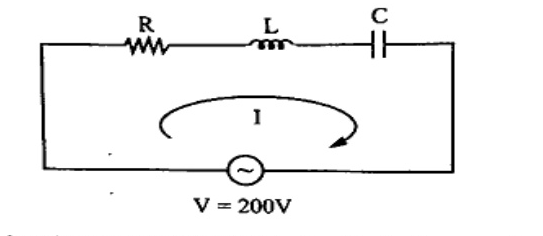
How to answer
- At resonance current is maximum and impedance is R
- Calculate R = V/I
- Use Vc = Q*V to find Q
- Find L and C from Q and resonant frequency
-
7 MarksaDerive the equation for Equivalent inductance, when two inductors are coupled in series opposing and mutual inductance exists between them.
How to answer
- Voltage equations for two coils with mutual term
- Sign for series opposing connection
- Total inductance expression L1+L2-2M
- Final equivalent inductance equation
-
7 MarksbDefine Incidence Matrix for the graph shown in Figure. Find the complete Incidence Matrix.
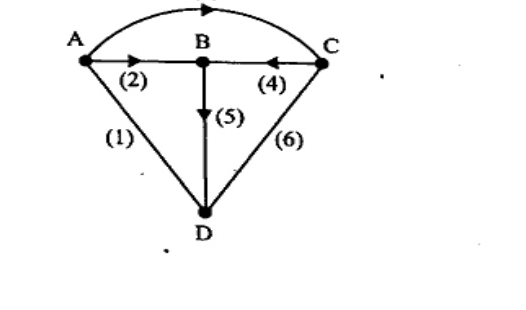
How to answer
- Definition of incidence matrix with entries 0,1,-1
- Identify nodes A,B,C,D and branches 1-6 with orientations
- Construct complete matrix of size nodes x branches
- Present final matrix
-
7 MarksaDefine and explain the following with an example:
- i)Graph and Subgraph
- ii)Oriented Graph
- iii)Tree of a Graph
- iv)Twigs and Links
How to answer
- Definition of graph and subgraph with example
- Definition of oriented graph with example
- Definition of tree of a graph with example
- Definition of twigs and links with example
-
7 MarksbDraw the parallel resonant circuit and derive the expression for resonant frequency
How to answer
- Parallel resonant circuit diagram with R,L,C
- Condition for resonance: susceptance zero
- Derivation steps for resonant frequency
- Expression for f0
-
7 MarksaFind the Norton's equivalent circuit for the following circuit
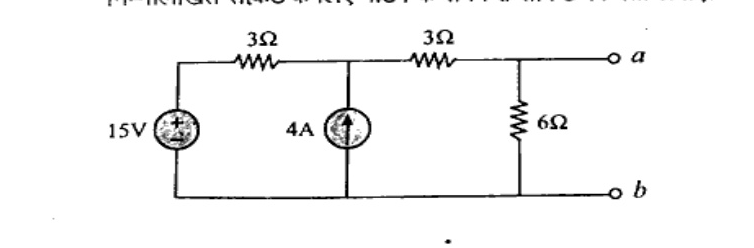
How to answer
- Find open-circuit voltage / short-circuit current at terminals a-b
- Deactivate sources to find Norton resistance
- Draw Norton equivalent with IN parallel RN
- Mention values
-
7 MarksbFind the voltage drop across $3\Omega$ resistor by Superposition theorem.
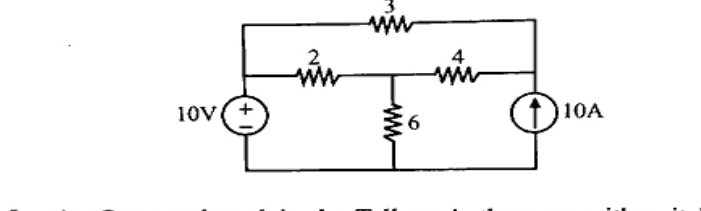
How to answer
- State superposition theorem
- Consider 10V source alone with current source open
- Consider 10A source alone with voltage source shorted
- Add contributions to get voltage across 3 ohm resistor
-
7 MarksaState and explain the Tellegen's theorem with suitable example.
How to answer
- Statement of Tellegen's theorem: sum of branch powers is zero
- Explanation with KCL/KVL basis
- Suitable example circuit with calculation
- Conclusion
-
7 MarksbFind the value of $i(0^+)$ using the initial value theorem for the function $I(s) = (2s+3)/[(s+1)(s+3)]$
How to answer
- Recall initial value theorem i(0+)=lim s->inf sI(s)
- Substitute I(s)=(2s+3)/[(s+1)(s+3)]
- Evaluate limit
- Obtain i(0+) value
-
7 MarksaIn the network shown in figure below, the switch K is moved from position 'a' to 'b' at t=0. Find the Particular solution for Current i(t).
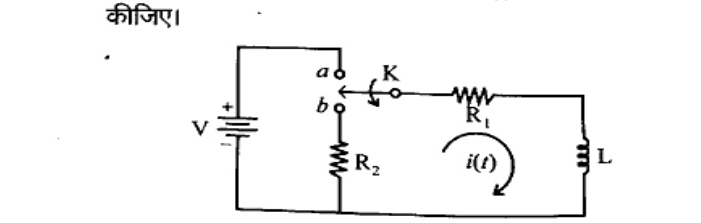
How to answer
- Initial condition at t=0- with switch at 'a'
- Transient equation for RL circuit after switching to 'b'
- Solve first-order differential equation
- Particular solution for current i(t)
-
7 MarksbFor the waveform shown in figure below. Write the expression and find the Laplace transform.
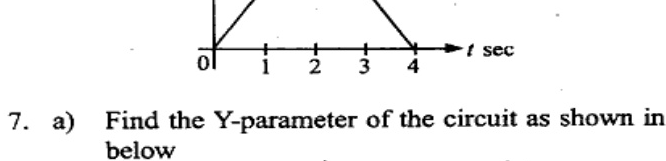
How to answer
- Write time-domain expression using unit step functions
- Break trapezoidal waveform into ramp segments
- Apply Laplace transform to each segment
- Simplify to get V(s)
-
7 MarksaFind the Y-parameter of the circuit as shown in figure below
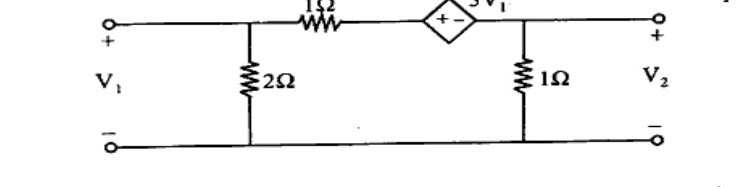
How to answer
- Write two-port equations for Y-parameters
- Apply short-circuit conditions
- Calculate Y11,Y12,Y21,Y22 with dependent source
- Present Y-matrix
-
7 MarksbDefine Hybrid parameters of a Two port network. Established the relation between Hybrid Parameters and ABCD Parameters.
How to answer
- Define hybrid h-parameters equations
- Define ABCD transmission parameters
- Derive conversion formulas
- State final relations
-
14 MarksWrite a short notes on any Two:
- i)Image Parameter
- ii)Steady State Analysis
- iii)Controlled and un controlled sources
- iv)Dual Networks
How to answer
- Select any two topics from list
- Give definition and key points for each
- Add example or diagram where relevant
- Conclude with applications
Go to where you left off?
Quick Add to Notes
Save questions, your own notes and screenshots into notes filed by unit. It takes a free account.
Create free accountHave an account? Log in
Notes Panel