ME-701 · Heat and Mass Transfer/Unsolved PYQ Paper
ME-701 Heat and Mass Transfer - Jun 2025 Question Paper
Under each question, How to answer lists the points an answer should cover, outlined by CampusPrep from the syllabus. Check the details against your textbook.
-
5 MarksaHow are heat, internal energy, and thermal energy related to each other?
How to answer
- Define heat as energy in transit due to temperature difference
- Define internal energy as sum of microscopic kinetic and potential energies
- Define thermal energy as sensible and latent part of internal energy
- Explain interrelation with examples
-
5 MarksbHow does heat conduction differ from convection?
How to answer
- Define conduction as diffusion through stationary medium via Fourier law
- Define convection as bulk fluid motion plus diffusion via Newton law of cooling
- Contrast mechanism, medium, governing laws
- Give examples
-
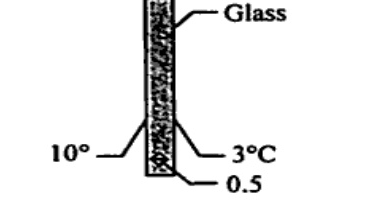
4 MarkscThe inner and outer surfaces of a $0.5$ cm thick $2 \times 2\, m^2$ window glass in winter are $10^{\circ}C$ and $3^{\circ}C$, respectively. If the thermal conductivity of the glass is $0.78\, W/m.\, ^{\circ}C$, determine the amount of heat loss, in kJ, through the glass over a period of 5 hours.
How to answer
- State Fourier's law $Q = kA\Delta T/L$
- Calculate area $A=2\times 2 =4\,m^2$ and $\Delta T=7^{\circ}C$
- Compute steady heat rate $\dot Q$
- Multiply by time 5 hours to get heat loss in kJ
-
4 MarksaDefine the parameters by which the fins performance is measured.
How to answer
- Define fin effectiveness
- Define fin efficiency
- Define fin parameter m and related performance
- State how each measures enhancement
-
4 MarksbWhat is the reason for the widespread use of fins on surfaces?
How to answer
- Low heat transfer coefficient on gas side limits heat transfer
- Fins increase effective surface area
- Enhance heat dissipation with low cost and weight
- Examples of applications
-
6 MarkscA steel rod ($k = 30\, W/m-deg$) $1$ cm in diameter and $5$ cm long protrudes from a wall which is maintained at $100^{\circ}C$. The rod is insulated at its tip and is exposed to an environment with $h = 50\, W/m^2-deg$ and $t_a = 30^{\circ}C$. Calculate the fin efficiency and temperature at the tip of fin.
How to answer
- Compute fin parameter $m = \sqrt{hP/kA_c}$ for circular rod
- Apply insulated-tip efficiency $\eta = \tanh(mL)/mL$
- Calculate heat transfer and tip temperature $T(L)$ formula
- Substitute $k=30$, $d=1\,cm$, $L=5\,cm$, $h=50$, $T_b=100^{\circ}C$, $T_a=30^{\circ}C$
-
4 MarksaState the Buckingham pie theorem.
How to answer
- State number of pi terms = n-m
- Explain repeating variables selection
- State formation of dimensionless groups
- Give functional relation form
-
10 MarksbA domestic oven has a composite wall formed by $0.5$ cm thick chrome-nickel ($k = 19\, W/mk$) sheet supported by $1$ cm thick asbestos ($k = 0.1105\, W/mk$) sheet. In steady state operation the hot gases inside the oven are at $350^{\circ}C$ while atmospheric air in at $30^{\circ}C$. The convective heat transfer coefficient at inside and outside surface of the oven are $100\, W/m^2k$ and $15\, W/m^2k$ respectively. Determine the rate of heat losses per unit area through the oven wall.
How to answer
- Draw thermal resistance network: two convection + two conduction in series
- Compute conduction resistances $L/k$ and convection $1/h$
- Compute overall heat transfer coefficient U
- Compute $q/A = (350-30)/\Sigma R$
-
6 MarksaWhat is the difference between evaporation and boiling?
How to answer
- Define evaporation as surface phenomenon below boiling point
- Define boiling as bulk phenomenon at saturation temperature
- Contrast temperature, bubble formation, energy
- Give examples
-
8 MarksbWhat is the difference between film and dropwise condensation? Which is a more effective mechanism of heat transfer?
How to answer
- Describe film condensation with continuous liquid film and thermal resistance
- Describe dropwise with discrete droplets exposing bare surface
- Compare heat transfer coefficients
- Conclude dropwise is more effective with reason
-
5 MarksaWhat is forced convection? How does external forced convection is differing from internal forced convection?
How to answer
- Define forced convection with external agency
- Define external flow over bodies vs internal flow in ducts
- Contrast boundary layer development, entrance effects
- Give examples
-
5 MarksbHow does turbulent flow differ from laminar flow? For which flow is the heat transfer coefficient higher?
How to answer
- Describe laminar ordered layers vs turbulent random fluctuations
- Contrast velocity profile, mixing, Reynolds number
- State turbulent has higher heat transfer coefficient due to mixing
- Give critical Re ranges
-
MarkscHow does the Rayleigh number differ from the Grashof number?
How to answer
- Define Grashof number as buoyancy/viscous ratio
- Define Rayleigh as Gr x Pr
- Explain role of thermal diffusivity
- State use in natural convection correlation
-
4 MarksaWhat is a radiation shield? Why is it used?
How to answer
- Define radiation shield as low-emissivity barrier
- Explain reduction of radiative exchange by multiple reflections
- Give formula with and without shield
- State applications
-
4 MarksbExplain the Planck's distribution law?
How to answer
- State Planck's law $E_{b\lambda}(T)$ expression
- Explain spectral variation with wavelength and temperature
- Mention Wien's displacement and Stefan-Boltzmann deduction
- Sketch distribution curves
-
6 MarkscConsider a person whose exposed surface area is $1.7\, m^2$, emissivity is $0.85$, and surface temperature is $30^{\circ}C$. Determine the rate of heat loss from that person by radiation in a large room whose walls are at a temperature of (i) $300\, K$ and (ii) $280\, K$.
How to answer
- State radiative loss $Q=\varepsilon A\sigma(T_s^4-T_{surr}^4)$
- Convert $T_s=30^{\circ}C=303\,K$
- Compute for $T_{surr}=300\,K$ and $280\,K$
- Compare increase with colder surroundings
-
7 MarksaClassify heat exchangers according to construction type and explain the characteristics of each type.
How to answer
- List types: double-pipe, shell-and-tube, plate, cross-flow, regenerative
- Explain construction of each
- State characteristics: compactness, pressure, fouling, application
- Give examples
-
7 MarksbEstablish the expression LMTD equation for parallel flow Heat Exchangers.
How to answer
- Consider differential element with energy balance
- Integrate $d(\Delta T)/\Delta T$ along length
- Obtain $Q = UA\Delta T_{lm}$ expression
- Define $LMTD = (\Delta T1-\Delta T2)/\ln(\Delta T1/\Delta T2)$ for parallel flow
-
14 MarksWrite short notes on any four of the followings.
- i)Fin effectiveness
- ii)Gray body
- iii)Fick's Law
- iv)LMTD
- v)Thermocouple
- vi)Parallel flow heat exchanger
How to answer
- Select any four topics from list
- Give definition/governing law or formula for each
- Explain physical significance with example
- Mention applications
Go to where you left off?
Quick Add to Notes
Save questions, your own notes and screenshots into notes filed by unit. It takes a free account.
Create free accountHave an account? Log in
Notes Panel