ME-701 · Heat and Mass Transfer/Unsolved PYQ Paper
ME-701 Heat and Mass Transfer - Dec 2024 Question Paper
Under each question, How to answer lists the points an answer should cover, outlined by CampusPrep from the syllabus. Check the details against your textbook.
-
5 MarksaWhat are the mechanisms of heat transfer? How are they distinguished from each other?
How to answer
- Define conduction, convection, radiation
- Medium requirement for each mode
- Driving potential and governing mechanism distinction
- Examples of each mode
-
5 MarksbWrite down the expressions for the physical laws that govern each mode of heat transfer, and identify the variables involved in each relation.
How to answer
- Fourier's law of conduction with variables
- Newton's law of cooling for convection with variables
- Stefan-Boltzmann law for radiation with variables
- Meaning of k, h, emissivity, temperatures
-
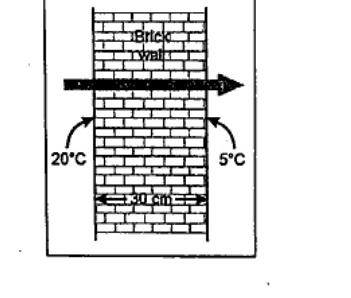
4 MarkscThe inner and outer surfaces of a $5 \times 6\, m^2$ brick wall of thickness $30\, cm$ and thermal conductivity $0.69\, W/m \cdot ^\circ C$ are maintained at temperatures of $20^\circ C$ and $5^\circ C$, respectively. Determine the rate of heat transfer through the wall, in W.
How to answer
- Fourier's law $Q = kA\Delta T/L$
- Area $A = 5 \times 6 = 30\, m^2$
- Temperature difference 15 K, thickness 0.3 m
- Compute Q in W
-
4 MarksaDefine thermal resistance and thermal conductivity.
How to answer
- Definition of thermal resistance $R_t = \Delta T/Q$
- Conduction, convection, radiation resistance forms
- Definition of thermal conductivity k
- Units and physical meaning
-
4 MarksbWhat is the significance of critical wall thickness?
How to answer
- Critical radius concept for cylinder and sphere
- Condition for maximum heat transfer
- Effect of adding insulation below/above critical radius
- Practical significance
-
6 MarkscDerive an expression of general heat conduction equation in rectangular coordinates.
How to answer
- Energy balance on differential element dx dy dz
- Fourier conduction terms plus generation plus storage
- General equation in Cartesian coordinates
- Simplifications for steady, no generation, constant k
-
14 MarksConsider a solid cylindrical rod of length $0.15\, m$ and diameter $0.05\, m$. The top and bottom surfaces of the rod are maintained at constant temperatures of $20^\circ C$ and $95^\circ C$, respectively, while the side surface is perfectly insulated. Determine the rate of heat transfer through the rod if it is made of: If heat conduction is steady, one-dimensional, thermal conductivities are constant and no heat generation.
- a)copper, k = 380 W/m · °C
- b)steel, k = 18 W/m · °C
- c)granite, k = 1.2 W/m · °C
How to answer
- Assumptions: steady 1-D, constant k, no generation, insulated side
- Fourier law $Q = kA(T2-T1)/L$ with $A=\pi D^2/4$
- Compute for k=380, 18, 1.2 W/m·°C
- Compare effect of conductivity on heat rate
-
6 MarksaWhat is the difference between the fin effectiveness and the fin efficiency?
How to answer
- Definition of fin effectiveness $\varepsilon = Q_{fin}/Q_{no\,fin}$
- Definition of fin efficiency $\eta = Q_{fin}/Q_{max}$
- Difference in reference and purpose
- Condition for effective fin use
-
8 MarksbObtain a relation for the fin efficiency for a fin of constant cross-sectional area. $A_c$, perimeter $p$, length $L$ and thermal conductivity $k$ exposed to convection to a medium at $T_{\infty}$ with a heat transfer coefficient $h$. Assume the fins are sufficiently long so that the temperature of the fin at the tip is nearly $T_{\infty}$. Take the temperature of the fin at the base to be $T_b$ and neglect heat transfer from the fin tips. Simplify the relation for:
- i)a circular fin of diameter D
- ii)rectangular fins of thickness t.
How to answer
- Energy balance on fin element, $m = \sqrt{hP/kA_c}$
- Infinitely long fin solution $Q = \sqrt{hPkA_c}(T_b-T_\infty)$
- Efficiency $\eta = Q/hA_{fin}(T_b-T_\infty)$
- Simplify for circular D and rectangular thickness t
-
5 MarksaDefine the type of fins used in various automotive industries.
How to answer
- Need for fins in automotive cooling (radiator, engine)
- Types: plate, pin, louvered, wavy fins
- Material and application examples
- Selection criteria
-
5 MarksbWhat is the utility of extended surface?
How to answer
- Purpose to increase surface area for low h fluids
- Enhancement of heat transfer rate
- Effectiveness criterion
- Examples of applications
-
4 MarkscConsider two finned surfaces that are identical except that the fins on the first surface are formed by casting or extrusion, whereas they are attached to the second surface afterwards by welding or tight fitting. For which case do you think the fins will provide greater enhancement in heat transfer? Explain.
How to answer
- Thermal contact resistance concept
- Integral fins have no contact resistance
- Welded/attached fins have interfacial resistance
- First surface gives greater enhancement
-
4 MarksaWhat is forced convection? How does it differ from natural convection?
How to answer
- Definition of forced convection with external means
- Definition of natural convection by buoyancy
- Differences in velocity, h, governing parameters
- Examples
-
4 MarksbWhat is the physical significance of the Nusselt number? How is it defined?
How to answer
- Definition Nu = hL/k
- Ratio of convection to conduction
- Physical meaning as boundary layer enhancement
- Relation to Re and Pr
-
6 MarkscA horizontal heated plate at $200^\circ C$ and facing upwards has been placed in still air at $20^\circ C$. If the plate measures $1.25m \times 1m$. Calculate the heat loss by natural convection. The convective film coefficient for free convection is given by the following empirical relation: $h = 0.32\,(\theta)^{0.25} W/m^2$-k. Where $\theta$ is mean film temperature in degree Kelvin.
How to answer
- Mean film temperature $\theta = (Ts+T_\infty)/2$ in K
- Compute h = 0.32(theta)^0.25
- Heat loss $Q = hA(Ts-T_\infty)$ with A=1.25x1
- Result in W
-
7 MarksaClassify heat exchangers according to flow type and explain the characteristics of each type.
How to answer
- Classification: parallel, counter, cross flow
- Temperature distribution sketches
- Characteristics and advantages of each
- Applications
-
7 MarksbEstablish the expression for log mean temperature difference for a counter flow heat exchanger.
How to answer
- Energy balance on differential length dx
- Integration for hot and cold fluids in counter flow
- Logarithmic temperature difference derivation
- Final LMTD expression
-
14 MarksWrite short notes on any four of the followings.
- i)Shape factor
- ii)Black body
- iii)Planck's law of the distribution
- iv)Regimes of boiling
- v)Radiation shield
- vi)Nucleate boiling
How to answer
- Select any four topics from list
- Definition plus key formula/diagram for each
- Physical significance and example
- Concise short-note format
Go to where you left off?
Quick Add to Notes
Save questions, your own notes and screenshots into notes filed by unit. It takes a free account.
Create free accountHave an account? Log in
Notes Panel