ME-404 · FLUID MECHANICS/Unsolved PYQ Paper
ME-404 Fluid Mechanics - Jun 2025 Question Paper
Under each question, How to answer lists the points an answer should cover, outlined by CampusPrep from the syllabus. Check the details against your textbook.
-
7 MarksaExplain the following.
- i)Newtonian Fluid
- ii)Non Newtonian Fluid
- iii)Vapour Pressure
How to answer
- Define Newtonian fluid with linear shear stress-strain relation
- Define non-Newtonian fluid with non-linear behaviour and examples
- Define vapour pressure and its significance in cavitation
-
7 MarksbTwo discs of 20 cm diameter are placed 1 mm apart and the gap is filled with an oil of viscosity 0.8 kg/m.s. Determine the power required to rotate the upper disc at 600 rpm while holding the lower one stationary.
How to answer
- Shear stress due to viscosity $\tau = \mu du/dy$
- Integrate torque $dT = r \cdot \tau dA$ over disc radius
- Power $P = T \cdot \omega$ with $\omega = 2\pi N/60$
- Substitute $D=0.2 m, h=1 mm, \mu=0.8 kg/m.s, N=600 rpm$
-
7 MarksaA steady, incompressible, two-dimensional velocity field is given by $u = x + 2y + 2.0$; $v = 2x - y - 3.5$. Determine the location of the stagnation point, if it exists.
How to answer
- Set $u=0$ and $v=0$ for stagnation point
- Solve linear equations $x+2y+2.0=0$, $2x-y-3.5=0$
- Obtain $x, y$ coordinates
- Check existence and uniqueness
-
7 MarksbExplain the terms rotation, vorticity and circulation, velocity potential, stream function, stream line and path line.
How to answer
- Define rotation, vorticity and circulation with formulas
- Define velocity potential and stream function
- Define streamline vs pathline with equations
- Give examples and physical meaning
-
7 MarksaTwo points A and B are located in a long 20 cm diameter pipe. When a downstream valve is completely closed the difference in pressure between B and A, $(P_B - P_A) = 100$ kPa. When the valve is open and a discharge of 70 L/s of water is flowing, $(P_A - P_B) = 50$ kPa. Calculate the head loss between A and B.
How to answer
- Use hydrostatic pressure difference with valve closed to get elevation difference
- Apply Bernoulli with head loss between A and B for flowing case
- Relate $(P_B-P_A)$ static to $\Delta z$
- Compute $h_L$ from $(P_A-P_B)$, velocity and $\Delta z$
-
7 MarksbExplain the concept of hydrostatic Paradox.
How to answer
- State hydrostatic paradox with vessels of different shape
- Pressure depends only on height, not volume/weight
- Explain with $P=\rho g h$ and force demonstration
- Give example and conclusion
-
7 MarksaProve that in case of forced vortex flow the curve acquired by fluid would be parabola.
How to answer
- Consider rotating fluid with angular velocity $\omega$
- Equilibrium of pressure, centrifugal and gravity forces
- Derive $dz/dr = \omega^2 r/g$
- Integrate to get $z = \omega^2 r^2/2g + C$ - parabola
-
7 MarksbWrite short notes on Hydraulic, gradient line, total energy line, Major and minor losses in case of flow through pipes.
How to answer
- Define hydraulic gradient line and total energy line
- Give equations for HGL and TEL
- Define major losses (friction) and minor losses
- List formulas for bends, entrance, exit etc.
-
7 MarksaWhat do you mean by boundary layer separation? What is the effect of pressure gradient on boundary layer separation?
How to answer
- Define boundary layer separation and separation point
- Explain adverse pressure gradient effect
- Describe backflow and wake formation
- Methods to control separation
-
7 MarksbWrite short notes on Stagnation Properties.
How to answer
- Define stagnation point and stagnation properties
- Give $P_0, T_0, \rho_0$ relations for compressible flow
- Explain isentropic relations
- Mention applications in Pitot tube, nozzles
-
7 MarksaA lawn sprinkler has two jets of 1.5 cm diameter on a rotating arm which can describe a circle of 60 cm diameter Fig. If the rotating speed is 210 rpm and the discharge is 3.0 L/s. Calculate the torque due to friction at the axis of rotation.
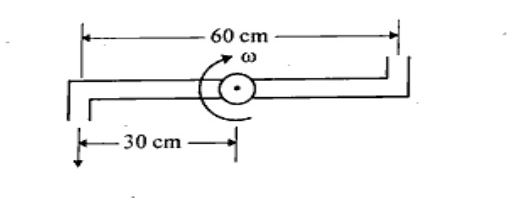
How to answer
- Compute jet velocity from discharge and diameter
- Apply moment of momentum for rotating sprinkler
- Find ideal torque without friction
- Subtract actual effect to get frictional torque at axis
-
7 MarksbDifferentiate shear thinning and shear thickening fluids with graphical representation.
How to answer
- Define shear thinning (pseudoplastic) and shear thickening (dilatant)
- Draw shear stress vs shear rate and viscosity vs shear rate graphs
- Give examples of each fluid
- Compare flow behaviour index n<1 vs n>1
-
7 MarksaA 20 cm diameter pipe has a $90^{\circ}$ bend (to the right) in the horizontal plane. When a discharge of 150 L/s of oil (RD = 0.8) is sent in this pipe, the pressure at the beginning of the bend is found to be 0.5 m of oil. Estimate the resultant force exerted by the oil on the bend.
How to answer
- Calculate velocity from $Q$ and pipe area
- Apply momentum equation in x and y for 90-degree bend
- Include pressure force at inlet $P=\rho g h$
- Compute resultant force magnitude and direction
-
7 MarksbWhy relative position of center of gravity and center of buoyancy cannot decide the stability of floating bodies?
How to answer
- Define centre of gravity, centre of buoyancy and metacentre
- Explain metacentric height governs stability
- Show cases where G above B can still be stable
- Conclude relative G-B position alone insufficient
-
7 MarksaA smooth flat plate 1.5 m wide and 2 m long is subjected to flow of water along its length at a uniform velocity of 2 m/s. Find ($\rho = 998$ kg/m$^3$, $\nu = 10^{-6}$ m$^2$/s).
- i)the extent of the laminar boundary layer on the plate
- ii)the thickness of the boundary layer at the edge of the laminar boundary layer and at the trailing edge
- iii)the shear stress at the trailing edge
How to answer
- Compute Reynolds number $Re_x = Ux/\nu$ and critical $Re_{crit}=5\times10^5$
- Find laminar length $x_{crit}$
- Compute $\delta = 5x/\sqrt{Re_x}$ at $x_{crit}$ and at $L=2m$
- Compute wall shear $\tau_0 = 0.332 \rho U^2/\sqrt{Re_x}$ at trailing edge
-
4 MarksbWrite the expression of Navier stokes equation and explain the uses of this equation.
How to answer
- Write Navier-Stokes vector and component form
- Explain pressure, viscous and body force terms
- Mention incompressible Newtonian assumptions
- List uses: pipe flow, boundary layer, CFD, aerodynamics
-
3 MarkscHow concept of control volume is more important than the concept of system in fluid mechanics.
How to answer
- Define system vs control volume
- Explain Lagrangian vs Eulerian approach
- Advantages for mass, momentum, energy analysis in fluid machines
- Give examples of nozzles, turbines
Go to where you left off?
Quick Add to Notes
Save questions, your own notes and screenshots into notes filed by unit. It takes a free account.
Create free accountHave an account? Log in
Notes Panel