ME-404 · FLUID MECHANICS/Unsolved PYQ Paper
ME-404 Fluid Mechanics - Jun 2022 Question Paper
Under each question, How to answer lists the points an answer should cover, outlined by CampusPrep from the syllabus. Check the details against your textbook.
-
7 MarksaWhen the pressure on a given mass of liquid is increased from $3.0\ \text{MPa}$ to $3.5\ \text{MPa}$, the density of the liquid increases from $500\ \text{kg/m}^3$ to $501\ \text{kg/m}^3$. What is the average value of bulk modulus of the liquid over the given pressure range?
How to answer
- Define bulk modulus K = -V dp/dV = rho dp/drho
- Compute dp = 0.5 MPa, drho = 1 kg/m3, average rho ~500.5
- Apply K_avg = rho_avg * dp/drho or dp/(drho/rho)
- Obtain value ~250 MPa
-
7 MarksbA flat plate of $1 \text{m}^2$ area and a weight of $100\ \text{N}$ is sliding down a $60$ degrees inclined plane to the vertical over a $1\ \text{mm}$ layer of oil whose $\mu = 1$ poise. Determine the steady state velocity of sliding.
How to answer
- Resolve weight component along incline
- Newton's law of viscosity tau = mu * V / y
- Equate shear force to driving component for steady state
- Solve for V
-
14 MarksA U-tube manometer is connected to a pipeline conveying water as shown in the Figure 1. The pressure head of water in the pipeline is
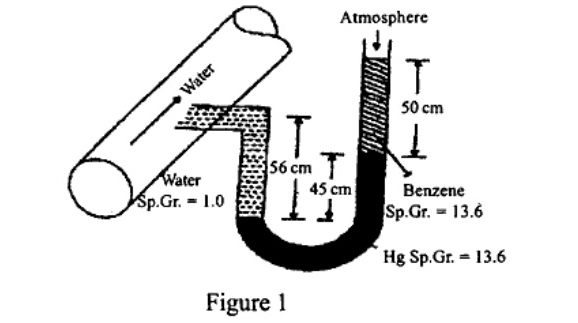
How to answer
- Draw manometer with water, Hg levels
- Write hydrostatic equation from pipeline to atmosphere
- Insert specific gravities and heights 56 cm, 45 cm, 50 cm
- Solve for pressure head of water in pipeline
-
14 MarksIn the situation shown in the given figure, the length BC is $3\ \text{m}$ and M is the mid-point of BC. The Hydrostatic force on BC measured per unit width (width being perpendicular to the plane of the paper) with 'g' being the acceleration due to gravity, will be
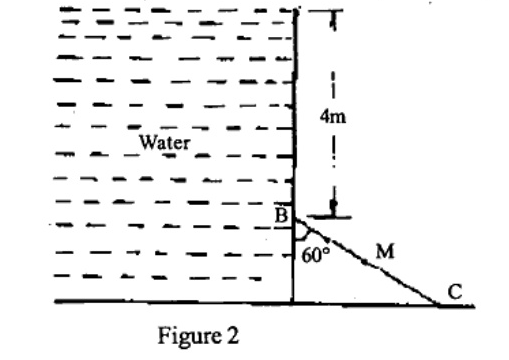
How to answer
- Determine depth of centroid of BC and area per unit width
- Hydrostatic force F = rho*g*h_c*A
- Account for inclined plate BC length 3 m, angle 60 deg, water depth 4 m to B
- Express result in terms of g
-
7 MarksaExplain the terms:
- i)Path line
- ii)Streak line
- iii)Stream line
- iv)Stream tube
How to answer
- Define path line, streak line, streamline, stream tube
- Give Lagrangian vs Eulerian viewpoint for each
- State properties and equation where relevant
- Give example / diagram distinction
-
7 MarksbA stream function is given by $(x^2-y^2)$. Find the potential function of the flow.
How to answer
- Compute u, v from psi = (x^2 - y^2)
- Use Cauchy-Riemann u = dphi/dx, v = dphi/dy relations
- Integrate to get phi = 2xy + constant
- Verify irrotationality
-
14 MarksDistinguish between:
- i)Steady flow and un-steady flow
- ii)Uniform and non-uniform flow
- iii)Compressible and incompressible flow
- iv)Rotational and irrigational flow
- v)Laminar and turbulent flow
How to answer
- Define each pair with time/space dependence
- Give mathematical condition and example
- Contrast with table or points
- Mention practical relevance
-
14 MarksDetermine the rate of flow of water through a pipe $300\ \text{mm}$ diameter placed in an inclined position where a venturimeter is inserted having a throat diameter of $150\ \text{mm}$. The difference of pressure between the main and throat is measured by a liquid of sp. gravity $0.7$ in an inverted V-tube which gives a reading of $260\ \text{mm}$. The loss of head between the main and throat is $0.3$ times the kinetic head of the pipe.
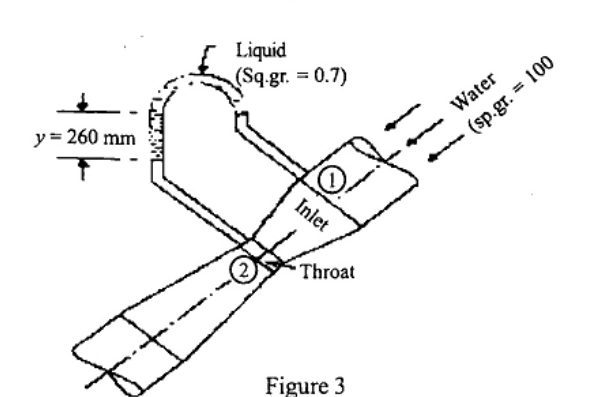
How to answer
- Apply Bernoulli between main (1) and throat (2) with head loss
- Relate manometer reading 260 mm of sp.gr. 0.7 fluid to head difference
- Use continuity A1V1 = A2V2 with D=300 mm, d=150 mm
- Solve for V1 and discharge Q
-
7 MarksaWhat is the physical significance of mathematical terms, $\Delta.\mathbf{v}$ and $\Delta \times \mathbf{v}$ in fluid mechanics? Where, v is the 3D velocity vector of the fluid flow.
How to answer
- Define divergence as net outflow per unit volume
- Define curl as circulation per unit area / rotation
- Physical meaning: compressibility/source vs vorticity
- Give examples in fluid mechanics
-
7 MarksbIf the velocity distribution in a turbulent boundary layer is given by $$\frac{U}{U_{\infty}} = \left[\frac{y}{\delta}\right]^{\frac{1}{9}}$$ Find the ratio of displacement thickness to nominal layer thickness.
How to answer
- Recall displacement thickness delta* = integral (1-U/U_inf) dy
- Substitute 1/9 power law U/U_inf = (y/delta)^(1/9)
- Integrate 0 to delta
- Obtain ratio delta*/delta = 1/10
-
7 MarksaWhat is a manometer? How are they classified? Explain on the basis of sensitivity of the manometer?
How to answer
- Define manometer and purpose
- Classify: simple vs differential, U-tube, inverted, well, inclined
- Explain sensitivity: small height change for small pressure
- Role of fluid density and inclination
-
7 MarksbWhat is the significance of Mach number? Write down the short note on Fanno lines and Reyleigh lines with neat sketch.
How to answer
- Define Mach number M = V/c and regimes
- Significance for compressibility effects
- Define Fanno (adiabatic) and Rayleigh (heat transfer) lines
- Sketch h-s diagram showing choking point
Go to where you left off?
Quick Add to Notes
Save questions, your own notes and screenshots into notes filed by unit. It takes a free account.
Create free accountHave an account? Log in
Notes Panel