ME-404 · FLUID MECHANICS/Unsolved PYQ Paper
ME-404 Fluid Mechanics - Jun 2023 Question Paper
Under each question, How to answer lists the points an answer should cover, outlined by CampusPrep from the syllabus. Check the details against your textbook.
-
7 Marksa1. a)
- i)Distinguish between ideal and real fluids.
- ii)How do you determine the hydrostatic force acting on an inclined surface?
- iii)What is metacentric height and what is its significance with respect to stability and periodic time of oscillation of a floating body?
How to answer
- Distinguish ideal (inviscid, incompressible, no shear) vs real (viscous, compressible) fluids
- Hydrostatic force magnitude F = rho*g*h_c*A and line of action via centre of pressure
- Metacentric height GM definition, stability criteria and formula for period of oscillation
-
7 MarksbWhat is the physical significance of mathematical terms, $\Delta \cdot \mathbf{V}$ and $\Delta \times \mathbf{V}$ in fluid mechanics? Where, V is the 3D velocity vector of the fluid flow.
How to answer
- Define divergence of velocity vector
- Physical meaning: volumetric dilatation rate, continuity
- Define curl of velocity vector
- Physical meaning: vorticity, rotation, irrotationality condition
-
14 MarksFor the velocity field, $\mathbf{V} = (y^3+6x-3x^2y)i + (3xy^2-6y-x^3)j$, check whether the flow is
- i)continuous
- ii)rotational or irrotational
- iii)if irrotational, find potential function.
How to answer
- Compute divergence to check continuity $\partial u/\partial x + \partial v/\partial y = 0$
- Compute vorticity $\omega_z$ to check rotationality
- If irrotational find velocity potential by integrating u, v
-
7 MarksaExplain the terms:
- i)Path line
- ii)Streak line
- iii)Stream line
- iv)Stream tube
How to answer
- Define path line: trajectory of single fluid particle
- Define streak line: locus of particles through a point
- Define stream line and stream tube with properties
- Distinguish steady vs unsteady case
-
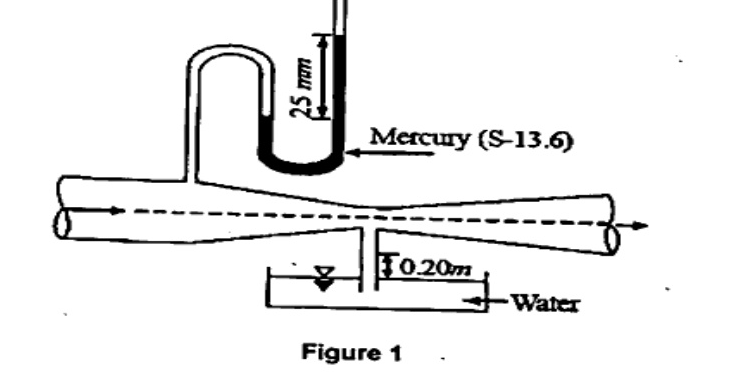
7 MarksbFor a discharge of $2.1\, \text{m}^3/\text{s}$ of air through a pipe of area $0.093\, \text{m}^2$, determine the area of throat of a venturimeter as shown in Figure 1. Take specific weight of air as $11.96\, \text{N}/\text{m}^3$ and neglect losses.
How to answer
- Apply continuity Q = A1*V1 = A2*V2
- Apply Bernoulli with manometer head difference
- Relate mercury deflection 25 mm to air-water head
- Solve for throat area A2
-
7 MarksaDistinguish between:
- i)Steady flow and un-steady flow
- ii)Uniform and non-uniform flow
- iii)Compressible and incompressible flow
- iv)Rotational and irrotional flow
- v)Laminar and turbulent flow
How to answer
- Define steady vs unsteady with time derivative
- Define uniform vs non-uniform with space derivative
- Compressible vs incompressible, rotational vs irrotational, laminar vs turbulent with examples
-
7 MarksbA stream function is given by $(x^2-y^2)$. Find the potential function of the flow.
How to answer
- Check continuity via stream function
- Derive velocity components u, v from psi
- Integrate to get velocity potential phi
- Verify Laplace equation
-
7 MarksaA vertical isosceles triangular gate is immersed in water with its vertex up. The base width of gate is $2\, \text{m}$ and height $1.5\, \text{m}$. The vertex of gate is $1\text{m}$ below the free water surface. Determine the total pressure force and its location.
How to answer
- Compute centroid depth h_c of triangular gate
- Total force F = rho*g*h_c*A
- Centre of pressure h_p = h_c + I_xx_c/(h_c*A)
- Locate distance from free surface / vertex
-
7 MarksbDerive Bernoulli's equation for flow along a stream line.
How to answer
- Consider Euler equation along streamline
- Assume steady, inviscid, incompressible flow
- Integrate to get p/rho*g + V^2/2g + z = constant
- State assumptions and limitations
-
7 MarksaA conical thrust bearing idealized as a cone of vertex angle $60^\circ$, maximum cone diameter $200\, \text{mm}$, rests and revolves about vertex over a uniform fluid layer of thickness $1\, \text{mm}$ at $600\, \text{rpm}$. If viscosity of fluid is $1\, \text{Poise}$, calculate the power lost in overcoming the viscous resistance.
How to answer
- Shear stress in conical gap tau = mu*V/h
- Integrate torque dT over slant element
- Power P = 2*pi*N*T/60
- Substitute vertex angle 60 deg, D=200 mm, N=600 rpm
-
7 MarksbWater at $25^\circ\text{C}$ is flowing through a $1.0\, \text{km}$ long G.I. pipe of $200\, \text{mm}$ diameter at the rate of $0.07\, \text{m}^3/\text{s}$. If value of Darcy friction factor for this pipe is $0.02$ and density of water is $1000\, \text{kg}/\text{m}^3$, find the pumping power (in kW) required to maintain the flow?
How to answer
- Compute velocity V = Q/A and Reynolds regime
- Head loss h_f = f*L*V^2/(2*g*D) using Darcy factor
- Pumping power P = rho*g*Q*h_f
- Convert to kW
-
7 MarksaTwo pipes each $300\, \text{m}$ long are available for connecting to a reservoir from which a flow of $0.085\, \text{m}^3/\text{s}$ is required. If diameters of the two pipes are $300\, \text{mm}$ and $150\, \text{mm}$ respectively, determine the ratio of head lost when the pipes are connected in series to the head lost when connected in parallel. Neglect minor losses.
How to answer
- Head loss in series = sum of h_f1 + h_f2 for same Q
- Head loss in parallel with flow division Q1+Q2=Q
- Use Darcy h_f proportional to Q^2/D^5
- Compute ratio h_series / h_parallel
-
7 MarksbWrite the short note on Fanno and Reyleigh lines. Draw the Fanno and reyleigh lines on the h-s plot.
How to answer
- Define Fanno flow (adiabatic with friction) and Rayleigh flow (heat transfer)
- Derive governing equations and choking condition
- Sketch h-s diagram with Fanno and Rayleigh lines intersecting at sonic point
- Explain subsonic and supersonic branches
-
14 MarksWrite the short note on the following:
- a)Stagnation properties
- b)Normal and oblique shocks
- c)Compressible flow
- d)Mach number
How to answer
- Stagnation properties: p0, T0, h0 definitions
- Normal vs oblique shock relations and deflection
- Compressible flow regimes by Mach number
- Mach number definition and significance
Go to where you left off?
Quick Add to Notes
Save questions, your own notes and screenshots into notes filed by unit. It takes a free account.
Create free accountHave an account? Log in
Notes Panel